Thursday, November 15, 2018

Neutrality means nothing when we have dollar signs in our eyes

Remembering a Syrian child, who was murdered in a US airstrike,
during the monthly Shannonwatch protest at Shannon

Irish Current Affairs Blog of the Year 2018


On a cold Thursday night in November, a few dozen of us congregated in a beautiful but obscure new lecture hall on the western outskirts of the sprawling campus at NUI Galway.

Two Members of the European Parliament (MEPs), four TDs, academics, and peace activists had gathered for a lively and informative three hour discussion which garnered little or no media attention.

I know, because I asked three news editors in advance of the meeting if they would be interested in a piece. Not one of them even replied.

The subject of the meeting was the thorny question of whether or not Ireland is being steamrolled into joining a European Union army since PESCO – Permanent European Security / Military Co-Operation – was rushed through the Dail last December.

In theory at least, Ireland is a “neutral” country. Luke ‘Ming’ Flanagan, the Independent MEP, called the Galway meeting in response to growing alarm over what PESCO actually means to Ireland.

Are we on our way to becoming part of a European ‘Super State’?

Is our military spending going to increase dramatically to €6 billion per year (or half of what we spend on our desperate health service) because of something our country signed up to with so little debate last year?

Does anybody care?

It is astounding that we hear so much about Brexit on the national airwaves every day, because Britain’s shambolic departure from the EU has such massive implications for Ireland, but we hear little or nothing about the contentious issue of a European Army.
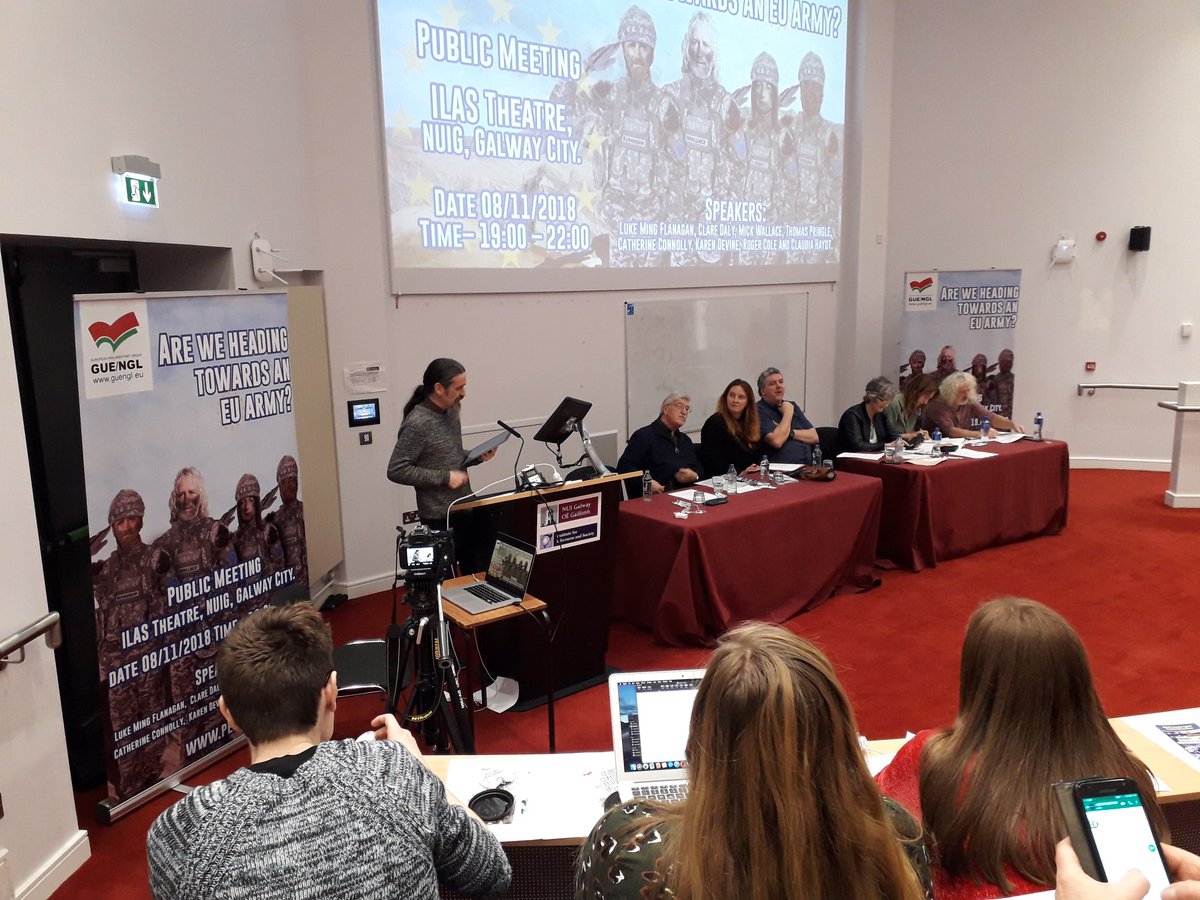

The conference about the EU Army at NUI Galway this week


Are ‘Ming’ and the Independent TDs just alarmist crackpots? Is it really acceptable that unelected EU officials can lead us towards the formation of a ‘super’ army to rival those of the USA and Russia in the future?

And why, oh why, are so few Irish people talking about this?

Perhaps Irish neutrality is a sham, but shouldn’t we at least discuss this issue?

In Shannon last week, the important Shannonwatch peace group noted that a US military plane stopped off in a civilian airport on its way to and from Tel Aviv.

Nobody in authority at Shannon Airport ever checks the contents of the US military machines which have been landing there each and every week since 2001.

Last year, over 61,000 US troops stopped off in Shannon on their way to and from wars in the Middle East.

That might mean a hell of a lot of leprechaun and whiskey sales in the duty free shop, but it also makes a mockery of the concept of Irish neutrality.


A US miltiary supply plane in Shannon this week. It was on its way
'home' from Tel Aviv. Photo via Shannonwatch. 


If it wasn’t so serious, Irish people would be laughing over Brexit and the shambolic way in which pro-Brexit politicians in Britain, in their jingoistic haste to leave the EU, seem to have had no vision for the future.

Perhaps reform, rather than withdrawal, might be the correct response to an undemocratic, unaccountable Europe; but at least in Britain they have had some sort of debate about the EU and their country’s place in it.

The Irish, meanwhile, see ourselves as “model” Europeans even though it was our EU masters who forced us into the “bank bailout”, with devastating implications in terms of the loss of public service jobs, health care and welfare cuts, the privatisation of state assets, and a new wave of emigration at the start of this decade.

Not to mention the huge debt our country has been saddled with for years to come.

Now PESCO, according to the Independent TDs and MEPs, will see Ireland being steamrolled into an EU Army and it is quite amazing how little talk there is about this in Ireland.

“We have to work on a vision of creating a real true European Army,” said German Chancellor Angela Merkel this week.

French President Emmanuel Macron called for the formation of a “real” European Army during the Armistice Day commemorations last weekend.

On Tuesday, the European Commission said that a European Army is “likely” to be formed one day.

So the Galway conference this week seemed to be extremely timely.

“Does PESCO damage our neutrality?” asked Catherine Connolly TD. “Yes, it does. We are normalising war and the militarisation of Europe. PESCO was not discussed in our Dail. The good news is that 42 of us voted against it. Language has been stood on its head. We are heading towards a militarised Europe.”

She said that Irish soldiers have to rely on family income supplement in order to survive, in the middle of unprecedented crises in health care and housing.

Deputy Connolly pointed out that the head of the European Commission has never been elected by anyone and spoke of how uncomfortable she felt when he was given a reverential reception in the Dail.


A Fine Gael MEP, Brian Hayes, has called for the “redefinition” of neutrality and both Fine Gael and Fianna Fail have denied that PESCO will impact on Irish neutrality.

Independent MEP Flanagan has described the massive global arms industry as an “untapped goldmine” in the eyes of the European Union.

Just as US President Donald Trump feels that punishing human rights abuses by Saudi Arabia would only be foolish if it damaged his country’s $110 billion arms trade with Riyadh, perhaps the Irish should be far more honest with ourselves.

Does our ‘neutrality’ mean anything when we get a chance to cosy up to and find favour with the world’s military powers?

Do we want to stand beside the French and Germans as they, too, aim to become global powers?

Perhaps, ultimately, the vast sums of money to be made from militarisation are far more important than the human rights of children in Syria, Palestine, Yemen or Afghanistan as the US military aircraft land and take off from Shannon Airport with total impunity every week.

“When you question why they are militarising the European Union, you must understand that this is not to protect or defend you,” said Flanagan.

“It is about money . . . and billions of it.”


Is Ireland already facilitating war crimes in the Middle East?
The horror of Syria.


Next time you have a loved-one lying on a hospital trolley for 48 hours, or finding it impossible to find an affordable place to live, remember that PESCO is set to increase Ireland’s military expenditure six times over.

Without any real, meaningful national debate about its implications.

Sometimes, when you look at the stories which are creating headlines, it’s just as informative to check out which stories are being ignored.

When a ‘neutral’ former colony wants to be part of a new global super-power, when arms sales are more important than human lives, language truly has been stood on its head.

Neutrality means next to nothing when we have dollar signs in our eyes.


Ciaran Tierney won the Irish Current Affairs and Politics Blog of the Year Award (personal) at the Tramline, Dublin, last month. He is seeking new opportunities in a digital age. Find him on Facebook at http://facebook.com/ciarantierneymedia

Find Ciaran on Twitter https://twitter.com/ciarantierney

The first Conference Against US and NATO Military Bases takes place in Dublin this weekend. Details at https://www.facebook.com/events/304522810146150/


Thursday, November 1, 2018

An escape to the city of Irish hopes and dreams

New York offered hope to so many distressed and impoverished Irish


In a crowded hall in Queens last week, it was hard to avoid the feeling that Ireland was a repressive place – a place to escape from – for so much of our island’s recent history.

A hushed silence had descended over the New York Irish Center in Long Island City as an audience of mainly elderly and middle-aged people gathered to watch a documentary about the harrowing scandal of the ‘Tuam Babies’.

And, then . . . the anger, the questions, and the disbelief. How had this happened to ordinary Irish women and children within living memory?

How had 796 babies and infants been discarded like rag dogs, and perhaps even dumped in a septic tank, in a 20th century Western society?

From the 1920s, when the Irish State was founded, to the 1990s, Irish women had been imprisoned for the terrible ‘crime’ of giving birth to a child outside marriage. Their children were branded as “illegitimate”, many taken from them often against their will, and the women themselves were shamed for life.

That’s why they needed to escape, not just from the institutions themselves but from an island which labelled and judged them, and seized them from their family homes in the dead of night.

Where was the justice? Where were the fathers? Why was such cruelty inflicted on these women and these children?

I watched in awe as Galway man Peter Mulryan and his wife Kathleen fielded their questions and told them what it was like to find out, as Peter did in his seventies, that a younger sister he never knew he had could be buried in a septic tank.

Or, for all he knows, Marian could be alive today and walking the streets of New York, Boston, or Chicago, completely unaware of who she really is or where she really is from.

Nobody has any idea yet about the scale of adoptions of Irish children of babies to the United States in the 20th century or the number of women who escaped from 'laundries' and 'baby homes' in order to move there.

Because the story of the ‘Tuam Babies’ is a story of (illegal) adoptions to ‘good’ Catholic families in America and a generation of women who emigrated to America to escape from the shame.

The documentary screened in Queens and Boston, ‘Mother & Baby’, looked at the harsh lives of 20th century Irish women and children . . . and the survivors’ valiant efforts to rebuild their lives.

A packed house at the New York Irish Centre in Queens


In the United States last week, it was astonishing to hear the children of these women stand up and tell their stories. How they knew they had left Ireland, but only found out after they died that they had been imprisoned for having babies long before starting new lives.

One man told me his sister lives just down the road from me in Galway. His mother never talked about her, or the horrors she experienced as a prisoner in the Tuam Mother and Baby Home before she escaped to America.

Where would his family be without America?

And, indeed, where would the Irish be without the great Irish cities of New York and Boston?
They offered hope, a refuge, and a fresh start for so many of us that we take our connections with America, and the Big Apple, for granted at times.

I arranged to meet Peter and Kathleen at the Irish Hunger Memorial in the financial district of Manhattan a few days before the screening of the ‘Mother & Baby’ documentary in Queens.

It felt like the perfect place to ponder on how our little windswept island in the North Atlantic had failed to provide fulfilling lives for so many generations of our people over the past couple of centuries.

The incongruous stone walls and little cottage under the gaze of so many skyscrapers and the One World building was a little reminder that, for so many Irish, this place offered the chance of a life which was impossible back home.

A family from Co Mayo transferred the entire stone cottage across the Atlantic to educate the people of the US about the Great Famine.

Peter and Kathleen Ryan at the Irish Hunger
Memorial in Manhattan, New York, last week


It makes for a remarkable image, and a wonderful quiet haven in the middle of the hustle and bustle of Manhattan.

At the memorial, there's a quote from Loughrea, Co Galway, a few years before the famine about people who had pawned off all their clothes and were unable to go to Mass.

It brought home to me how close the people of Syria today are to the Irish, and those from Connacht in particular, who fled oppression, conflict, and famine.

The simple, but beautiful, memorial in New York reminded me of our own simple seaside memorial in Salthill, to remind people of the 100 ‘coffin ships’ which set sail from Galway Bay to America between 1847 and 1850.

Thousands of our people set sail for the great cities of New York and Boston at a time when a million people died of starvation.

Without the hundreds of thousands of Irish who found new lives in the Americas, the scale of the disaster back home would have been unthinkable.

Without the money they sent home to loved-ones in Ireland throughout the 19th century, the deprivation experienced would have been off the scale.

Many of those who were “lucky” enough to have a ticket to America never even made it to the other side.

When they poured off the boats and into the crowded slums of the Five Points, they may have encountered criminality, murders, and discrimination, but they had power in numbers, they organised themselves, and they built new lives.

At the Irish Hunger Memorial in Manhattan 


At the wonderful Tenement Museum in the Lower East Side, our informative young Italian-American guide marvelled at how an Irish family had improved their lot by moving out of the ghetto in the 1860s.

She showed us around the small yard they would have shared with 22 other families and showed us the picture of Daniel ‘The Libertor’ O’Connell and the map of Ireland on the wall.

They worked hard to make decent lives for their children and in many respects the impoverished Irish back home had no idea of the struggles their emigrant brothers and sisters had to forge out a decent standard of living in America.

The Irish were still facing discrimination when they moved into that building but, remarkably, she told us that 25% of the people in New York had been born in Ireland at that time. No wonder our people took over City Hall, the police, the fire department, and perhaps even the crime gangs at the time.

Our guide, Chelsea, told us of how the Irish enriched New York with their music, their pubs, and their culture, but not their food, unlike say the Italians or the Chinese.

She knew a lot about the Great Famine, but I didn’t have the heart to tell her that huge swathes of the Irish population had lived solely on the humble potato for over half a century before the Moore family moved to their small tenement in the Lower East Side in 1869.

Out at Ellis Island, a steady stream of tourists is reminded every day that a young Irish girl called Anna ‘Annie’ Moore, aged just 15, was the very first immigrant to be processed at Ellis Island in 1892.

They are asked to imagine the excitement of a young girl upon seeing the Statue of Liberty for the first time, after making a 12 day voyage from Co Cork.

At the World Trade Centre site, I came across the memorial to Tuam woman Ann McHugh who lost her life on 9/11, just a five minute walk from the Irish Hunger Memorial.

In Hell’s Kitchen, Mayo women in their 50s and 60s used to serve us tea and coffees in Irish cafes on my first visit to New York two decades ago.

So many of our generation found new lives in the United States in the 1950s and again in the 1980s when the Irish Government could offer them little hope of finding work at home.


Celebrating the Irish Current Affairs Blog of the Year award


"Emigration will soon cause it to be said that Ireland is no longer where flows the Shannon, but rather beside the banks of the Hudson River,” says one of the more memorable quotes at the Irish Hunger Museum.

New York is no longer an “Irish” city in the way it was a century ago and the Irish have long since moved out of the Five Points to be replaced by Chinatown.

The distressed migrants of 2018 are no longer crossing the Atlantic on ‘coffin ships’ from Cork and Galway, but joining a caravan from Honduras and El Salvador or paying people traffickers to take them out of the hell of Syria.

For so many of our people, escaping famine and persecution in the 1800s, the shame of a judgemental society in the 1950s, or recession and stagnation in the 1990s, New York – and America – offered the Irish opportunities and dreams which were denied to them at home.

Where would the Irish be without America?

As we look forward, and our lives evolve, we should never forget where we came from.


Ciaran Tierney won the Best Current Affair Blog in Ireland award at the Tramline, Dublin, last week. Find him on Facebook here

Find Ciaran on Twitter, https://twitter.com/ciarantierney

Please note that you can now subscribe to this blog by clicking the button at the top of this page. You will then have to register your email and you may need to check your SPAM or JUNK folder when you receive confirmation. Please note that you will only receive an email when I update this blog (about once a week or so) and I will never share your email address with other parties. Thanks a million for all the support! 


Tuesday, October 9, 2018

No ordinary friend

Brave meningitis survivor Liam Cullinane


A few weeks ago, on a glorious Saturday afternoon, I met an old friend for a cup of coffee outside a café in the centre of town. He might not realise it, but meeting Liam is almost always an uplifting experience.

On this particular day, his positivity was unreal. He was more animated than I had seen him in months.

He had just emerged from an oxygen chamber, where he had been getting daily treatment for a few weeks. As I sat down across from him, he raised his right hand.

“Watch this!” he exclaimed, loudly.

He picked up a cup with his right hand.

The tourists at the next table looked up momentarily, curious as to why this middle-aged man was so animated about picking up a cup outside a Galway city centre café.

He paused.

“I haven’t been able to do that for the past 25 years!”

He was so thrilled, his enthusiasm was infectious. Suddenly, a hundrum afternoon in my home town had been transformed. The significance of the gesture was lost on the people sitting at the nearby table.

I wanted to shout out, to tell them if only they knew what this man had been through. Instead, we just sat there, beaming.

It was the first time he had been able to pick up a cup or a glass with that hand in 25 years. This was not some small little victory. This was a triumph and we were both thrilled.

Six weeks earlier, he had discovered a new oxygen treatment facility in Galway. Both of us are trained professional scuba divers, but it was news to me that privately run hyperbaric chambers are now being used to treat multiple illnesses, infections, and diseases across the world.


I had only really associated them with divers and ‘the bends’, even though I knew the chamber at University Hospital Galway was used for non-diving injuries.

If only the people at the next table could understand. My old buddy had been diagnosed with a deadly form of meningitis way back in 1993. This man had lain in a coma in Scotland for months, he had had to teach himself to walk again, to brush his teeth, and to move around.

At one stage, the only parts of his body that he could move were his eyes. The prognosis was grim. And now, a quarter of a century later, he had picked up a cup with that hand – without shaking – for the first time.

He has been blown away by what the anti-inflammatory oxygen therapy has done for him for the past few months.

“It seems to be working away at reducing the inflammation in my brain and body, and the results so far have been excellent. After the very first treatment I noticed increased flexibility and slept really well that night,” he told me this week.

“I awoke feeling energised the following morning. After six weeks of treatment, the tremor in my right arm reduced to such an extent that I was able to drink a glass of water using my right hand without any spillage for the first time in 25 years!”

A meeting with an old friend for coffee on a Saturday afternoon had become a thrilling moment of jubilation. I was delighted, but not surprised.

Because, like so many people I know, I have been inspired by the battling qualities of Liam Cullinane ever since we met as teenagers in school over three decades ago.


Liam was a tough young adventurer, who left school in Colaiste Iognaid with just one mission on his mind. A star of the victorious school rugby team, he wanted to join the French Foreign Legion.

A lot of Galway teenagers spoke with bravado about their plans to leave our small city behind them in the recession-hit 1980s. Only Liam was as good as his word. As soon as he finished school, he hit for Corsica and enlisted. He ended up staying in the French Foreign Legion for seven years, including three years skydiving with the Parachute Regiment.

If he showed a spirit of adventure in his youth, it was nothing compared to the bravery he has demonstrated to all of his friends and family members over the past 25 years.

When he left the legion, he never wanted to live in Galway. He wanted adventure in sun-kissed lands far from the wet and windy west and was looking forward to new adventures when he trained to become a commercial diver in Fort William, Scotland.

Only Liam, more than anyone I know, discovered at an early age that life does not always follow the best-laid plans and that nothing should ever be taken for granted.

If, like Liam, you jump out of bed with that attitude every morning, it’s amazing how much your life can be transformed. No matter what the ailment or problem.

In Scotland, he had just finished the diving course when disaster struck. His landlady found him lying in a coma after he should have left his flat. He had made light of what he thought was a headache or a very bad flu.

Aged just 26, he had contracted a rare and deadly form of listerial meningitis which normally only affects the elderly or babies under three months old. He was given very little hope of a long or healthy life and it took months before Liam was well enough to be transferred home to be near his family in Galway.

Sometimes the true value of a person is not in his job, or career, money in the bank, or sporting prowess, but in the example he sets to others.

Ask anyone who knows Liam and they will tell you the same thing. The man simply inspires, because the thing he values above everything else is the kind of thing we all tend to take for granted. A walk in the wind, a cycle along the promenade, a visit to a friend’s house, an independent life . . . all things which seemed impossible for Liam during his long spell in hospital in the 1990s.

I don’t know anyone else who knows and understands the value and importance of the simple things in life. The fun of ‘slagging’ a group of old friends, the social side of enjoying a cup of tea, and especially the importance of good health – which is something many members of our generation rarely put a value on in our younger years.

A quiz for Liam takes place on Thursday night


The determination this man has shown to build an independent life has been nothing short of inspirational.

He managed to get a Council house from Galway City Council because he did not want to be a burden on his family.

He persuaded a friend to build a custom-built tricycle, which gives him the freedom to move around. He’s as well known as the Mayor as he bombs around the streets of Galway.

And, indeed, when he had a problem with a spout of dampness in his house, he had no qualms about calling the current Mayor of Galway, Niall McNelis, to make sure he helped him out!

And, above all else, he has sought out a healthy lifestyle. Whatever treatment possible which could help him strengthen his limbs and boost his independence, Liam has tried it. He has travelled far and wide and often doctors, overwhelmed by his spirit of determination, have befriended Liam and decided to waive their fees.

He has travelled to Australia, to visit his brother. He joined ultra-marathon organiser, and Galway native, Richie Donovan on a trip to the North Pole.

He has travelled to the US, Holland, Dublin, and London for different types of treatments.

He has travelled to Thailand on his own, even though walking can be a challenge.

And he has kept in touch with a huge circle of friends, each and every one of us inspired by his determination to be healthy and to make the most of life.

He has befriended and become something of a model for ACT for Meningitis in Galway, the charity set up by a young mum who lost her little daughter to the deadly infection.

It can be truly uplifting to see how Liam inspires the families of people who have lost youngsters to meningitis, or how he helps the ACT women in raising awareness for families as to how they should look out for the symptoms.

Four years ago, when I had taken voluntary redundancy and picked up the MRSA bug in University College Hospital, I was seriously ill for seven months.

The illness only added to my worries about an uncertain future after leaving a full-time job in the newspaper industry behind. I was filled with fear. 

Any tendency I had towards self-pity would evaporate whenever I arranged to have a coffee with Liam (only he would drink tea, because his super strict diet includes a ban on caffeine!).

He would show me that it’s not what happens to you in life (relationships, jobs, careers, set-backs, whatever) that matters, it’s how you deal with it that counts.

Because nobody else I know has staged such a long and brave battle just to have a full and independent life.

Now he wants our help.

The hyperbaric oxygen therapy which has transformed his life in recent months is costly.

Liam is a daily user of the OxyGeneration clinic in Galway, and he wants to continue the treatment until the end of this year.

The treatment involves breathing almost 100% oxygen in a pressurised room. It is considered a medicine, but is not covered by the public health care system.

A group of his friends have come together to raise funds for Liam’s treatment at Crowe’s pub, Bohermore, Galway, this Thursday, October 11, at 8pm. Entry costs €40 per table of four.
If you cannot make the quiz, you could also support Liam at: https://www.gofundme.com/oxygeneration-liam-cullinane

Because the value Liam Cullinane brings to the people who know him cannot be measured in monetary terms.

He’s still battling, after 25 years, and the money raised from this quiz will help to transform his future.


Ciaran Tierney is a journalist, blogger, and digital storyteller, seeking new opportunities in the digital age. Find him on Facebook at http://facebook.com/ciarantierneymedia

This blog is a finalist in the 2018 Irish Blog of the Year Awards

Monday, October 1, 2018

They travelled to remember the lost children of Tuam

A cermony of healing in Tuam on Saturday


They came from Cork, Donegal, Tipperary, and even Newry, to underline that the story of the ‘Tuam Babies’ is not just a story of Tuam. It’s a story of survivors and families in similar institutions all across the land, and how the Irish State, their communities, and even members of their own families let Irish women and children down.

Two bus-loads arrived from Dublin. As if to remind some of them of how hurt many people still feel by this issue, one man declined to give the women on one bus directions when they lost their way on the edge of town.

For many, it was a first ever visit to a site which is now known all across the globe.

It still seems incongruous to have to go through a narrow gap between local authority houses and walk around a playground to access a site which has become Ireland’s most infamous unmarked burial ground.

Only this was a day for healing, for forging friendships, and showing solidarity with a remarkable group of people, elderly now, who never sought the global spotlight. As they stood around the site, it was amazing to hear them share their stories in ways which must have been unthinkable just a few short years ago.

If the research of Catherine Corless has shone a spotlight on some of the darkest history of 20th century Ireland, it has also given a voice to people who never spoke out before.

Such as the lovely man from Cork, now in his 70s, who told me he had never met a woman because he never felt worthy of love; or the man who worked for years in South Galway and created a loving family, despite the beatings and never being taught to read or write in that infamous institution they dared to call a ‘home’.

But there were good stories too, of good priests who went to a lot of trouble to help some of them track down their birth mothers and family reunions which had seemed impossible to them in the earlier years of their lives.


The beautiful white blanket featuring 796 squares for each of the babies


Three hundred women all across the globe, including many in North America, were inspired by a Dublin artist to make a blanket of 796 hand-knitted pieces which they presented to the families and survivors of the Tuam Mother and Baby Home on Saturday.

In an emotional ceremony at the site where up to 796 babies and children are believed to have been buried in an unmarked grave, Dublin artist Barbara O’Meara unveiled the beautiful white blanket – sewn together in four parts to depict the four provinces of Ireland – to the family members after meeting them for the first time.

The unveiling of the beautiful blanket, knitted by hand following a Facebook campaign, coincided with an inaugural Remembrance Day for the Lost Children of Ireland event at the site of the former home.

Former residents of institutions across Ireland travelled to Tuam for the event, which included poetry from survivors, a concert, and the screening of a documentary about the ‘Tuam Babies’ which is due to be shown in New York and Boston at the end of this month.

The survivors are still trying to reach out to people in North America who may have been adopted illegally from Catholic institutions in Ireland, as they have no idea how many of the children really are buried next to a playground in the Co Galway town.

Survivors and family members at the Tuam site


Tuam Home Survivors Network Chairman Peter Mulryan, whose younger sister is one of the 796 dead babies, said the survivors continue to be overwhelmed by the support they receive from across the globe.

Now 74, Peter only found out he had a younger sister among the ‘Tuam Babies’ four years ago. He has been on a mission to find out what happened to her ever since, and believes she may have been adopted by a family in the United States.

Until an exhumation is carried out at the site, he said he had no way of knowing what happened to her.

“We are the kind of people who would not have been known or heard of, but now we are being extremely well represented all over the world. It’s just mind-boggling, the way the wheel has turned around. We were classed as nobodies, people who were not to be heard,” said Mr Mulryan.

Mr Mulyran expressed anger that An Taoiseach, Leo Varadkar, had visited the site in a personal capacity after attending a Fine Gael party event in Galway recently, without making any attempt to contact the survivors.

He accused the Irish Government of trying to turn local residents against the survivors in determining the future of the site.

Reading out the names of the 796 'Tuam Babies'


“Our search for justice is awful slow. We don’t understand why a public figure like An Taoiseach would come sneaking down, with nobody to meet him. It hurt us very much. We were so disgusted with An Taoiseach, to hear that he spoke to the residents, to ask them what they would like done here, rather than to ask us, the families and survivors,” he said.

Peter and his wife Kathleen are set to travel to the US in two weeks as a bid to reach out to people who were adopted from institutions in Ireland.

“We are hoping to meet up with people who believe they may have been adopted from Ireland. If anybody wants to contact we are here to help them,” he told me.

Although she has no connection with the Tuam families or the site, artist Barbara O’Meara said she was compelled to set up the ‘Stitched With Love’ project after watching coverage of the ‘Tuam Babies’ case on Irish television.

“I do a lot of work with marginalised groups, people with addiction or people who have been bereaved. I felt a need to do this project. I kind of realised that women wanted to do something to support the Tuam Babies and the survivors,” she said.

“I just set up a Facebook page and then women across the globe began to hear about it. Women from America, Scotland, and Australia began to get in touch. Everybody bought their own wool and I did have some help stitching them together. We got the 796 together and the survivors’ groups were informed. The project has taken two years, just me and a Facebook page!”

She said that women across the globe found a great sense of healing by knitting the 796 white squares and it was a really emotional experience to see the full blanket being unveiled at the site at the weekend.

She organised a Shamanic healing ceremony with Karen Ward, who had worked on her for a project to heal the children of the 1916 Easter Rising. Two bus-loads of women travelled from Dublin for the Tuam event and they were deeply moved by the experience.

“I hadn’t been to the site before and I decided not to come until the blankets came with me. I kept wondering how I would feel if my brother, my sister, or my mother was here. Having the sensibility of an artist, I am not very political or verbal. But I’m a creative person. When I walked onto the site I felt the energy was very heavy. It’s just an honour, really, to meet these survivors and honour these little children,” she said.


With Alison O'Reilly and Anna Corrigan at the site on Saturday


At the ceremony, I was also delighted to meet Anna Corrigan of the Tuam Babies Family Group and author Alison O'Reilly.

Alison and Anna worked together to write 'My Name is Bridget', the story of Anna's mother who had been incarcerated in the Tuam Mother and Baby Home. Anna, who grew up in Dublin, only discovered that she had two older brothers after her mother passed away. Her two brothers are among the 796 missing children and babies.

The book is a harrowing read, but it also really 'humanises' the story of the lost children and also looks at some other case histories from homes across Ireland.

Breeda Murphy of the Tuam Home Survivors Network pointed out that the infant mortality rate at the home was five times that of the population outside; and that 126 of the babies died within the first six months of life.

“Death certificates were not signed by a medical practitioner, but rather a domestic at the home, burials were outside the norm, custom or law. Without coffins.  Without a word, a prayer or a gesture of sympathy in a land that is renowned for its funeral services where communities seek comfort in the untimely death of a young person,” she said.

She pointed out that 35,000 women and girls went through Ireland’s Mother and Baby Home system between 1904 to 1996. This was a national issue, she said, as she pointed out that survivors from institutions all across Ireland had travelled to Tuam for the event.


• Peter Mulryan will lead a Walk With Peter event in which 796 cardboard coffins will be carried through the streets of Dublin this Saturday, October 6. The little coffins will be carried from O’Connell Street to the Garden of Remembrance to remind people that the families are still seeking justice for their loved-ones. 

* Ciaran Tierney is a journalist, blogger, and digital storyteller, based in Galway, Ireland. He is looking for new opportunities in a digital world. Find him on Facebook here

Find Ciaran on Twitter, https://twitter.com/ciarantierney


Tuesday, September 25, 2018

Brexit border implications never even entered some minds

Reviving memories of troubled times at the Irish border last year


In recent weeks, as Britain has hurtled towards a seemingly uncertain Brexit, many politicians in the United Kingdom have shown little or no interest in recent Irish history - or memory of the anguish of those who lived through 30 years of conflict.

Unlike those living along the 300 mile Irish border, who are waking up with increasing alarm as to the reality of what a “hard Brexit” actually means with every passing day.

People remember Bloody Sunday.

They might not have been in Derry on that terrible January afternoon, but they remember the black flags flying from houses all across the country, the sense of hopelessness, anger, and despair.

Bad enough that 14 innocent people were gunned down, but when the atrocity was committed by the State – the very forces who were supposed to protect ordinary people – the sense of isolation, of a city under siege, was palpable throughout the nationalist areas of Northern Ireland.

And the IRA described the atrocity as the greatest recruitment drive they could have hoped for in the province’s second city. Young men were queuing up to join.

Atrocities such as Bloody Sunday prolonged The Troubles


People remember Ballymurphy in Belfast, 1971.

Even though they may not have been told about it at the time.

Six months before the slaughter of innocents in Derry, British soldiers ran amok and massacred 11 people in two days.

Only nobody knew the full extent of the massacre, until a brave British TV crew put all the pieces together for a Channel 4 documentary 47 years later.

The inquests into those shootings, set to take place this coming November, will open up old wounds. How in the late 20th century the slaying of innocent people in their own housing estate could be spun into a grotesque parody of the truth.

The devastation of the Miami Showband Massacre.
Photo courtesy of Stephen Travers. 


People remember the Miami Showband massacre.

Talented young musicians, Catholic and Protestant, travelling home across the border after a wonderful gig in Co Down. Their music brought communities together at a time of too much polarisation and division.

Three men were hauled out of a van, gunned down at the side of a lonely road, after an attempt to frame them with a bomb. Their band mates left to die.

Collusion? That attack was all about the Irish border. It would have been so much easier to persuade the Irish Gardai to ramp up security at the 300 mile long border if people believed young musicians were driving around with bombs in the dead of night.

To this day, the survivors of that 1975 atrocity have never got justice or the sense of peace which comes with finding out the truth.

People of a certain vintage remember . . . and this week they have been choking on their breakfasts as Tory Brexiteers tell them that Ireland would be better off rejoining the United Kingdom and leaving the European Union.

“Re-joining the UK is the only way to reunite Ireland and the British Isles. Brexit makes Irish EU membership less logical,” tweeted one of them this week.

Irish people may have reservations about the growing power and bureaucracy of the European Union, but you would be hard pressed to find too many people who would countenance a new political union with the country which colonised our island from 1169 to 1921.

Talk of rejoining the old colonial power would be hilarious if it was not such a tragedy, if people did not worry that the Brexit drama was playing with people’s lives.

A mural in Belfast recalling one of the worst atrocities of 'The Troubles'
15 people - including two children - were killed at McGurk's Bar


Many British Brexiteers have no idea regarding the impact their words and deeds are having or the impact the return of border posts and checkpoints would have on people all along the 300 mile frontier.

In less than six months, Britain is due to have left the European Union and, already, the Irish Government has begun recruiting 450 customs and veterinary inspectors.

British politicians like Jacob Rees Mogg, Boris Johnson, and Nigel Farage do not seem to give a damn about the impact a “hard border” will have on ordinary people.

Instead, they rail against the EU for daring to contemplate splitting up the UK, seemingly with no memories of the damage caused to communities along the 300 mile long Irish border by the partition of Ireland.

Try telling a person who lives in Newry and works in Dundalk about what life will be like if he or she had to face border checkpoints every day.

Try telling young people living in Inishowen in Co Donegal that a trip to the cinema or a night club in Derry is set to become a logistical late night nightmare. After all, the border was never a ‘”real” border – it cut places such as Derry and Strabane off from much of their natural hinterlands.

Northern Ireland was created from six of Ulster’s nine counties in order to have an artificial two-thirds Unionist majority and the experience of being treated as second class citizens led the nationalist minority to rise up in search of civil rights in the late 1960s.

Of course, the British were not solely responsible for three decades of ‘The Troubles’. Far from it, in fact.

You only have to list the names of places – Omagh, Enniskillen, Manchester, Warrigton, Guildford, Mullaghmore, Kingsmill – to recall some of the terrible atrocities committed by the IRA in the name of Irish “freedom”.

Belfast's famous murals are now seen as a tourist attraction


But the British state played a huge part in creating the conditions which led to The Troubles and prolonged the violence by committing atrocities of its own.

Without Bloody Sunday, Ballymurphy, and the internment of young Catholic men, would so many young people have joined the IRA?

Would the conflict have gone on for so long?

And how can the concerns of people who have genuine fears of a return to violence, the hated border posts giving dissident republicans the motive they require, be dismissed so lightly?

People remember border checkpoints, watchtowers, and aggressive searches from gun-toting soldiers every time they popped across the road to a neighbouring town or village.

And they wonder if those awful scenes will return.

Belfast is now a fantastic place to visit, thanks to a fragile peace process.
The Titanic Quarter is now a 'must see' for tourists from all over the world


They remember the sense of elation which followed the Good Friday Agreement, the first sightings of tourists on the streets of Belfast, and how deserted those streets used to be after 7pm in the bad old days.

Not only did that historic vote bring about peace, it gave the unionists of the north a cast iron guarantee that they will never be steamrolled into a United Ireland against their will. It showed that, for all our differences, ordinary Irish people value peace and compromise over ancient tribal divisions.

Now the murals on the Belfast walls teach tourists about a bygone era.

Now people flock to the wonderful Titanic Belfast, because it's one of the most amazing attractions in Europe. Tourists in Belfast . . . what a strange concept that would have been three decades ago!

People have had 20 years of a fragile peace now and they cannot believe how quick jingoistic politicians in London are to dismiss their concerns.

Such as Jacob Rees Mogg MP, who said there was no need for him to visit the Irish border in order for him to understand it (although he was shamed into finally doing so in July).

Or his Conservative party colleague Boris Johnson, who pointed out that there was no border between two suburbs of London as some sort of a valid contribution to the “hard Brexit” debate.

Or Nigel Farage, of UKIP, who called on the Irish people to leave Europe when he visited Dublin in February of this year. He accused the Taoiseach, Leo Varadkar, of “taking Brussels’ side against Britain”, which was not “in the best interest of his country”.

Not for them concerns that 56% of the people of Northern Ireland voted against leaving the EU, that 3,600 people died in the conflict, or that peace remains fragile in a place in which two communities largely live their lives apart from each other, in terms of schooling, housing, or even where they socialise or work.

Twenty years after the Good Friday Agreement brought a welcome peace, transforming life in the North completely, 90% of the housing estates are still segregated; and nationalist and loyalist communities are divided by 90 “peace walls”.

The European Union underpinned the 1998 Good Friday Agreement, which is tied into 142 areas of north-south co-operation, and yet blustering Brexiteers are claiming that the EU should have no role in the future of Northern Ireland.

It’s not nice to realise that you are seen as peripheral, that your concerns don’t matter in the corridors of power in London.

People in Northern Ireland look around now and see a place brimful of hope, of normal life, with tourists enjoying themselves from all over the world, and wonder how anyone could even countenance a return to a “hard border” and the hated signs of division they were sure they had left behind.

And all because some people in Britain were so keen to break their ties with Europe that the implications for Ireland’s border communities never even entered their minds when they voted for Brexit two years ago.


Ciaran Tierney is a journalist, blogger, and digital storyteller, based in Galway, Ireland. Find him on Facebook at http://facebook.com/ciarantierneymedia/


Monday, September 17, 2018

Call off the blimp!

The Donald Trump 'blimp' is not coming to Ireland after all 


Let’s call off the blimp, because Mr President is not coming after all.

Well, not yet, at any rate!

It has been amazing to hear so many people in Ireland express regret that President Trump has postponed (or cancelled) his Irish visit this coming November.

They were so fired up that many said they were looking forward to joining a political protest for the first time.

Irish protesters had to reach out to their counterparts in the UK, who turned out in their thousands to make the President feel so unwelcome when he visited London back in July.

Sorry, they said, we won’t need to ship the giant orange “baby blimp” to Ireland after all!

People in Dublin were really looking forward to the sight of a giant baby Donald in a nappy floating across the skyline.

And a hugely successful crowdfunding campaign had already covered the cost of bringing over the six metre high blimp within days of being set up.

Everyone, it seemed, wanted to be part of mass protests against the US President. The sense of anti-climax was palpable as soon as the White House announced that he had postponed his travel plans.

The leaders of two opposition parties, Labour and the Greens, had come  together to announce plans for a joint rally for “democracy, decency, and international solidarity” in Dublin.

As though such concepts, so alien to Mr Trump, were plentiful across the political spectrum here in Ireland.

Labour Party leader Brendan Howlin went as far as to say that President Trump was “no friend of democracy or human rights”.

Mr Howlin said it was important to stand up to Trump on issues such as climate change, the treatment of migrant and asylum-seekers, spending on arms, and the slashing of aid budgets.

In Galway, the local anti-racism group wanted hundreds of people to gather to spell out the words “Feck off Trump” (with a little Irish humour, from the ‘Father Ted’ TV series) on a beach.

In much different times, President John Fitzgerald Kennedy addressed 50,000 people in Eyre Square and the city authorities renamed it as Kennedy Park in his honour.

We are unlikely to see a ‘Trump Park’ in Galway any time in this millennium.

So many Irish people wanted to protest against Trump in November


So many people are disappointed that the street protests are off. They wanted to convey a firm message that Trump’s policies have no place in a modern, prosperous, outward-looking Ireland.

They want to reject the anti-immigrant rhetoric on an island where emigration provided the only refuge for the afflicted through much of the 19th and 20th centuries.

The street protests are off . . . as though there was nothing to protest about closer to home.

The economy might be in recovery, but the recovery does not seem to have reached so many Irish people who are struggling to keep a roof over their heads.

Last week, masked thugs – protected by masked Gardai – used heavy-handed tactics to evict homelessness campaigners from an empty building in Dublin.


Marcing in solidarity with homelessness campaigners
in Galway city centre last week


The sight of masked policemen with no identification on their uniforms caused consternation at a time when there are almost 10,000 people living in emergency accommodation across Ireland.

And now our Minister for Justice says he would support moves to criminalise the photographing of Gardai as they carry out their duties.

Such a move would be an attack on press freedom and should lead to questions as to what the Gardai have to hide.

Would that mean banning photos of public events such as GAA games or the annual Macnas Parade?

The last time I checked such measures were only being considered in states such as Israel, where an oppressive occupation force has a vested interest in covering up its crimes in the West Bank.

Given recent Irish history, we don’t have to cross the Atlantic in search of police forces who abuse their power. In fact the filming of protests has helped to prevent injustice from occurring.

So, instead of worrying about Trump, perhaps we should be looking at how power is being abused much closer to home.

Children sleeping in a Garda Station in Dublin


Last month, a photo of homeless children sleeping in a Garda Station went viral. The youngsters had to sleep on hard chairs in the police station because there was nowhere else for them to go.

The distraught mother who took that photo could soon be guilty of a crime.

Last week, a photo of a sick and distressed 92-year old woman sitting on a chair in a public hospital Emergency Department went viral.

Gladys Cummins posted the photo on Facebook out of frustration and despair. Her mother did not even have a trolley, as she spent 25 hours sitting on that chair.

Two months ago, I saw a 93-year old family member spent 48 hours on a trolley in the ED Department in Galway. The unacceptable has become acceptable and lengthy waiting lists in our public hospitals have become the new norm.

In a supposedly “socialised” health service – compared to the US at any rate – the old and the weak are being forced to spend days lying in corridors in overcrowded facilities.

But Irish people are not taking to the streets to protest about our health crisis.

In June, Irish people became outraged by the images of child migrants on the US-Mexico border crying in distress after being separated from their families. They were outraged by Trump.

Yet few of them have much awareness of the hardships endured by those who spend up to seven or eight years in Ireland’s own Direct Provision system.


A protest against Direct Provision in Dublin


About 5,000 asylum-seekers are detained at 31 accommodation centres without permission to work, or even to cook for their children. Among them are 2,000 children, growing up in highly inappropriate shared spaces with adults from a variety of countries.

Direct Provision centres have been described as the Magdalene Laundries and Mother and Baby Homes of our times. Some even see them as a "time bomb" for future problems to come.

We have British politicians steamrolling headlong towards Brexit, with little or no awareness that their dangerous language is threatening the peace process which transformed life in Northern Ireland over the past 20 years.

We have the families of victims of loyalist collusion who are shocked that a former member of the Royal Ulster Constabulary is now at the helm of the Irish Gardai.

They believe he has questions to ask about their long search for justice for atrocities such as the Miami Showband Massacre and the Dublin and Monaghan bombings.

We rant against Trump for his sexism, at a time when Irish society has been convulsed by a cervical smear test scandal in which the Irish Government treated Irish women appallingly this year.

A lot of Irish people are disappointed that they won’t get a chance to protest against President Trump, but let’s not pretend that we don’t have some pressing problems much closer to home.


Would you like to advertise on this blog? Please email ciaran@ciarantierney.com if you would like to find out more! 

Ciaran Tierney is a journalist, blogger, and digital storyteller, based in Galway, Ireland. Find him at http://ciarantierney.com/


Monday, September 10, 2018

Just another Sunday afternoon at Shannon

The monthly peace vigil at Shannon Airport 


It’s just an ordinary Sunday afternoon at Shannon Airport.

Funny how, in an upside-down world, the small group of peace activists waving flags at a roundabout are made to feel like criminals while the police force ‘protects’ members of the most powerful military in the world . . .  just a few metres down the road.

It’s almost a pantomime at this stage, as everyone knows his or her role.

On the first Sunday of every month, the peace activists descend upon the roundabout on the fringes of the civilian airport.

They unfurl their banners and flags, and commuters, bus-drivers, or cars containing families honk their horns in support as they drive by in sunshine, hail, wind, rain or snow.

It’s some record. They haven’t missed a first Sunday of the month for over a decade now and, indeed, the protests have been going on for a lot longer.

They wish they didn’t have to meet at the roundabout, that they could find something better to do on a Sunday afternoon. But every month they feel a need to return.

One man makes the round trip from Donegal, it takes him ten hours by bus. Another comes all the way from Dundalk. He feels he has to make the effort.

Others have less of a journey. Former Irish Army man Edward Horgan and academic John Lannon, who never seem to miss a monthly Sunday gathering, make the short trip out from Limerick City.
Quite a few drive down from Galway.

Horgan and Lannon are the two main men behind Shannonwatch, the group of peace activists who protest at the airport every month.

Their mission is simple, to highlight the fact that a ‘neutral’ country is continuing to support the US war machine, to raise awareness, and to remind the Irish Government and international community that this civilian airport on the west coast of Ireland could be facilitating war crimes.

For them, Irish neutrality actually means something. With talk of a European ‘super army’ on the horizon and President Donald Trump set to visit in November, their monthly protest seems as timely and relevant as when they began to assemble outside Shannon over ten years ago.

Even today, as I write this, the National Security Advisor to Donald Trump has attempted to discredit the International Criminal Court. He has described the internationally recognised court as "illegitimate" and "dead" in the eyes of the superpower which uses Shannon every day.

It's pretty easy to discredit a court if you feel you have something to hide or you are in breach of international law.


A cargo plane contracted to the US military at Shannon


They know the routine.

The activists stand at the roundabout. A young lady sees the irony when she pops into the new Starbucks nearby to pick up a coffee. Drivers and their families honk their cars in support. And the Gardai maintain a safe distance, sometimes driving up close, though, to monitor the activists and their parked cars.

There are rarely confrontations, but the Gardai maintain a visible presence. After all, some of these activists have undertaken direct action – breaking through the airport’s perimeter fence in order to try to inspect the US military or chartered civilian planes. The protest starts at 2pm and finishes within an hour.

It’s a small but clear reminder that not every Irish person is happy with the fact that US troops land in Shannon on their way to and from their wars in the Middle East.

This month’s protest could not have been more timely. During the one hour vigil at the airport, two Omni Air planes on contract to the US military landed at Shannon.

Shannonwatch activists, who track the military flights in and out of the airport, told me that one of the planes was coming from a NATO base in the north of Norway. The other was on its way to the US from Kuwait.

They said they had no idea whether there were up to 600 troops or cargo on board, and they were pretty sure that the Irish authorities had no idea either.

Horgan, who has a camera with a powerful lens, invited me to join him at the perimeter fence. He focused his camera on the two planes, under the watchful eyes of plain clothes Gardai who pulled up alongside him as he took his photos.


The peace vigils at Shannon have gone on for over ten years


Now in his late 70s, with a respected military background, he told me he was banned from flying from Shannon. It’s a bit of an inconvenience, given that he lives just down the road in Limerick.

But he made headlines across the globe when he decided to inspect a US military plane as he was about to board a Ryanair flight to London. Ed does not believe in mellowing with old age as he is disgusted that nobody in Ireland has a clue about who or what is being carried on the military planes at Shannon.

Horgan took legal action against the Irish state in 2003, on the basis that the US military’s use of Shannon violated Ireland’s status as a neutral country.

He finds it strange to be under scrutiny from the Gardai every time he brings his camera along to his local airport, but he’s determined to continue annoying those in power.

To him, the criminals are inside the airport fence, not those trying to document their movements from the outside.

As the wind howled around us, Lannon told me that the Shannonwatch people had no intention of giving up their monthly protests.

They will be back at Shannon next month and they hope to organise a huge demonstration if, as expected, President Trump used the airport when he visits Ireland, and nearby Doonbeg in particular, in November.

“Two planes arrived here today which have been contracted out to the US military. One of them has just arrived in from a military base in northern Norway. We believe it may have been involved in some NATO exercises,” he tells me.

“We track these planes as best we can on websites. We photograph them. These are military planes. We have our own way of tracking these planes. It’s not just with cameras, we use software to track them. We believe they are involved in NATO exercises even though Leo Varadkar and all our Ministers promise us that the planes that land here have nothing to do with NATO.”

Shannon has served as a refuelling stop for warplanes and protests have taken place there ever since President George W. Bush began his ‘war on terror’ with the invasion of Afghanistan in 2001.

Most of the military flights since then have been to or from countries in the Middle East, including Iraq and Syria.


Ed Horgan holding a photo of a Syrian girl murdered in
a US bombing last year


A decade ago, concerns were raised that Shannon was used for rendition or torture flights by the CIA.

In 2006, the Irish Independent reported that a cargo playing carrying Apache helicopters had landed in Shannon on its way to Israel.

In 2008, Irish activists became suspicious about a C-130 Hercules plane, normally based in Little Rock, Arkansas. They linked it to white phosphorous, a weapon known to cause horrific burns, which originated in Arkansas and was used in the bombing of Gaza.

Given Irish people’s traditional support for and empathy with the people of Palestine, such claims would alarm many Irish people in a supposedly ‘neutral’ country.

Few Irish people want to be associated in any way with war crimes.

But of course the peace activists have no proof.

Nobody does, because no inspections have ever been carried out on US military or contracted planes during their stopovers at Shannon.

Please click on the 'Subscribe' button at the top of this page if you would like to be notified every time I publish a new blog. I usually post a blog about once a fortnight ... so you won't be bombarded with emails! 


Ciaran Tierney is a journalist, blogger, and digital storyteller, based in Galway, Ireland. He's available for hire!

Find his website at http://ciarantierney.com/ Find him on Facebook at http://facebook.com/ciarantierneymedia