Showing posts with label Dublin. Show all posts

Saturday, April 4, 2020

When all of this is over ...

Irish Current Affairs Blog of the Year 

Medical staff in Galway with a message for us all


When all of this is over, will we remember . . .

The rich people who flew all over the world so that poor people could die.

The 17-year old denied treatment at an urgent care centre, because he did not have health insurance in the richest country in the world.

The horse racing officials who thought it was fine for 250,000 people from all over Britain and Ireland to mix, drink and mingle at Cheltenham Racecourse, right at the outset of a pandemic.

The Taoiseach (or Prime Minster) who claimed workers were asking to be laid off because the Government was paying them so much in emergency welfare. Because, you know, poor people are lazy and don’t really like to get up in the morning.

The politicians, “celebrities”, and “royals” tested so quickly; while no test kits were available to doctors, nurses, and carers on the front line.

The Irish TV presenter who got his results back while a doctor missed seven shifts due to worry that she had contracted Covid-19.

The deliberate downgrading of a public health service which had been in crisis for decades, while handsome grants were provided for the building of private hospitals.

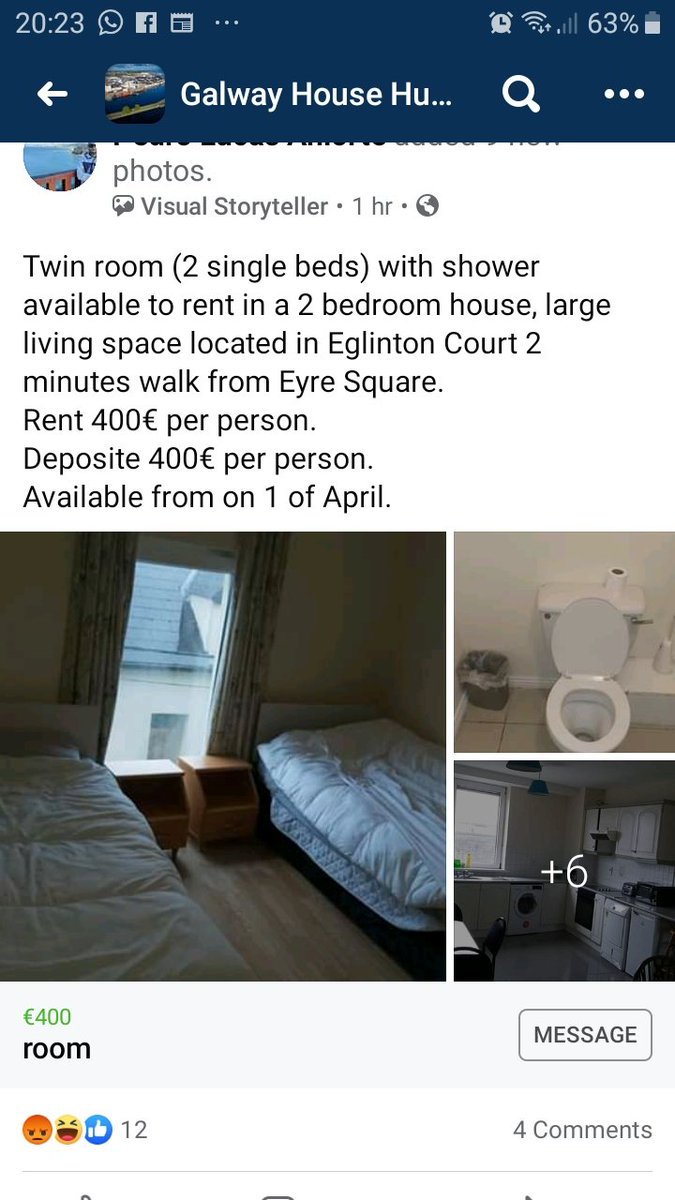
The landlord who reckoned it was a good time to rent out a shared room to two single people in Galway City, for €400 per month per person.

The Dublin landlord with at least three properties who ruled out a temporary rent freeze for tenants who had just lost their jobs.

The health service worker who was asked to leave her accommodation by another landlord . . . because of her job.


The rich state in a rich country which painted out social distancing markings for homeless people to sleep in boxes in an outdoor car park, while dozens of hotel rooms lay empty nearby.

The Irish hotels who put in elaborate security systems because they were closing up for three months, leaving empty rooms when there was never such demand.

The banks who decided to charge thousands of people “quarterly charges” or punish them for not having enough money in their accounts, two weeks after thousands had lost their jobs.

The Government officials who thought “social distancing” and “self-isolation” were possible for asylum-seekers sleeping in bunk-beds, seven to a room.


A proposed 'self-isolation' facility for asylum-seekers in Ireland


The local supermarket owner who more than trebled the cost of hand-sanitizers; because he was “only responding to demand”.

The football club which told its staff it could not afford to pay them €600 per week, while their “superstar” players continued to pocket €150,000.

So they put their ordinary workers, the ones who never appear on TV, on a Government scheme.

The “celebrity” tweeter who invented fake news about the deaths of four health care workers, because he wanted us to believe everything the Government did was wrong.

The minority of pubs who stayed open for a few “sneaky pints” because social distancing didn’t apply to their customers or their families.

The big country which tried to hijack life-saving equipment on its way to small countries, or which tried to bribe a private company in order to get exclusive access to a vaccine.

The Israeli who said there was “no way to spin” footage of thousands of Palestinians being massacred if they rushed to the border fence in urgent need of health care.

The Indian authorities who announced a three week lockdown at such short notice that, in the absence of public transport, thousands of jobless poor people had to walk hundreds of kilometres home.

The thousands of homeless people who found “social distancing” an impossibility as they were forced to queue for food.

'Social distancing' for the homeless in Nevada


The British and American politicians who insisted on keeping their schools and workplaces open, forcing millions to cram into crowded buses and subway trains. Long after they knew the disease would not spread if they just stayed at home.

The ‘wet markets’ in China where animals are treated appallingly and were supposed to be permanently shut down in 2003.

How stocks and shares still mattered to some people as the Intensive Care Units and morgues filled to capacity.

The US troops flying in and out of Shannon, buying leprechauns at the duty free shops, when commercial flights were being shut down.

The President who called the virus a “hoax” before his inaction and desire to put the economy over people cost thousands of lives.

The poor people who felt they had to work, even with the symptoms, because (unlike in Ireland) there was no safety net for those who had to isolate themselves at home.

How politicians who opposed a strike by nurses, seeking decent pay and conditions, asked us to stand and applaud them outside our doors. In Germany, they applaud their health service by funding it.


The absurdity of a rich country with no public health system, and how a global pandemic has shown us that health care for all is a necessity – not a luxury – when something like coronavirus rampages through a country and takes so many lives.

How empty the lives of shallow “celebrities” seem when we stop and pause and tune in to the real people living around us in our daily lives.

In Ireland, and indeed across the world, we have so much to be proud of in terms of how we have responded to the coronavirus emergency.

Will we remember how the smog lifted in Chinese cities and that people could hear the birds sing for the first time in years?

Will we remember how clean the air was or the beautiful blue skies?


The blue heart, a symbol of hope, overlooking Galway Bay


Will we remember the Italians who sang to each other across empty squares or the Dubliners who played bingo on the balconies? Reminding us that community and solidarity are more important than the economy, stocks and shares.

Will we remember the hotels in the West of Ireland offering free meals to the elderly even as their businesses were about to shut down?

Will we remember the businesses who put up symbols of hope, such as the blue heart on the big wheel in Salthill, even as their businesses fell apart?

When all of this is over, will we remember the huge lessons to be learned?

Or will we just go back to the way we were?


--  * A digital journalist based in Galway, Ireland, Ciaran Tierney won the Irish Current Affairs and Politics Blog of the Year award. Find him on Facebook  or Twitter here. Visit his website here - CiaranTierney.com

Cheltenham Racecourse in March


Friday, August 16, 2019

Sorry, I missed the party

Irish Current Affairs Blog of the Year


What does it mean to be an Irish "patriot" in 2019?


Dear “patriots” of Ireland,

My apologies. I am sorry I did not get to attend your Dublin street rally last weekend.

It would have been good to travel across the country for three hours to stand in solidarity with a fellow former newspaper journalist who wants to stand up for free speech.

Only she blocked me from following her on Twitter months ago, just for asking a pretty innocuous question about her beliefs.

It would really have been a bold expression in favour of freedom to stand alongside an ex-journalist who, until recently, used to rant on her YouTube channel wondering if white Irish women who sleep with black African men were “fools”, “sluts” and “whores”.

Of course, she was only asking questions. She didn’t say straight out that these women were prostitutes, but she had heard, you see, that “some African guys” were impregnating Irish woman so that they could get residency in Ireland.

It would have been brave to stand beside the woman who described an appalling terrorist attack on two mosques in New Zealand as a “false flag” operation. You see, I’m more inclined to believe a former journalist thousands of miles away in Dublin than the New Zealand police who actually were on the scene and had to investigate the appalling slaughter of 51 people.

By a "terrorist" who also happens to be a white supremacist.

Funny how the protesters didn’t pop down the road to Facebook, to complain that the mass murderer at the Christchurch mosques had been able to video part of the slaughter live on their site. No. Better to lament the closure of the YouTube account of someone who believes that the Irish will become an ethnic minority in their own country in just a few years.


Gemma O'Doherty used her YouTube channel to denounce immigration


Better to lament the closure of a channel which has been consistently used to claim that our country is being “inundated” with migrants who are adding to the crises in our health care and housing sectors.

It would have been "nice" to go along and listen to the leader of a new political party who wants to deport all of the immigrants living in Ireland.

How I would have liked to stand there and watch him ridicule the mental health of a woman he despises, mainly because she is best known for campaigning in favour of vaccinations for Irish children.

This is a man, by the way, who proclaims that the threat of suicide does not justify legal abortion under any circumstances; a man who has admitted attending rallies organised by far-right parties in other counties.

I have actually seen him on social media proclaiming that white Irish Catholics are the “superior” race and that the Irish need to retain their Judeo-Christian heritage.

It would have been interesting to hear him talk, mainly because my work over the past five years has seen me meet many of the survivors of the Tuam Mother and Baby Home and the families of the 796 disappeared (or missing, or dead, or adopted for money, or buried in an unmarked grave) children.

I’d love to know when this superior Catholic Ireland existed.

Survivors of the Tuam Home standing together in solidarity last year


Was it when their mothers and sisters were dragged out of their beds in the dead of night and locked up in inhumane institutions for the crime of having children?

Was it when gay and lesbian people (I have seen them described as “perverts” in videos from the Dublin protests) were so afraid of revealing their true identities that they felt they had no choice but to take their own lives?

Was it back in the days (not so long ago at all) when young female rape victims had to sneak off to London or Liverpool, in shame, because Ireland judged them so harshly even though they had done nothing wrong?

Was this mythical Catholic Ireland evident in the priests who beat Irish children so cruelly after branding them as “illegitimate” ... or the whispered tales about men of the cloth who were moved around from one parish to another whenever anyone tried to expose their crimes against Irish children?

Do we really want to go back to that Ireland, in which the Bishop of Galway used to urge his flock to beat their daughters if they dared to venture out late at night?

Funny how we have protests outside the headquarters of Google, but none outside the HQs of the religious institutions who have not paid the victims of their crimes a fraction of the damages they owe?

Remembering the 796 'Tuam Babies' with baby shoes last year


It would have been interesting to be in Barrack Street last weekend, alright, to witness fascist salutes at an Irish protest for the first time in my life.

I’m aware that my country was colonised, that Irish people were second class citizens in their own land, and I’d have found it interesting, no disturbing, to see people associate a far-right salute with our beloved national flag.


How quickly we forget that we were once the despised refugees ourselves. And, if you think we are the "superior race", pity you didn't tell the British in the 1950s when they greeted people in search of accommodation with signs which read 'No Blacks, No Irish, No Dogs'.

It would have been interesting to see if the three men who engaged in Nazi salutes last Saturday were ignored or challenged by those who had supposedly gone to Barrack Street to support free speech. Instead of pretending they were "plants" from the other side.

It is clear that Ireland is in a mess, that the gap between the “haves” and “have nots” has never been wider and that the Irish Government have let us down in terms of housing, homelessness, inequality, job security, vulture funds, ‘jobs for the boys’, and the provision of proper health care.

But people are now using social media sites to call for refugees to be burned alive in boarded up Direct Provision centres.

And those who choose hate and fear above love, equality, and justice seem to have little understanding of what generations of Irish people went through when they landed, penniless and full of fear, on the shores of the US, UK, Australia, and Canada.

Some of the protesters in Dublin see nothing wrong with social media posts which call for migrants to be locked up and burnt alive inside their homes.

They want to drag us back to an Ireland which turned a blind eye to the crimes of the Catholic clergy, where gay and lesbian people were “perverted”, and where teenage rape victims or couples given a diagnosis of fatal foetal abnormalities had to sneak away to the UK on ferries, as though they were common criminals.

Our country has voted to give gay people equal rights, to give women under duress the right to choose, and we are largely a welcoming people who remember how so many of our people had to flee our homeland in search of better lives.

I could have joined the protest in Dublin, but no thanks.

I don’t want to be dragged back to an Ireland of drawn curtains, squinting windows, harsh judgements, and “disappeared” young women and children, hidden away in homes and industrial schools.

This mythical Ireland beloved of the far-right either never existed in the first place or mistreated its most vulnerable in a way which would be unthinkable to the young people of today.

Freedom of speech? Yes. Tackle corruption? By all means. Deal with the bankers and vulture funds?

Of course.

But there’s no dragging us back to a horrible or non-existent past.

We have come too far from the days when women were locked up for the "crime" of being raped or lesbian and gay people were told they don't belong in their own land.

Yes, dear "patriots" of Dublin, your Ireland is not my Ireland.

Never was.


--  * Ciaran Tierney won the Irish Current Affairs and Politics Blog of the Year award at the Tramline, Dublin, in October 2018. Find him on Facebook  or Twitter here. Visit his website here - CiaranTierney.com. A former newspaper journalist, he is seeking new opportunities in a digital world.


Thursday, April 19, 2018

The desperate cry of a people calling out for help


Young Gaza footballers in Galway in 2016. 


They feel as though the wider world has forgotten about them.
They live in what has been described as the world’s biggest open-air prison camp, 1.8 million of them crammed into a tiny strip of just 140 square miles, and they want the world to remember that they exist – and that they are finding it almost impossible to breathe.
For 11 years now, they have been blocked into an area which is smaller than County Louth by fences, bullets, and occasional bombs.
Travel is an impossible dream for most of them, a life-saving hospital visit can become a logistical nightmare, and even the fishermen risk being murdered if they dare to venture just a few miles offshore.
Gaza is a humanitarian catastrophe in the making and yet when the local people protest, as they have done in their thousands over the past three weeks, they are demonised, dehumanised, and gunned down.
Shot at by snipers located behind a fortified fence, murdered, or hospitalised, for daring just to protest, even if they are unarmed.
If it happened closer to home, there would be an international outrage. The perpetrators would be hauled before the International Criminal Court for shooting unarmed protesters but, in Gaza, life just goes on.
Irish people can relate to the slaughter surrounding the Great Return March because the shooting of protesters at the border fence has been described as Gaza’s ‘Bloody Sunday’, the terrible day in Derry when the murder of 14 people by occupying soldiers traumatised a city and prolonged a terrible conflict for decades.
The Great Return March is a desperate plea by a desperate people to be heard, it’s also a courageous declaration that refugees who were run out of their homes and villages have a right to freedom, a right to return, and to forge out some sort of a life for themselves.
The vast majority of those crammed in behind the fence in Gaza are refugees from what is now the south of Israel. Some of them even have the keys of the houses their family members fled in terror seven decades ago.


An old Palestinian man holds the keys to
his former family home in what is now Israel


The Gaza Strip was designated as a place to imprison them after they were forced to flee their homes. Israeli soldiers and ‘settlers’ may have withdrawn from the tiny enclave 11 years ago, but every movement in and out of the strip by land, air, or sea is controlled by Egypt and Israel.
If you need life-changing treatment in Israel, you face harassment and humiliation at the Erez crossing, if you are even allowed through at all. You might have family members just a few miles away in Jerusalem or the West Bank, but visiting them has become an impossible dream.
And yet the tendency among many members of the Western media is to demonise and dehumanise these people who are crying out for some sort of a shot at having normal lives.
When unarmed protesters are shot by armed snipers, and hundreds end up in hospitals, the shootings are described as “clashes” as though they were some sort of exchange between equals.
In the first three weeks of the Great Return March, 34 people were killed and at least 1,500 were injured, rushed to hospitals which are already struggling to cope in the face of the 11 year siege.
In Gaza, life is anything but normal.                                        

When the talented young footballers from a soccer academy in Gaza came to Ireland in 2016, the complications surrounding the trip brought home to Irish people just how horrible life is for ordinary Palestinians on the strip.
The trip was delayed by three weeks, forcing a raft of cancellations of flights, accommodations, and games. The Israeli authorities decided at the last minute that the boys and their mentors from the Al-Helal academy were not allowed out of Gaza.
Irish activists, who had been planning the trip for three years, were crushed. A lot of organisation had gone into sourcing host families, clubs to play ‘friendly’ matches, and a schedule which would allow them to make the most of their ten days in Ireland.
Then, suddenly, almost three weeks after the trip was called off, the Israeli authorities allowed 14 of the 15 boys on the squad to travel, along with two of the seven adults who were supposed to accompany them to Ireland.
The only talented young footballer who was refused permission to travel, Karam Zaidan, was badly injured when Israel bombed Gaza in 2009.
The only reason anyone could come up with for his omission from the squad was concern among the Israeli authorities that his visible facial injuries would upset Irish people or cause them to ask too many questions.
Only two of the seven adults who were supposed to travel were allowed through the militarized Erez checkpoint which blocks Palestinians in Gaza off from the international airport at Tel Aviv and any connection with the outside world.
The two adults who did travel with the boys were visibly stressed by the trials and tribulations of having to look after the youngsters whose lives have been scarred by bombing attacks and the deprivation caused by the relentless 11 year siege.
No explanation was given when exit permits were denied to five of the coaches and child psychologists from the academy, which attracts the best young footballers from throughout Gaza.
And yet the boys represented Gaza, and Palestine, with so much pride. They won all six games on their Irish tour, outplaying Irish boys of the same age who were in some cases twice their size.


The Al-Helal boys represented Palestine with such pride
Photo courtesy of John Kelly, Co Clare

Footballers in Gaza are subjected to controls and restrictions which would be unthinkable to their counterparts in any country in Europe.
They are regularly harassed at checkpoints, prevented from travelling, and forced to cancel games. The Al-Helal ground in northern Gaza, where the boys play their home games, was bombed by Israel in 2012 and again in 2014.
And yet the children from Gaza have delighted Irish people when they were allowed to visit Ireland over the past two summers.
Those of us who met the boys were struck by how serious and proud they were about representing Palestine, how courteous they were to their hosts, and how keen they were to present a positive image to the world.
The children appreciated the trips all the more because they were acutely aware of how rare it is for a team from Gaza to represent the enclave in any part of the world.
Children in Gaza are among the most traumatised in the world. Many of the Al-Helal boys were emotionally scarred by the 2014 Israeli military assault on the Gaza Strip, in which more than 2,250 Palestinians, including 551 children, were killed.


Although the world has quickly moved on from that atrocity, most of us can remember the image of the four little boys playing on a beach – aged nine to 11 – who were killed by an Israeli missile that year.
Innocence and all hope for the future are lost when the simple act of playing hide ‘n’ seek on a beach is punishable by death.
And yet, repeatedly, we hear that the people of Gaza deserve their terrible fate, that they must be punished for voting for the appalling ‘terrorists’ of Hamas.
Two days after 30 unarmed people, including a journalist, were shot dead by his troops the Israeli Defence Minister, Avigdor Lieberman, said there were “no innocent people” in the entire Gaza strip.
“There are no innocent people in the Gaza Strip,” Lieberman told Israel’s public radio. “Everyone’s connected to Hamas, everyone gets a salary from Hamas, and all the activists trying to challenge us and breach the border are Hamas military wing activists.”
Presumably, his comments include even the little 10 to 14 year old boys – much smaller and yet more skilful than their Irish counterparts – who captured the hearts and minds of Irish people with their skills, dignity, and innocence over the past two summers.
So when Dublin City Council votes to support the Palestinian Boycott, Divestment, and Sanctions (BDS) movement, to pressurise Israel to end the occupation and obey international law, the councillors are not being racist or prejudiced.
They are supporting a people who are living under a horrible occupation.
When Galway City Council votes to call on the Irish Government to recognise the state of Palestine, they are not neglecting their duties to the people of their own city. Rather, they are trying to give a tiny glimmer of hope to desperate people living under occupation who are inspired by Ireland’s own struggle for self-determination.
The people of Gaza only want to remind us that they exist and, like everyone else, they are entitled to some sort of a decent life.
·         The gifted young footballers from the Al-Helal Football Academy are due to return to Ireland from July 28 to August. To find out more, to raise funds or awareness for the trip, or to help out in any way you can find details at http://gazaactionireland.weebly.com/gaza-kids-to-ireland-2017.html

Thanks to Sean Ryan, John Kelly (Clare), and Andrew Downes (Xposure.ie) for the photos. 

Ciaran Tierney is a journalist, blogger, and digital storyteller based in Galway, Ireland. Find him on Facebook at http;//facebook.com/ciarantierneymedia/

Marching in solidarity with the people of Gaza
on the streets of Galway. Photo by Ciaran Tierney.


Tuesday, August 8, 2017

Our divided tribal loyalties

The Basque woman five seats down from me was in awe.                
Is there a better game on the planet than a championship
battle between two top hurling teams? 

The stadium was packed. Over 50,000 souls had taken over the place and turned it red.

It was only a ‘friendly’, but the supporters of the ‘home’ team cheered every pass and move with a gusto which was totally out of kilter with the importance of the occasion.

"Why does everyone in Ireland support Liverpool?” she asked me at half-time. “Do you not support your own teams?”

In the city of Shamrock Rovers, Bohemians, and St Patrick’s Athletic, she was shocked to see so many Dubliners come out to support a team from the old colonial power.

In the Basque Country, they have grown up on tales of the Irish fight for independence from the British Empire. Now she was shocked to be in Ireland and to find that all the locals were roaring on a British team.

Her team is a total anomaly in modern professional football. They have a Basque-only recruitment policy, even today, and have finished in the top seven of La Liga for each of the past four years despite this restriction.

In Dublin, she was shocked to see that so many people had paid a minimum of €60 a head to support a team from the other side of the Irish Sea, in a contest which would have absolutely no bearing on the outcome of their season.

She wondered why Irish people didn’t support their own local clubs and how much stronger the League of Ireland would be if they weren’t so obsessed by the world-famous players who line out each weekend in the English Premier League.

Thousands of Irish fans turned up on Saturday to support
Liverpool FC in a friendly game against Athletic Bilbao
I didn’t know where to begin.

My own association with Liverpool FC dates back well over 40 years, before the days when my own city even had a team in the national league.

I ‘picked’ Liverpool as a five year old and my brother chose Arsenal, because younger siblings were not allowed follow in the footsteps of their siblings in 1970s Ireland. He has long since forgotten his boyhood preference for the North London club.

He has completely lost interest, and I'm losing mine, when the players no longer seem to have anything in common with the fans, no loyalty, no passion. And match day tickets are now beyond the budget of many Scousers.

As a squatter in 1980s London, I was lucky enough to see the best Liverpool team in history play on numerous occasions. They were probably the best team on the planet at the time and had a good sprinkling of Irish players, including Mark Lawrenson and Ronnie Whelan.

When, 15 years later, a childhood friend moved to Merseyside, trips to Anfield became regular occurrences. Memorably, between 2001 and 2007, a group of us followed Liverpool FC all around Europe. We had legendary nights in exotic cities which would never have been possible for fans of Galway United FC.

The average home attendance at Eamonn Deacy Park, the home of Galway United, is about 1,400 this season. There are thousands of soccer ‘fans’ in my city and county who have never seen their local team, even though United are producing some sparkling football as they battle against relegation in 2017.

Every Saturday or Sunday during the winter months, a group of them sit in a pub roaring on Chelsea FC. I've heard one of them say he'd rather be tortured than pop down the road to watch live football at Galway United FC.

When people ask me why I support Liverpool, I talk about the Hillsborough disaster, the close friendships I made following the team all around Europe, and the city’s long-established links with Ireland. But, ultimately, Liverpool FC are not “my” team. How could they be? I’m not from Merseyside and I don’t live there.

There was a magical atmosphere at the All-Ireland semi-final
between Galway and Tipperary at Croke Park
I felt a bit guilty about taking up a ticket when the opportunity arose to purchase one 24 hours before the game on Saturday.

But, as I was in Dublin for the weekend anyway, I still felt a desire to attend, to check out the new players who currently line out for my boyhood club.

Liverpool beat Athletic Bilbao 3-1, but the whole experience left me cold. I felt duped to have spent €60 for a game which had no meaning and slightly embarrassed as I tried to explain to the Basque fans why so many Irish people have such an affinity with a club from another land.

Especially while our own clubs are struggling to survive, including Bray Wanderers, who almost went out of business a few weeks ago.

It was hard to care too much about a game featuring players whose pay-packets mean they are totally out of touch with working-class fans, who can no longer afford to attend league games.

Watching 50,000 mostly Irish fans roar on an English club made me squirm a little, as though this was a triumph of hype and marketing over the reality of our lives on the Emerald Isle.

Of course, this is not just an Irish - or post-colonial - thing. I have met taxi-drivers in Bangkok and fishermen from Norway who describe themselves as passionate Liverpool fans. I have met fans from Hong Kong and Malaysia who have spent small fortunes to attend Liverpool games.

I could see that some parents were delighted to give their youngsters a first ever taste of ‘You’ll Never Walk Alone’, the Liverpool anthem which is now famous all across the globe. Dare I say it, though, the game was boring and definitely not worth the €60 admission fee.

I couldn’t help wondering why so many Dubs had turned up to support a team from England on an evening when their own GAA team was in action in front of 80,000 fans just up the road at Croke Park. I felt slightly embarrassed after talking to the Basque woman and slipped away before the end.

Less than 24 hours later, I found myself among my own Tribe.            
Celebrating Galway's victory minutes after the
All-Ireland semi-final in Dublin

Galway were playing Tipperary in front of 68,000 people and the skill levels, the passion, and the speed of the game seemed to belong to another world.

My ticket for a superb seat in the Upper Hogan Stand boasted a fantastic view and actually cost €15 less than my stub for a poor seat in the Aviva Stadium the night before.

As the crowd roared around me, I had to pinch myself to remind myself that these were amateurs, playing for the pride of the county, not professional athletes who kiss a club badge one month before moving on to join deadly rivals the next.

There was a huge tension in the air as two groups of young men battled bravely for a place in the All-Ireland final.

When Joe Canning produced a wonder strike in the very last minute, to decide the issue by the narrowest of margins, we all lost the run of ourselves, hugging strangers and jumping up and down with our fists in the air.

When it all died down, three different Tipp fans approached me to shake hands in the top of the Hogan Stand and wish us well for the final.

Gone was the poisonous atmosphere which marked games between our two counties in the late 1980s and 1990s, and I couldn’t help thinking that fans of Chelsea, Liverpool, or Man United could never sit beside each other in stadia and share our love of a beautiful game.

Neither would they ever imagine being so gracious in defeat as the wonderful Tipp fans I had the pleasure of meeting on Sunday.

The Liverpool game almost put me to sleep, while the hurling match demonstrated so much about what is brilliant about being Irish … touches of genius, passion, skill, and just enough lunacy to keep us all enthralled right to the end.

On a high after the hurling semi-final
Instead of being so obsessed by global superstars, we should learn to appreciate the wonders and home grown heroes who live and work among us.

Such as the two teachers from a Loughrea school who are now preparing for one of the biggest sporting occasions in Ireland. It’s hard to imagine the excitement among the town’s youngsters as they prepare to return to school to see home grown heroes Johnny Coen and David Burke come September.

And it might be easier to explain the pure joy of hurling, surely one of the best games on the planet,  to a Basque woman than to explain why so many Irish people are in thrall to Sky Sports and the major English soccer clubs.


Ciaran Tierney is a journalist, blogger, and digital storyteller, based in Galway, Ireland. Find his Facebook page at http://facebook.com/ciarantierneymedia

Tuesday, May 16, 2017

Welcome to the wonderful 'Regime Radio'!

Welcome to ‘Regime Radio’ … right here on your dial every Saturday and Sunday morning.

Giving you all the information you need to know your place in this big, bad world.
You know you should 'rat' on your neighbour, you
really should ... for the greater good!

 . . . First up this morning we have a Government Minister to tell us about his campaign against welfare fraud. The frightening underclass among us are ripping us off for millions and he wants you to “rat out” your neighbour if you see him going on holidays or buying a new car.

Funny that he doesn’t have statistics to back up his claim that welfare cheats are milking the system or that he’s launched his hate campaign against the poor just when he’s aiming, too, to become leader of our land.

And we won’t bother asking him about banker fraud, because we don’t get “sexy radio” out of that kind of white collar crime.

 . . . Now, next up in the studio we have a ‘Senator’ from outside the Pale. And not just any old Senator, but a former successful businessman, until he went bust, who will tell us all about the wonderful committee he chairs.

He’s a great man to talk, this Senator, especially about himself and his wonderful political connections.

What we forget to mention, though, is that he wasn’t actually elected to the Senate by ordinary or normal people like you, dear listener. After failing to win a popular vote, by a complete miracle he was nominated by the leader of a party who bankrupt the country a few years ago.

But we don’t talk about things like that here on Regime Radio!

Or we won’t talk about his old company, and how it survived for so long on subsidies from that same – once disgraced, but now resurgent – political party.

Sure, they are on the way back, we’ve completely forgotten that they brought the country to its knees, and so is our wonderful Senator.

And we only back winners here on Regime Radio!

 . . . Next up we have a wonderful former Government Minister. Wonderful, because he likes the sound of his own voice so much we have no problem inviting him onto the radio, to talk about anything at any time.

We only back winners ... here on 'Regime Radio'!
He’s from deepest Tipperary where they know a lot about the kind of neck it takes to get to the top in Irish politics.

He’ll tell you how he did this and he did that, and he was the first person to raise this or that issue in the Dail. We love big egos here, to match our massive salaries on your favourite Regime Radio!

We won’t ask him much about how his party collapsed after turning their backs on the working class or how one of his colleagues referred to the poor among us as “the f---ing dregs”.

We try to be positive here on ‘Regime Radio’!

 . . . And now we have a communications expert, who will laugh and joke about how she prepares her political clients for grillings on this very type of show.

She’ll defend the indefensible, as long as the price is right. Mind you, she might storm out of the studio if we ask the wrong question. She won't let us talk about nasty religious orders, who have refused to compensate abuse victims after causing them decades of pain. They're great clients, you see, and she's coached them on how to avoid pesky questions.

But, sure, we wouldn’t want to ruin your weekend morning by talking about such horrible issues here on the wonderful, positive 'Regime Radio'!

 . . . And now we have another Senator, a superb male expert on female bodies. We won’t talk about the fact that he was “elected” by a tiny pool of University graduates, or the fact that his beloved Institute seems to have been on the radio more times than we’ve had hot dinners this year.

He’ll give you the courage of his convictions and, sure, if he’s not available this Saturday we will replace him with another member of his Institute who bemoans the biased “liberal” media while she writes a national newspaper column every week.

 . . . We have a special guest this week, a senior Garda officer. We won’t ask her about the corruption, the smears, or the fabrication of evidence which has undermined your faith in the Irish police force; instead, we will guarantee her the easiest interview she’s had since she entered the service at Templemore.

Let's not talk about the viciosu smears, which almost ruined the
life of an honest whistleblower. Sure, it'd ruin the dinner!


. . . And we’ve time for one more superstar, a “celebrity” guest from the heart of Dublin 4. She’ll remind you how insignificant your little life is out there on the West coast, you consequential little peasant, as she gives us “the goss” on “celebrities” you’ve never heard of.

We’ll celebrate the pending arrival of the summer, loike, with our tales of the hardship of camping in the VIP section of a sold-out music festival. There’s no mixing with the plebs for us, here, when we have such access to the stars on ‘Regime Radio’!

There’s no better way of feeling like an outsider in your own land than listening to a lovely group of South Dublin people gossip about other South Dublin people.

Just to remind you how “out of the loop” you truly are down there in darkest Donegal or gloomy Galway.

If you are lucky, yes really lucky, we might have a time slot to feature one of our colleagues just up the corridor, after nailing him or her in the ‘Regime Radio’ canteen. There’s hardly a Saturday or Sunday goes by that we don’t interview one of our own colleagues, just to justify all the money you spend on the licence fee.

We are so glad to bring this dizzying array of high profile guests to you here on ‘Regime Radio’ every Saturday and Sunday. It’s such a stressful job that we have to take about ten weeks holidays a year.

. . . Of course, if you want to find out more about our wonderful station, you might learn more by looking at the people we WON’T put on the show this week or any week in the near future!

 . . . You won’t hear from the young mother from Cork who walked all the way to Dublin because she wants to use medical cannabis to treat her daughter’s severe form of epilepsy.

Her seizures stopped when she got access to medicinal cannabis, but her mother was made to feel like a criminal when she was forced to import the drug from overseas. We can’t have anyone who challenges the law of the land contaminating your little West of Ireland minds!

 . . . You won’t hear from the bank executive turned whistleblower who reported breaches in liquidity to the central bank a year before the nation’s entire banking system collapsed. He might just have saved the State a few billion euros if anyone in authority actually listened to him back in 2007.

He wants to know why no action was taken to deal with his concerns, or why the State contrived with developers and bankers to help out a rotten banking system in a ‘bailout’ which resulted in a cost of billions of euros to the Irish taxpayer.

The authorities have never explained why they didn’t act on his urgent warnings. He hasn’t worked for years, but his voice is not the kind we want to hear to challenge the cosy consensus here on ‘Regime Radio’.

Our readers don't really want to hear about the mum
in Direct Provision who couldn't afford a taxi at UHG
 . . . We won’t hear from the mother who carried her child home from a Galway hospital last week, because she couldn’t afford a taxi on her weekly allowance of €19.10.

We don’t want to upset your dinner by discussing the terrible Direct Provision system – not while we are highlighting the plight of “our own” undocumented Irish fearing for their lives that Donald Trump will expel them from the United States – here on ‘Regime Radio’.

 . . . And we won’t hear from the single mother who has been living in a hotel with her daughter for a year, because the homelessness crisis might also upset our listeners as they prepare their weekend dinners here  on your favourite radio show.

 . . . Or the teenager who was hauled out of his bed at dawn for daring to sit down in front of a Minister’s car during a protest in Dublin. He’s too articulate, too angry, too intelligent and too much of a threat to the widespread view that those awful Irish Water protesters are nothing more than the “sinister fringe”.

Sometimes, you see, you learn more about what’s going on in the real Ireland by looking at the stories we don’t feature here on your beloved ‘Regime Radio’.


Ciaran Tierney is a journalist, blogger, and Digital Storyteller, based in Galway, Ireland. Check out his Facebook page here He admits to having a sense of humour and denies being a member of the "sinister fringe"


Thursday, November 10, 2016

If only the red poppy honoured all lost lives

In the cold, eerie courtyard where each of the 1916 rebel leaders was killed at dawn by a British Army firing squad, our excellent tour guide Ben spoke with clear emotion in his voice this week as he told us about the execution of James Connolly.

At the end of our wonderful, hour-long tour of Kilmainham Gaol in Dublin’s western suburbs, where so many Irish rebels had been held, he pointed to the lonely cross which marks the spot where Connolly had faced the British soldiers for the final time.

Standing in Kilmainham Gaol, where 14 of the Easter Rising
leaders were held before being executed at dawn
Our guide told us that Connolly, due to the extent of the injuries he sustained in the ill-fated rising, was unable to walk to the courtyard.

The Scottish-born son of Irish emigrants was carried from a hospital bed and tied to a chair before facing his executioners.            

A doctor said that he probably only had a day or two to live, before Connolly had his last rites administered and a final visit by his grief-stricken wife.

"I will say a prayer for all men who do their duty according to their lights,” he said, when asked to pray for the British Army soldiers who were about to execute him.

Although our guide must lead dozens of tours of the historic prison each week, he was clearly moved by the stories of the men and women who gave up their lives for Irish freedom throughout the 19th and early 20th centuries.

As word began to filter out, news of the executions of 14 rebel leaders at Kilmainham caused uproar across Ireland and Irish-America in 1916 – and even some controversy in Britain, then in the midst of the First World War. 

The rebels, previously seen as traitors by many Irish families who had sons fighting for the British Army in Europe at that time, became martyrs for Irish freedom. The surge in support for independence as a result of their deaths changed the course of Irish history.

There has been a surge in interest in Ireland’s troubled history in recent months as a result of the 1916 centenary.

Standing in that prison courtyard this week, where all of the guided tours have been sold out due to the Halloween holidays, it was hard to imagine that any Irish person would be asked to wear a poppy to honor the British Army troops who shot the rebel leaders one-by-one.

Footballer James McClean is criticised every year for
refusing to wear a poppy to commemorate British soldiers
It is ridiculous to think that professional soccer player James McClean, who grew up in the Bogside in Derry, manages to attract controversy every year because of his unwillingness to wear the ubiquitous poppy to honor British troops on his club football jersey.

The British Army shot 14 innocent civilians dead in the neighbourhood where he grew up in January 1972 and, presumably, McClean feels that he would be letting his own community down if he wore the poppy to honour the army dead.

He chose to play for the Republic of Ireland, rather than Northern Ireland, because of the political turmoil and sectarianism his community experienced during ‘The Troubles’. 

Families in the Creggan and the Bogside spent almost 40 years campaigning for justice for their loved-ones, until they finally received an apology from then British Prime Minister, David Cameron, in 2010.

In their particular communities, the notion of honouring the British Army dead still seems absurd.

"People say I am being disrespectful but don’t ask why I choose not to wear it,” said McClean this week. "If the poppy was simply about World War One and Two victims alone, I'd wear it without a problem.

"I would wear it every day of the year if that was the thing but it doesn't, it stands for all the conflicts that Britain has been involved in. Because of the history where I come from in Derry, I cannot wear something that represents that."

The English Premier League is now one of the most cosmopolitan soccer competitions in the world. Yet there is outrage on social media if players from Argentina, Colombia, Ireland, or wherever, decide not to wear a poppy to remember people who died in a war which took place a century ago.

Until relatively recently, the wearing of the poppy on Remembrance Day (November 11) used to be optional.

Now it’s impossible to switch on a chat show or current affairs programme on British TV for a period of about a month without noticing that every single presenter and guest seems to be obliged to wear one.

This year, we have a new scandal because FIFA – world football’s governing body – is preventing players from England and Scotland from wearing the poppy during a World Cup qualifier in London on November 11.

The cross marks the spot in the yard where James Connolly,
tied to a chair, was executed by a British Army firing squad
FIFA prohibit the use of political, religious or commercial messages on team shirts and FIFA’S ban has been called “utterly outrageous” by the UK Prime Minister, Theresa May. 

On Friday, FIFA opened disciplinary proceedings against the Irish football body, the FAI, for including a 1916 anniversary logo on the Republic of Ireland team’s jerseys for a ‘friendly’ against Switzerland back in March.

FIFA were accused of double standards after being alerted to the Irish jerseys by a disgruntled British Member of Parliament, Damian Collins.

Time was when the whole point of Remembrance Day was to honor the British Army servicemen and women who died in World War One in quiet contemplation.

Now any public figure, such as McClean, who dares not to wear a poppy can expect abuse from the British tabloids and vilification by fans on social media. 

If you are a member of the large Muslim, Irish, or Asian communities in Britain, these can be an uncomfortable few weeks.

A presenter or guest on TV really sticks out if he or she dares not to wear a poppy for Rememberance Day. The poppies seem to be everywhere, on the trains, the buses, in the parks, at places of work. 

If you don’t wear the poppy, you risk standing out from the crowd at work and even being a target for abuse now that racists seem to be emboldened by the Brexit vote in the UK.

But, if you do, can an Irish person really be comfortable in honoring the people who died on just one side in World War One?

Especially now while their sacrifice is still being used by political leaders to justify current wars involving the British Army, in far-off lands. 

The poppy has become a British nationalist symbol, rather than a way of remembering so many ordinary people who lost their lives in a terrible war.

If people really want to honor their war dead, they should provide better support for veterans instead of forcing the likes of the Royal British Legion to write begging letters to support “our boys” who were injured in battles in Syria, Iraq, or Afghanistan. 

The US and UK continue to maim and kill civilians in Syria
and Iraq a century on from the horrors of World War One
They should ask why the British Army continues to occupy, bomb children, or start new wars in countries so far from home a century after the horrors of World War One.

Not engage in bickering over whether James McClean, or the English and Scottish teams, should wear the poppy, as all the bickering shows how far Poppy Day has drifted away from its original meaning.

If Rememberance Day involved honouring those who died in all wars, and trying to stop future wars from occurring, then people would have no issue about supporting it by wearing the red poppies on both sides of the Irish Sea.

But if the poppy only honors the members of a colonial army, who caused so much suffering in so many lands, then no wonder its symbolism remains clouded in controversy.  

All of the bickering only shows that the red poppy has been hijacked by British nationalists over the past few years, to the extent that many people feel very uncomfortable about wearing it.


Instead of the red poppy, it is possible to wear a white poppy to remember ALL victims of war: http://www.ppu.org.uk/whitepoppy/index.html


A shorter version of this blog post was published as an opinion piece by Irish Central on Monday: http://www.irishcentral.com/opinion/others/poppy-fascism-forcing-irish-nationalists-to-wear-them-in-britain


Find me on Facebook here