Showing posts with label Galway. Show all posts

Saturday, April 4, 2020

When all of this is over ...

Irish Current Affairs Blog of the Year 

Medical staff in Galway with a message for us all


When all of this is over, will we remember . . .

The rich people who flew all over the world so that poor people could die.

The 17-year old denied treatment at an urgent care centre, because he did not have health insurance in the richest country in the world.

The horse racing officials who thought it was fine for 250,000 people from all over Britain and Ireland to mix, drink and mingle at Cheltenham Racecourse, right at the outset of a pandemic.

The Taoiseach (or Prime Minster) who claimed workers were asking to be laid off because the Government was paying them so much in emergency welfare. Because, you know, poor people are lazy and don’t really like to get up in the morning.

The politicians, “celebrities”, and “royals” tested so quickly; while no test kits were available to doctors, nurses, and carers on the front line.

The Irish TV presenter who got his results back while a doctor missed seven shifts due to worry that she had contracted Covid-19.

The deliberate downgrading of a public health service which had been in crisis for decades, while handsome grants were provided for the building of private hospitals.

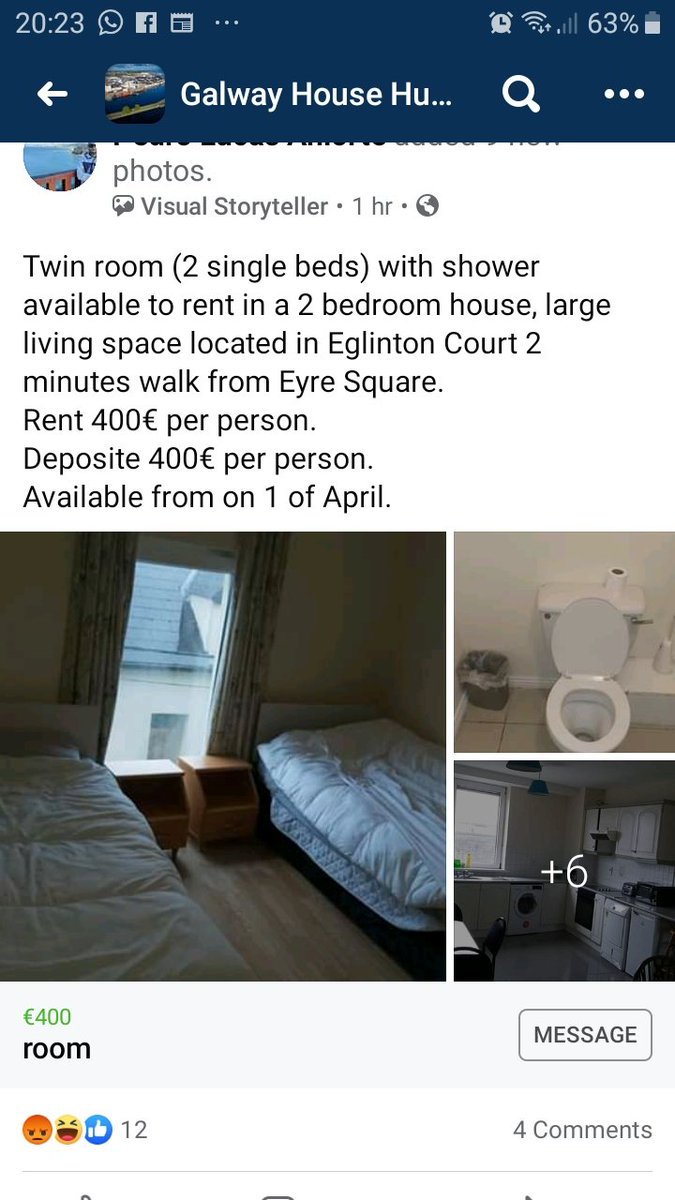
The landlord who reckoned it was a good time to rent out a shared room to two single people in Galway City, for €400 per month per person.

The Dublin landlord with at least three properties who ruled out a temporary rent freeze for tenants who had just lost their jobs.

The health service worker who was asked to leave her accommodation by another landlord . . . because of her job.


The rich state in a rich country which painted out social distancing markings for homeless people to sleep in boxes in an outdoor car park, while dozens of hotel rooms lay empty nearby.

The Irish hotels who put in elaborate security systems because they were closing up for three months, leaving empty rooms when there was never such demand.

The banks who decided to charge thousands of people “quarterly charges” or punish them for not having enough money in their accounts, two weeks after thousands had lost their jobs.

The Government officials who thought “social distancing” and “self-isolation” were possible for asylum-seekers sleeping in bunk-beds, seven to a room.


A proposed 'self-isolation' facility for asylum-seekers in Ireland


The local supermarket owner who more than trebled the cost of hand-sanitizers; because he was “only responding to demand”.

The football club which told its staff it could not afford to pay them €600 per week, while their “superstar” players continued to pocket €150,000.

So they put their ordinary workers, the ones who never appear on TV, on a Government scheme.

The “celebrity” tweeter who invented fake news about the deaths of four health care workers, because he wanted us to believe everything the Government did was wrong.

The minority of pubs who stayed open for a few “sneaky pints” because social distancing didn’t apply to their customers or their families.

The big country which tried to hijack life-saving equipment on its way to small countries, or which tried to bribe a private company in order to get exclusive access to a vaccine.

The Israeli who said there was “no way to spin” footage of thousands of Palestinians being massacred if they rushed to the border fence in urgent need of health care.

The Indian authorities who announced a three week lockdown at such short notice that, in the absence of public transport, thousands of jobless poor people had to walk hundreds of kilometres home.

The thousands of homeless people who found “social distancing” an impossibility as they were forced to queue for food.

'Social distancing' for the homeless in Nevada


The British and American politicians who insisted on keeping their schools and workplaces open, forcing millions to cram into crowded buses and subway trains. Long after they knew the disease would not spread if they just stayed at home.

The ‘wet markets’ in China where animals are treated appallingly and were supposed to be permanently shut down in 2003.

How stocks and shares still mattered to some people as the Intensive Care Units and morgues filled to capacity.

The US troops flying in and out of Shannon, buying leprechauns at the duty free shops, when commercial flights were being shut down.

The President who called the virus a “hoax” before his inaction and desire to put the economy over people cost thousands of lives.

The poor people who felt they had to work, even with the symptoms, because (unlike in Ireland) there was no safety net for those who had to isolate themselves at home.

How politicians who opposed a strike by nurses, seeking decent pay and conditions, asked us to stand and applaud them outside our doors. In Germany, they applaud their health service by funding it.


The absurdity of a rich country with no public health system, and how a global pandemic has shown us that health care for all is a necessity – not a luxury – when something like coronavirus rampages through a country and takes so many lives.

How empty the lives of shallow “celebrities” seem when we stop and pause and tune in to the real people living around us in our daily lives.

In Ireland, and indeed across the world, we have so much to be proud of in terms of how we have responded to the coronavirus emergency.

Will we remember how the smog lifted in Chinese cities and that people could hear the birds sing for the first time in years?

Will we remember how clean the air was or the beautiful blue skies?


The blue heart, a symbol of hope, overlooking Galway Bay


Will we remember the Italians who sang to each other across empty squares or the Dubliners who played bingo on the balconies? Reminding us that community and solidarity are more important than the economy, stocks and shares.

Will we remember the hotels in the West of Ireland offering free meals to the elderly even as their businesses were about to shut down?

Will we remember the businesses who put up symbols of hope, such as the blue heart on the big wheel in Salthill, even as their businesses fell apart?

When all of this is over, will we remember the huge lessons to be learned?

Or will we just go back to the way we were?


--  * A digital journalist based in Galway, Ireland, Ciaran Tierney won the Irish Current Affairs and Politics Blog of the Year award. Find him on Facebook  or Twitter here. Visit his website here - CiaranTierney.com. 

Cheltenham Racecourse in March


Friday, January 31, 2020

Why bother blogging about the election?


Irish Current Affairs and Politics Blog of the Year 


Noel Grealish TD has targeted immigrants and asylum-seekers 


Why bother blogging about the election?

After all, every fool seems to have an opinion, and nobody seems to want to pay for decent journalism these days.

Why bother writing about the old friend you met at Christmas who you rarely bump into any more?

He’s voting for Noel Grealish in the upcoming election, he said, because he “said what nobody else is saying”.

With a straight face, he told you that immigrants and asylum-seekers are to blame for nearly all our woes, but nobody else has the courage to say so.

Your friend has a business to run, a young family to feed, and spends hours stuck in traffic every day. Life’s a struggle, he said, and when he heard a local politician describe African migrants as “spongers” it seemed to really strike a chord.

My old friend doesn’t pay much attention to what goes on in the Dail. He doesn’t know that Noel Grealish has one of the worst speaking and attendance records in the Irish parliament or that he was exposed as one of the worst offenders for signing in, claiming travel and accommodation expenses, and failing to turn up for votes.

Or that he plucked figures about Nigerians from thin air before raising spurious questions about reparations in the Dail.

He’s too busy to pay attention, you see, but he bought into the atmosphere of intimidation, fear, and hatred whipped up by the prospect of a Direct Provision centre being located in a small Galway town last October.

Blaming the immigrants because you can’t buy a house or get a bed in a hospital allows him to find a scapegoat and feel better about himself, but does it offer a solution to our problems?

Scapegoating the most vulnerable and marginalised never tackles the cause of injustice or inequality, but it sure allows some people to find a target for their rage.


Why bother blogging about the health service?

Why bother writing about the 48 hours your late father spent lying on a trolley in a corridor after a fall in his house two years ago?

Dad was 93, a lifelong Fine Gael supporter who had worked hard for 45 years, when he suffered that fall.

Like thousands of others around the country, he lay in silence at University Hospital Galway for two full days and nights before being transferred to a ward.

It is hard to know exactly when the unacceptable became the norm, but the tendency of Irish people to just grin and bear it – and never complain – was very clear to me when I took two days off work to sit or stand by his side.

How could such an elderly man be left to lie for 48 hours in a brightly lit corridor with not a hope of privacy or confidentiality for such a long time? It felt like a war zone in that Emergency Department just down the road and I wondered what kind of Government could treat its most vulnerable citizens with such contempt.

My dad was lucky because he had a family member by his side, to provide him with an occasional glass of water, to look out for him, or just to ask what the heck was going as his wait for a bed and some comfort continued over two horrible nights.

All around me, other relatives were faced with the same ordeal. We shared each other’s agonies and frustrations. I had to stand for three hours without a chair as I paced up and down, feeling like a burden or an inconvenience on the nurses who seemed unable to cope with so many patients.

“If you treated an animal in the way the HSE (Health Service Executive) is treating patients you’d be up in court and rightly so,” a woman tweeted me in frustration, four months after her father died 36 hours after being admitted to an overcrowded public hospital.

I counted 18 trolleys occupied by patients in the corridor at any one time and I know the situation has deteriorated since then.

Almost 900 people were left lying on trolleys in January 2020.

What kind of heartless Government would allow this kind of situation to continue, to promote a “two-tier” health service which favours the rich?

What kind of canvassers would dare to come around to our houses to ask us to vote to keep the people responsible in power for another term?


Why bother blogging about the housing crisis? The students sleeping in hostels, or  sharing rooms with strangers, or sleeping in vans, or forced to clear out of their accommodation on Friday nights so that the landlord can get tourists in (and make bigger profits) at the weekends?

Why bother blogging about the domestic violence victims who opt to stay and be abused because the alternatives are unthinkable? Or the people you know in their 30s and 40s who have moved back in with elderly parents because they can’t afford the rents?

In a country which is supposed to be “booming” it’s amazing how many of us are just a monthly pay cheque or two away from living on the streets.


Why bother blogging about job insecurity?

Why write about the colleague you know who, at short notice, was given just one week’s work for the month of January? He still has the rent to pay and feels guilty each week when he has to share the bad news with his wife.

He won’t go on the dole, he tells me, because people on Social Welfare are “spongers” and it just wouldn’t feel right. So he suffers on with no money, hoping things will pick up, and the Government statistics will insist that he – like thousands of others – is gainfully employed in 2020.

So there’s an election coming up and the choice seems to be between Fine Gael and Fianna Fail, the two parties who have shared power between them since the foundation of the State.

When Fine Gaelers come canvassing will I be too polite to tell them the devastation their policies are causing in the provision of health care?

When the Fianna Failers knock on the door, will I thank them for being so greedy, bankrupting my country, and forcing many of my friends to seek new lives overseas.

Or will I do “the Irish thing” and smile and thank them for calling, because their dad used to play for Galway or they once managed to get a few workmen to fix the road outside my estate?

We vote for the same chancers time after time and then we are surprised when hospitals are overcrowded, houses are unaffordable, and there is no security in our jobs.

We vote for them again and again, and we expect the results to be different.

Yep, when there are false promises and appalling track records to be challenged, why bother blogging at all?


--  * A digital journalist based in Galway, Ireland, Ciaran Tierney won the Irish Current Affairs and Politics Blog of the Year award. Find him on Facebook  or Twitter here. Visit his website here - CiaranTierney.com. 

A meeting to oppose a Direct Provision centre in Oughterard


Wednesday, July 31, 2019

Struggling to come to terms with a hate crime

Irish Current Affairs Blog of the Year


Gathering in solidarity at a Galway mosque this week


Apart from the wanton destruction, it was the look of despair and anguish on the young boy’s face which left the most lasting impression.

As an adult member of his community brought me on a guided tour of the vandalised mosque, the little boy – no more than nine or ten years old – expressed his bafflement that such vandalism could occur in such a peaceful place.

Why would anyone want to destroy this place where his parents brought him to worship every weekend?

Why is there such hatred for his people in the city he knows and loves?

The Ahmadi Muslim boy with the strong Galway accent was upset and bewildered. As they showed me the broken windows, the flittered books, and the place where the CCTV panel was ripped from the wall, he could not hide his sense of anguish.

The irony, of course, is that many of Galway’s 200 Ahmadi Muslims came to Ireland to seek refuge after being persecuted in other countries.

They are considered non-Muslims, even considered heretics, by many mainstream Muslims and faced persecution or oppression. In May 2010, 84 of them were murdered in the Lahore massacre – the year in which the Maryam Mosque opened in Galway.

Such details were possibly lost on the people who carried out the attack in Ballybrit either late Sunday night or early on Monday morning.

In Galway, the Ahmadis had found a place of refuge. But now their safe place has been attacked twice by vandals in the space of three years.

Adults expressed fear, terror even, when community leaders and politicians from across Galway gathered to express solidarity with them on Monday night.


A discarded Irish flag at the  Galway mosque


The Imam, Ibrahim Noonan, told me he had received an anonymous call three months ago to warn him that a far-right group was planning an attack.

Locks and windows were broken, security camera equipment had been stolen, many of his 2,000 books had been destroyed, family photos were smashed, and an Irish tricolour was thrown outside.
A native of Waterford, Imam Noonan was heartbroken when he saw the scale of the destruction. There was glass all over the place when the alarm was raised on Monday morning.

Nothing seemed to have been stolen, which led members of the community to believe that this was a hate crime. Gardai said that the violent removal of CCTV material from a separate room showed there had been some element of pre-planning.

Politicians from across the political spectrum and community leaders gathered later that night in a show of solidarity in response to the attack.

The gathering at the mosque was organised at short notice to allow people to express their outrage and to show the Ahmadiyya Muslims that the act of vandalism did not reflect the feelings of the local community towards them.

“This act of vandalism was committed by cowards,” said Cllr Alan Cheevers (Fianna Fail). “I can assure you that this does not represent the people of the east side of Galway City. Today was a very upsetting day for me, to see the damage here. I will work tirelessly with the city’s Ahmadiyya Muslim community to make sure that this kind of thing never happens again.”

Gardai launched an investigation into the attack which occurred sometime between 10pm on Sunday and 4am. Rocks were used to break the windows and property was destroyed.

The smashed up CCTV system


“This was a clear, deliberate, and vicious attack being delivered to our community. This gathering tonight is the best possible answer to such people, to show that they don’t speak for the Irish. They don’t speak for anyone in Ireland, for that matter,” said Imam Ibrahim Noonan, whose office was damaged in the attack.

“I think that’s what is important. I have been receiving warnings that the mosque was going to be attacked and that I should be careful about my own movements. I have never allowed such people to intimidate me, because I stand for everything that’s good about Ireland, as an Irishman, and I will not back down to such people.”

Imam Noonan urged Irish people to visit the mosque, have a cup of tea and a chat, and to find out about the belief system of the Ahmadiyya Muslims.

Joe Loughnane, of the Galway Anti Racism Network (GARN), recalled that the mosque was also attacked in July 2017, when graffiti was daubed on the walls. Earlier in the day, he had invited people to attend the solidarity gathering to show the Ahmadiyya Muslims that they were not alone.

“When I came here earlier, it was obvious that the people who worship here felt they were alone and under attack. We wanted to prove to them that this wasn’t the case,” said Mr Loughnane.

“People are coming here, drinking cups of tea, and trying to find out more about the Ahmadiyya Muslim community. This is a hate crime. In these situations, the community can come to understand that there is solidarity towards them.”

He asked people to call out hate speech when they see it on-line.

In recent months, there has a significant growth in the number of social media accounts which spread hatred and fear of Muslims in Ireland.

A new member of Galway City Council, Owen Hanley, told the congregation that he had canvassed every house on the east side of the city in the run-up to the local elections in May.

“This act doesn’t represent the east side of the city,” he told the gathering. “Galway is a city of openness and love. Sadly, there is a small but growing number of people in this country who are full of hate. But ‘Peace and Love’ are the first things you hear when you visit this mosque.”


Imam Noonan reminded the congregation that ‘Love for All, Hatred for None’ is the slogan of the Ahmadiyya Muslim community. It’s a slogan which attracts a sustained round of applause when his congregation take part in the St Patrick’s Day parade in Galway every year.

A member of the congregation who converted to Islam last year, Roscommon native Alan Kelly, said it had been a traumatic day for the community when word spread that the mosque had been attacked.

He received a call at work, to tell him about the attack, on Monday morning.

“Everyone was so was shocked. We didn’t know how this kind of thing could occur in such a peaceful country. I am Irish and I grew up in this country. We need to join together. Everyone should be united, to create a better life. I don’t see why people have to judge other people or criticise their religion.

“The support we have received today from across Ireland has been amazing, but it is sad to think that there are people out there who want to cause destruction and spread fear without knowing anything about us. I don’t know why anyone would do this to us. There is no reason for any of this.”


Hire a professional blogger for your business at ciaran@ciarantierney.com

 * Ciaran Tierney won the Irish Current Affairs and Politics Blog of the Year award at the Tramline, Dublin, in October 2018. Find him on Facebook  or Twitter here. Visit his website here - CiaranTierney.com. A former newspaper journalist, he is seeking new opportunities in a digital world.


Monday, June 10, 2019

Farewell to a West of Ireland dad

Irish Current Affairs Blog of the Year 2018


If there is one thing my family learned over the past nine months or so, it’s the amazing public health system we have out in our communities here in Ireland.

A team of nurses, carers, and staff from our local pharmacy were on call every day of the week to give my father as comfortable a life as possible and to fulfil his wish of dying in his own home.

Thanks to our public health care professionals, and the support of a loving family, my dad had the most peaceful death anyone could ever hope for. He had spent an entire Sunday surrounded by people who cared for him, before deciding to leave this world just before 1am on a Monday morning.

Last August, we saw the other side of the Irish health service when, at 93 years of age, he was forced to spend 48 hours on a trolley in an overcrowded Emergency Department after sustaining a fall in the family home.

Never a fan of hospitals, all Micheal Tierney wanted was to get home to his own place. And, thanks to a rota devised by his family, the support of care workers who called twice a day, and an amazing Public Health Nurse, we managed to let him realise his dream of staying in the home and the neighbourhood he adored.

Our public hospitals may be in crisis, but the care provided to our most vulnerable in their own homes and communities is second to none.

Patients lying on trolleys in an Irish public hospital


My dad showed the true spirit of a fighting Irishman.

He lived far longer than the few weeks he was given back in January and even defied the doctors to be still with us when his beloved son, Micheal Junior, flew in from New York 48 hours before he passed away.

Family meant everything to my dad and it was the love of his family which drove him on, confounding the nurses and doctors with his determination and will to live over the past few weeks and months.

After he had been told never to climb the stairs, my sister came into the house one day a few months ago to find him frantically cycling on a gym bike he had installed in an upstairs bedroom. On another day recently he went upstairs to “sort out the bills” because our mother “knew nothing about them”!

His generation, born in the first few years of an independent Ireland, were made of stern stuff. Most of his aunts and uncles had emigrated to the United States in the early part of the 20th century, because of the grinding poverty in Co Galway at the time, and he used to recall trying to pinch bread from the priests in his boarding school in the 1940s.

It was hard for him to see his strength go, to have to get people to put him to bed at night, but amazingly he became firm friends with some of his carers and could be heard laughing and joking with them as they helped him get to bed at night.

How amazing it was for his adult children to see him befriend carers from Malaysia, the Philippines, Holland, or Mayo, after his initial reluctance to even allow them into his home!


Dad with my sister, Mura, at a wedding in Spain in 2006


In the West of Ireland, in particular, we tend to do funerals and dying with great dignity and compassion.

We spent three hours shaking hands as literally hundreds of people made the effort to get to the Funeral Home. Such a tribute to a Civil Engineer, almost three decades on from his retirement from the local authority, would not be deemed unusual in this part of the world.

An amazing priest, Father Martin Downey, brought great peace and comfort to the family home when he made three house calls in the last few weeks of his life, as it began to dawn on my dad that his race was run.

My father only stopped jogging at 84 years of age, after embracing the fitness craze of the 1980s, and the medics were astounded by both his physical stamina and determination to live for as long as possible.

The staff at our local chemist in Galway City made the family feel that our father was the most important man in the world and a gentleman – they would repeatedly offer to call down with medicines, even giving us their mobile phone numbers if we ever needed them when the shop was closed at 3 or 4am.

That kind of personalised service would be unthinkable in many parts of the world.


Showing determination at University College Hospital Galway (UCHG)


And the neighbours rallied around over the past few weeks of his life, repeatedly calling in with cakes or ready-cooked meals. It was impossible not to shed a tear when they formed a Guard of Honour outside his home for his final journey.

His last day on earth was a perfect Sunday in a West of Ireland household.  His adult children did not feel guilty about leaving his bed side to watch a championship hurling game between Galway and Wexford on television, because that’s exactly what Micheal would have wanted.

Indeed, his beloved grandchildren, who gave Micheal so much pleasure in his later years, were dispatched to give him regular updates from the game every five minutes or so.

His six year old grandson, Mateo, would tell him “Ganga, it’s Ireland ten points, Waterford five” (It didn’t seem to matter that it was actually Galway against Wexford!) and granddaughter Sofia would report back that his pulse had settled every time Galway scored.

Like many Irish families, we grew up loving Sunday dinners and GAA games on television during the summer months.

Growing up in tough times, education was very important to my Dad. He might have seemed to be obsessed with education when we were teenagers in the 1980s, but – like many West of Ireland people of his generation – he saw it as a way out of poverty.

So many people from his area and generation were forced to emigrate in search of new lives that he and his friends wanted as many opportunities as possible for their children. They knew all about the heartbreak of people being forced to leave their homeland against their will.

These days, of course, we are connected by technology and the cousins in New Jersey or California don’t seem to live so far away any more.

He gave his children a life-long love of travelling since we used to go camping every Summer on the West coast of France in the 1980s, where he met some amazing life-long friends from throughout Ireland. Before that, virtually nobody he knew could afford to go abroad and our family holidays were spent, often in pouring rain, in Donegal.

He also gave us a love of nature. In Galway we are blessed to live beside Connemara, the Burren, and the wild Atlantic Ocean, and he loved to swim in the chilly waters of Galway Bay.

He has given all of us a love of the outdoors, an appreciation for healthy living, and a sense of justice and fairness which ensures that, like many Irish people, we always seem to root for the oppressed or the underdogs.

The extended Tierney clan assembled for his Requiem Mass


As children in the 1970s, we were thrilled when he allowed us to get up at 3am to watch the Mohammad Ali versus Joe Frazier fights as small kids in the 1970s.

Like virtually every West of Ireland family, America and Americans were always close to his heart. His own father, Martin, had spent five years working as a tram conductor in St Louis, Missouri, a century ago and used to joke that he wished he’d never come home!

There was a lot of heartbreak involved in emigration in those days – none of dad’s uncles or aunts ever made the journey home – but he got great joy in rekindling friendships with the New Jersey first cousins when transatlantic travel became affordable for ordinary Irish and American people.

Ireland is not a perfect country by any means, but the outpouring of affection, love and compassion which surrounds the death of an elderly Irish person after a long illness shows that that we do live life the way it should be lived, when it comes to family, community, and respect for the elderly here in the West of Ireland.

“May he Rest in Peace”

In the last few weeks of my father's life, my family received wonderful support from the Irish Cancer Society which allowed him to stay in his own home. You can find out more here


--  * Ciaran Tierney won the Irish Current Affairs and Politics Blog of the Year award at the Tramline, Dublin, in October 2018. Find him on Facebook  or Twitter here. Visit his website here - CiaranTierney.com. A former newspaper journalist, he is seeking new opportunities in a digital world.


Tuesday, May 21, 2019

Beware of shysters bearing promises ... !

Irish Current Affairs Blog of the Year 2018

Homeless on the streets of Galway, May 2019

In my part of Galway, a young man running for the local elections told one of my neighbours recently that he had never heard of Direct Provision.

The system which the Irish State has used to detain asylum-seekers for almost two decades somehow slipped under his radar.

A system which has made some business people, no doubt many of them supporters of his party, very rich indeed had never entered his consciousness before he began to canvass householders across the city.

But, sure, it doesn’t matter.

He’s a sound lad and he used to be a mighty footballer.

He's the new face of the most popular political party in the land.

He wears a shiny suit and, sure, what more do you want from a local politician? He might even swing a planning application for a member of your family sometime in the future.

Another young(ish) man from his party, who happens to be the Minister for Housing, announced this week that young people in our cities should be “excited” by the prospect of co-living apartment schemes.

The en-suite bedrooms proposed are smaller than the recommended minimum size for a disabled parking space and young workers or students should be delighted to fork out €1,300 per month for these tiny rooms with no kitchen facilities.

As a young man in the late 1980s and early 1990s, I remember being shocked by the tiny bedsits some of my friends were living in on weekend visits to Dublin.

It seems the solution to our appalling housing crisis, with 10,300 people now homeless, is to return to the bedsits of the 20th century or the tenement slums of the 19th century, while business people in suits – the kind of people who vote for Fine Gael – can celebrate the huge profits to be made from other people’s misery.

The scale of the homelessness crisis is unprecedented


But we vote for these people, don’t we?

We vote for the kind of people who left my 93-year old relative lying on a hospital trolley for 48 hours last summer.

As I sat beside him for hours and hours, losing hope, I didn’t dare to complain.

Because that’s not the Irish way, that’s just the way it is, and anyway you might just be punished if you dare to speak out.

You wouldn’t want to be left an extra day without a bed because you made a complaint now, would you?

Third world conditions in an Irish public hospital


We all know there have been crises in health care and housing for a decade and yet here they are again, knocking on our doors, filling us full of promises five years on from the last round of promises which led to very little or no action.

In my city, the men in shiny suits tell us we badly need a bypass.

As the climate teeters on the brink of catastrophe, an urban roadway through one of the most beautiful parts of the city is the solution to the city’s chronic traffic problem.

No talk of buses, trams, or bicycles, when planners cannot think beyond the car, even as some of the children of the city are experiencing an obesity epidemic.

At the primary school I pass every morning, the road was widened on both sides to make more room for the parents’ cars. And yet they still double or treble park when dropping off the youngsters in the mornings.

It never entered the minds of the planners, or the local politicians, to look for alternatives to the car or to point out to parents that it might be a good thing for the youngsters if they could walk, cycle, or take the bus to school.

Plans are in place for a motorway to destroy a green area of Galway

Across the city, in another ward, a councillor in a shiny suit has become adept at making slick videos.

He walked through the city centre last year to make a video about buskers. Only he didn’t actually speak to any of the buskers themselves.

In the Capital of Culture 2020, it’s all about business and not so much about culture. Why bother talking to the artists who give the city such a welcoming atmosphere when there are businessmen to listen to and bucks to be made?

Funny, I have never, ever met a tourist who has told me he or she has left Galway with treasured memories of the British-owned shops along the high street.

They tend to love our city for its street life, for its vagabond performers, but try telling that to our local politicians who are more interested in looking after investor landlords than solving the needs of the hundreds of thousands of people who are struggling to pay the rent on time.

The street performers, the artists, the vagabonds, and the ordinary working class people are being driven out of our cities and out of their homes by politicians who have done so little to provide social housing or control spiralling rents since they last came knocking on our doors five years ago.

It’s actually monstrous that so few people (investors, landlords, bankers, developers) are benefiting so much from the troubles and struggles of so many.


So many people I know have no money at the end of each month.

So many with “zero hour” contracts or par-time work barely earn enough to pay the average rent in Irish cities.

So many people worry at night that they are just a week or two without work, in jobs with no security, away from not having enough money to pay the ridiculously high rents on their homes.

So many people I know believe – sorry, know – they inhabit a different planet from smooth talking Government Ministers like Eoghan Murphy, with his proclamation that the young should be “excited” by paying €1,300 per month to live in a shoebox on the edge of town.

But I guess it’s our own fault.

After all, don’t we vote for these “shysters” with their promises time after time?


--  * Ciaran Tierney won the Irish Current Affairs and Politics Blog of the Year award at the Tramline, Dublin, in October 2018. Find him on Facebook  or Twitter here. Visit his website here - CiaranTierney.com. A former newspaper journalist, he is seeking new opportunities in a digital world.


Tuesday, May 14, 2019

Ask them!

Irish Current Affairs Blog of the Year 2018


When it comes to housing, our politicians are letting us down


Here he comes in his shiny new suit, primed for action and full of the joys of life. He wants your vote and he’s ready and willing to engage with you on your doorstep. As long as you don't delay him for too long!

Funnily enough, you haven’t seen much of him for the last five years or so.

There’s football on the telly or you are engrossed in your favourite soap opera and you wonder if you should bother answering the door.

But you should!

Because this is the one time of the year when your local politicians will truly listen to what you have to say.

They are desperate for your votes and some of them are running scared. It’s your chance to tell them what you think.

Such as your disgust that the beautiful green space next to a historic castle, where you like to take an evening stroll, is about to be turned into a four lane urban motorway.

You haven’t spoken to him in five years and maybe it’s time to ask him why he and his colleagues have no imagination when it comes to transport in your city. The medieval streets are clogged and they can never imagine life beyond the car.

Maybe it’s time to tell him how healthy you feel because you abandoned the car and now you cycle to work or school.

But also how unsafe you feel in the mornings because you are so vulnerable on the road.

It’s time to ask why the roads are so eerily quiet during the school holidays and why so many people are so reliant on their cars.


Our streets are gridlocked with cars


Why, in the past five years, have he and his colleagues done so little to provide your neighbours and friends with viable alternatives to their cars?

And why are we building motorways when the very future of your planet depends on less reliance on our cars?

You could tell him that you wrote articles about wonderful plans for a state-of-the-art tram system a decade ago, only for them to be discounted by the "powers that be" at the time.

You could ask him about the scandalous rent prices and how some of the people you work with are spending more than half their wages just to keep someone else’s roof over their heads.

You can ask why local authority meetings can end in furious arguments over issues as trivial or irrelevant as whether or not they should have a monthly prayer and why his party doesn’t feel ashamed that there are now so many homeless children in this city.

You could ask him why a national emergency wasn’t declared when the number of homeless people in this country passed the 10,000 mark for the first time.


Homeless in Galway, just two minutes from Eyre Square


And you could ask him if he felt even a tiny bit of embarrassment when the man in charge of housing people in this city “slept out” for charity last Christmas. All for a glorious photo opportunity, admittedly for a worthy charity, alongside the auctioneer who thrives on pushing up the prices and the businessman who put half of his staff out of work last year.

He might tell you that health care has nothing to do with the local authority, but you might tell him how I felt when I saw my 93-year old father spend 48 hours on a trolley in the Emergency Department of our local public hospital last summer.

About the despair I witnessed all around me and the fear in the voices of people who felt they would be punished or further delayed if they dared to complain.

Only for you to see a smug, happy, smiling Minister for Health post a photo of his dog on social media the following week, seemingly without a care in the world.

You might tell him how hollow the great national “recovery” seemed as you sat there, hour after hour, watching the stressed out hospital staff struggle to cope with the sheer number of bodies in that overcrowded corridor.

Our public hospitals are crowded as the economy "recovers"


You might ask why so many people you know are frightened, clinging on to private health care they can’t afford in the full knowledge that they are only one pay cheque away from being left without a home.

You might ask why so many of your friends and neighbours are struggling, when it still seems that a tiny elite of select individuals can make a "killing" from lucrative Government contracts which are beyond the reach of 99% of us.

You could ask why those who are scraping a living in insecure jobs are forced to pay the deeply unpopular Universal Social Charge, or why the council doesn’t seem to build any houses while so many people are relying on emergency accommodation.

If it wasn't for those charities, or the kindness of friends, how many people would be forced to sleep out in this city every night?

 . . . Or you could leave the telly on and not bother to answer the door!


Got a story worth investigating or a business blog to be written? Email ciaran@ciarantierney.com

--  * Ciaran Tierney won the Irish Current Affairs and Politics Blog of the Year award at the Tramline, Dublin, in October 2018. Find him on Facebook  or Twitter here. Visit his website here - CiaranTierney.com. A former newspaper journalist, he is seeking new opportunities in a digital world. 


Monday, April 29, 2019

Is this the Ireland we really want?

Irish Current Affairs Blog of the Year 2018


The number of homeless people in Ireland has passed the 10,000 mark for the first time


A friend of mine is a volunteer coach with his local hurling club.

Like many parents all across Ireland, he only got involved with the GAA once his son began to play our national games, as he grew up many miles away, in another county.

He finds that he loves helping out at the sprawling rural club just outside the city, even though the early morning sessions can curtail his social life at the weekends.

On Saturday, I met him at a 50th birthday party.

He was bothered. He wanted to talk politics. He asked me why I wasn’t running for the local elections. And he voiced a question which I hear many people asking these days, in the midst of a so-called boom.

“Is this the kind of Ireland we really want?”

In recent weeks, he has discovered that a huge proportion of the families in his parish cannot afford helmets for their kids.

Faced with crippling mortgages, high rents, or insecure and low-paying jobs, many of the parents are living ‘hand to mouth’ every week and month. They hate to admit it publicly, but they confide in the coaches, privately, that they simply cannot afford new jerseys, helmets, or hurls.

An unexpected expense of €60 or €70 is simply beyond their means. And this is in a relatively affluent rural parish, just outside one of Ireland’s major cities.

It’s the kind of thing you would never hear An Taoiseach, Leo Varadkar, mention when he boasts about the Republic’s remarkable “recovery”. Most of these people are working, but they are the new working poor.

So many of them have confided in my friend and the other coaches that helmets and hurls are beyond them that the club has been forced to change its policy in relation to equipment for the youngsters.

Now, after a fundraising drive, each child is provided with a helmet.

Otherwise, their embarrassed parents would be unable to send them to the training sessions.


A child's hurling helmet is now too expensive for many struggling parents


Perhaps it’s a small thing.

But it has left my friend and the other coaches in shock.

In this “booming” Ireland, with such a low unemployment rate, how come so many people have so little money to spend every month?

How come an expense of €60 could cause a family emergency? Or force parents to withdraw their children from participating in the sport they love?

It’s a theme which seems to be popping up more and more. If this country really is in "recovery" how come so many people I meet every day are struggling to survive?

Campaigning is well underway for both the European and local elections and my friend is adamant that people like me (and him, I retort!) should get more involved in local or national politics.

The candidates we haven’t seen for half a decade are suddenly knocking on our doors, making promises, and calling on us to give them our votes.

Isn’t it time we asked them some pertinent questions?

Such as why so many working people are paying so much in rent or on their mortgages that they are literally broke by the end of every month.

Or why are so many of us working in insecure jobs, not knowing if we will earn enough to pay the bills next month?

The true level of poverty in our thriving cities is hidden away from view


Since taking voluntary redundancy from an industry which is in crisis, I have been shocked by how many people I have met who have next to no security in their jobs. A boss can tell them, at just a week’s notice, that there is no work for them and leave them short of money for the rent.

When populist European Parliament candidate Peter Casey generates front page headlines by criticising “freeloader immigrants” how come nobody asks him to direct his ire at “freeloader landlords” who hike the monthly rents up at every opportunity?

We should ask the candidates why so many people in their 20s and 30s are now in despair that they will never be able to own a home.

As rents spiral out of control, how come so many of us are earning so much less than we were a decade ago in the middle of this so-called “boom”?

How come so many people are sleeping on our streets or spending months on end in facilities provided by our homelessness charities?

How come a national emergency wasn’t declared when the number of homeless people in Ireland crossed the 10,000 mark for the first time?


Why is homelessness not a national emergency? 


A sober walk through Galway’s streets, where you can see desperate people lying in doorways on the coldest and wettest nights, would make anyone question how much this economy really is booming in 2019.

We should ask why poor people can be sent to jail for not paying their €160 TV licences while huge multinational corporations can avoid paying billions in taxes.

We should ask why the well-connected at the top of Irish society are still getting lucrative contracts from their friends in Government, even when some of them have cost us millions in tribunals and investigations.

We should ask why properties are being sold off to vulture funds while those of us scraping by on tiny incomes are forced to pay the deeply unpopular Universal Social Charge.


Financial struggles are causing unprecedented levels of stress


Of course, those on “zero hour contracts” or insecure, part-time jobs are still working, and off the live register, so our unemployment rate should be the envy of the world – if only it told the full story.

We should ask why old people like my father, in his 90s, have had to spend 48 hours lying on a trolley in one of our main public hospitals. Or why the Government funds a two-tier health system which allows the richest in our society to live longer, healthier lives.

Our ruling politicians never squirm with embarrassment when they write pleading letters to pop stars or turn up for the opening of private clinics which are built for a tiny fragment of the population.

As former Tanaiste Mary Harney once said, the Irish are “closer to Boston than Berlin” – that’s certainly true when you see how ordinary people suffer when they are forced to attend any of our overcrowded Emergency Departments.

This is the time to ask politicians if they are happy to live in a country, or support a Government party, where people stuck on trolleys for 24 or 48 hours are too afraid of the consequences to complain or speak out.

A candidate for the local or European elections might argue that they have nothing to do with our scandalous health service, but their parties are deliberately running down a broken system and forcing those who can barely afford it to cling on to private health care.

This is the right time to ask sitting City Councillors why some buildings lie empty while our homelessness crisis has spiralled out of control since they last knocked on our doors.

Or why they are threatening to spoil one of the most beautiful parts of my city in order to make way for a new road, at a time when a pending climate catastrophe and a growing obesity epidemic should be forcing all of us to abandon our over-reliance on cars.

In Galway and other Irish cities, it's all about the cars. 


Leave it to the charities?

They might tell us why our most senior city officials “sleep out” for charity every December when it’s actually their job - not that of the charity - to tackle the out of control rate of homelessness in our city.

But they smile for the cameras with the rich businessmen, because they have no concept of shame.

So many working people I know are fed up, living week-to-week, and literally unable to afford a child’s hurling helmet or a meal out at the weekend.

So many are afraid that they are just one month away from being made homeless by a greedy landlord or in terror of falling ill because our public hospitals are substandard.

Too many are struggling, too few are thriving or living off their backs, and yet if you were to believe these politicians Ireland is in the midst of a remarkable recovery after taking on so much of Europe's banking debt.

Ireland may be “booming” again, but only for the vultures, the bankers, the landlords, and the well-connected businessmen who, funnily enough, seem to be very close to the right wing parties who have divided up the ruling of this country since the foundation of the state.

As my friend put it so succinctly at the weekend . . . is this the Ireland we really want?


To hire a professional blogger / content writer, please email ciaran@ciarantierney.com


--  * Ciaran Tierney won the Irish Current Affairs and Politics Blog of the Year award at the Tramline, Dublin, in October 2018. Find him on Facebook  or Twitter here. Visit his website here - CiaranTierney.com. A former newspaper journalist, he is seeking new opportuniities in a digital world. 


Irish Current Affairs Blogger of the Year 2018