Showing posts with label Catherine Corless. Show all posts

Wednesday, May 8, 2019

Compounding the injustice of Tuam

Irish Current Affairs Blog of the Year 2018

Standing together on the weekend of the Pope's visit last year

Why bother writing about the struggle for justice of those who were treated so appallingly by the Irish State?

Why not move on?

Why bother going to events organised by the families and survivors of the "Tuam Babies" when many media outlets don’t bother?

Why spend an hour or two with them on a Sunday afternoon when a news editor shrugs and proclaims, “Arragh, sure, didn’t we cover that event last year?”

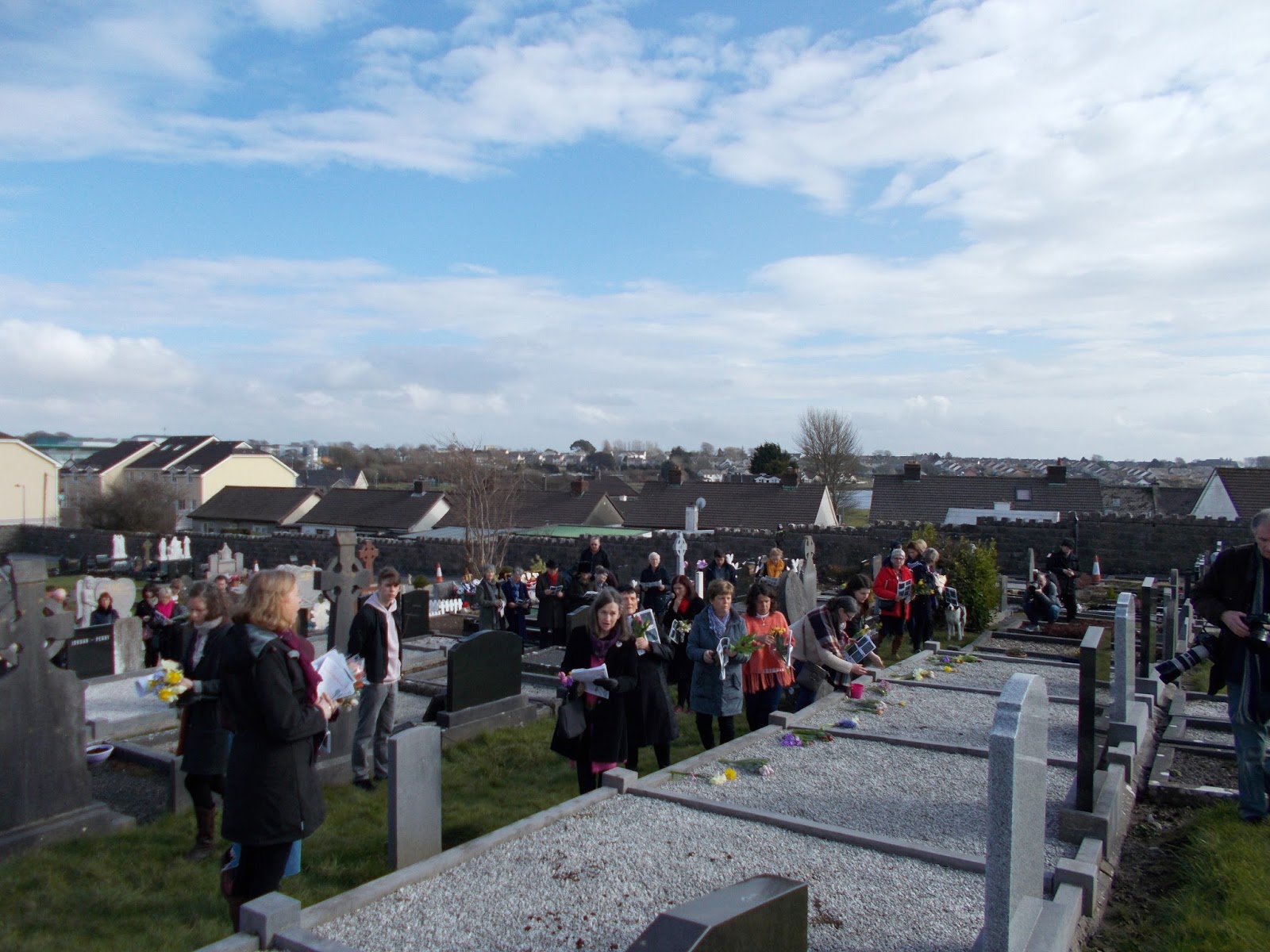
(Even though they didn’t – as you can remember how few journalists there were among the small number of people who congregated in that lonely graveyard 12 months ago).

One of the most striking aspects of the scandal of the 796 ‘Tuam Babies’ is the widespread belief among survivors and family members that “official Ireland” has no interest in granting them the truth and justice they crave.

And the story of Tuam is replicated for the survivors and children of those who were incarcerated in dozens of other institutions all across the island of Ireland.

In Tuam, business people express regret that the scandal unearthed by local  historian Catherine Corless has damaged the image or reputation of the town. They have made it known to her, via third parties, that they wish she would have left well enough alone.

It’s not good for business, you see, to be the subject of scandalous headlines from San Francisco to Sydney when the economy is in “recovery” and there’s money to be made.

People whisper to Catherine on the street when they talk about "the home", and she can sense shame, fear, or guilt in their voices when they approach her to applaud her for the research which has made headlines across the globe.

Only for her determination, the story might never have been known.


Catherine Corless: her research was "not good for business" in Tuam


When it comes to the victims, though, the perception in some quarters is that these people are getting old now and it’s time to move on.

Forget about the fact that the mortality rate in the Tuam Home – where up to 796 babies may or may not be buried in a cesspit – was five times that of the general Irish population or that 126 of the 796 babies died within the first six months of life.

Forget about the fact that 35,000 women and girls were locked up in Mother and Baby Homes between 1904 and 1996 – hardly ancient history – and that those who are still living have never received a proper apology for how they were imprisoned for their “crimes”.

Or that some of them were asked to produce time sheets for the hours they worked in laundries where they were imprisoned and forced to work as slaves, with the collusion of the state, by cruel and judgemental nuns.

Forget about the fact that some older people still know what went on in these institutions, but are too afraid or too ashamed to come forward.

Or that a local councillor in Tuam, Cllr Donagh Killilea, has berated the current Minister for Children, Katherine Zappone TD, for daring to suggest that people with some memory of what happened should come forward with information, even at this late stage.

He's offended by the idea that anyone in the town might still know why these bodies were discarded or disposed of in such a heartless fashion.

Forget about the fact that the Bon Secours nuns, in their infinite wisdom, hired a prominent PR person and paid her handsomely when the scandal of the “Tuam Babies” first broke in the Irish media.

“If you come here, you’ll find no mass grave, no evidence that children were ever so buried, and a local police force casting their eyes to heaven,” wrote Terry Prone, still the Goddess in Chief of “communications” for “official Ireland”.

And still she coaches or grooms our richest and most powerful politicians in terms of how to deal with our media.

And still she hasn't apologised to the families for the hurt she has caused.

A sign erected in North Galway this week


Forget about the fact that the Bon Secours nuns run private hospitals for a handsome profit and have never dealt directly with the families of their victims.

Forget that the pain of the survivors was compounded by a Fianna Fail TD, Anne Rabbitte, when she stated that the estimated €13 million cost of excavating the site of the “Tuam Babies” home could not be justified when it could be spent on the children of today.

“It’s a wilful waste of public money that could be spent on the children of today,” Deputy Rabbitte told The Sunday Business Post last weekend.

The FF spokesperson on children, who is running for the European Parliament this month, seemed to have little concept of the anger these remarks would ignite among survivors and family members who are finding it so hard to obtain the truth from “official Ireland”.

For them, the story of the "Tuam Babies" is very much alive.

Bad enough to discover only in your 70s that you had a brother or sister you never heard about, only to find it next to impossible to find out what happened to them.

Forget about the fact that Ms Rabbitte's party, Fianna Fail, was in power for most of the lifespan of the Mother and Baby Homes and Magdalene Laundries, when a harsh and judgmental Irish State asked religious orders to imprison and enslave thousands of Ireland’s most vulnerable women.

Let's just forget that these poor women were locked up with the full knowledge of both the Irish State and their own families.

Or that the fathers of these children could get on with their lives while the mothers spent decades washing the dirty laundry of the elite of Irish society.


Wtih Peter Mulryan at his mother's grave in Galway 


Peter Mulryan, Chairman of the Tuam Home Survviors Network, contrasts the reverence of the Bon Secours nuns for their own members, removing their bodies from the Grove private hospital before being re-interred with dignity, with how callously the bodies of up to 796 babies and children were discarded at the home.

They sold the building for €4.1 million in 2001 but, as so many survivors have discovered, religious institutions in Ireland have no interest in compensating victims and their families for the terrible times they put them through.

Mr Mulryan claims the “full horror” of what happened in Tuam has yet to be exposed.

Forget about the fact that survivors and family members, including Peter and Dublin woman Anna Corrigan, have no idea what happened to their siblings.

They still believe, rightly or wrongly, that their brothers and sisters could have been adopted (illegally) by families in the United States and cannot be persuaded otherwise until they have some proof of what happened to these children and babies.

Criminal acts were carried out to their family members and now they feel that there can be no closure to this terrible story until the full truth of what happened to the “Tuam Babies” is revealed to the world.

If the families believe that this can only be achieved through a full Inquest, isn’t it time “official Ireland” gives them the truth and the justice they have been calling out for?

Otherwise, we are compounding a terrible injustice and we are still betraying the dead children of Tuam (and their mothers and surviving family members) in the much more “enlightened” Ireland of 2019.


--  * Ciaran Tierney won the Irish Current Affairs and Politics Blog of the Year award at the Tramline, Dublin, in October 2018. Find him on Facebook  or Twitter here. Visit his website here - CiaranTierney.com. A former newspaper journalist, he is seeking new opportunities in a digital world. 

If you would like to get an emailed notification when I upload a new blog, please enter your email address in the 'Follow by Email" box above. Please remember to check your junk mail for notifications. It is usually updated every two weeks or so. 


Tuesday, August 28, 2018

They stood together in an Irish town

The Tuam Home survivors stand together in solidarity on Sunday


They stood together, side-by-side, in solidarity in the heart of an Irish town.

Their hearts beating loudly, but their heads held high.

These were once the marginalised, the forgotten ones, the ones who were never supposed to speak out, express their pain, or make much of their lives.

As children, they were called the ‘Home Babies’.

Or . . . the children of the ‘fallen women’.

Or . . . the illegitimate ones.

Or . . . appallingly, the bastards.

Bastards –  the disgusting word of choice of a judgmental society, which allowed the imprisonment of innocent women and children to go on for decades.

There were thousands of children like them all around Ireland, malnourished, tearful, forced to march to school in hobnailed boots; forced to arrive later than the luckier ones who were considered “legitimate” in the eyes of a Church and a State which never cared much for their welfare.

There but for the grace of a God who didn’t show much concern for them in the first few years of their lives.

They could have been adopted to America, illegally, to "good" Catholic families who were able and willing to pay the right price.

They could have been farmed out to “respectable” Irish families, some of whom were quick to remind them of their true place in this earth and their lowly station in life.

Abuse did not always end in the confines of those homes.

Or, God forbid, they might have lived just a matter of days or months, and found themselves dumped in a mass grave in a septic tank.

These were people who were never meant to make it onto our TV screens or into our newspapers, but thanks to the tireless research of a brave historian called Catherine Corless we are now getting to know their stories and their names.

They stood together in the heart of Tuam on Sunday afternoon and tears were shed as they began their silent, dignified walk through town.


Locals placed baby shoes along the route of the vigil


People like Peter, who expressed his anguish to a small group of us in a Galway graveyard last year.

At 70 years of age, he found out about the little sister he never knew he had. He’s 74 now and only a disgusting, morally bankrupt Church or State would dare to deny him access to justice and the truth about what happened to his younger sibling.

People like Annette, whose older sister, Mary Margaret O’Connor, died as a child in the home in 1943. Annette, who lives in Manchester, England, described it as an “obscenity” that the site was not being excavated in order to provide closure and the truth to the families.

“I don’t know a country that would put 796 babies in a disused sewage tank. Those babies aren’t hidden, they are in that septic tank and they need to be given back to their families,” she said.

People like Anna, who only discovered she had two older brothers after he mother’s death in Dublin.

“The Tuam grave is a jigsaw and it needs to be put together,” she said.

How can any of us imagine the emotions Anna went through when it began to dawn on her that her brothers could have been buried in a septic tank on the site of the Tuam Mother and Baby Home?

How can any of us imagine how they and other family members feel when they see that part of the site is now a children’s playground in a Council estate in the North Galway town?

As though the authorities really went out of their way to cover up and forget the horror of what happened at that site.

How can any of us imagine what they go through every day when the Irish authorities fail to comply with their absolute conviction that there should be a complete and thorough exhumation of the site?

Can we even begin to imagine what it’s like to believe you have a close member dumped among 796 children in a mass grave in a septic tank?

If all of those family members are even there at all, because many Irish campaigners now believe that dozens of the “home babies” were adopted by families in the United States.


Calling out the names of the 796 'Tuam Babies' in Tuam


While Pope Francis was appearing before thousands of Irish people at a Mass in the Phoenix Park on Sunday, these amazing survivors came together in the heart of Tuam.

The hundreds who turned out to support them were moved into a sustained and dignified round of applause after their silent vigil through the town.

They read out the names of all 796 'Tuam Babies', one-by-one.

Local people hung children’s toys along the route to show their support to the survivors and to remind participants of the terrible, brutal injustice which occurred at the site.

While the visit of Pope Francis was expected to cost €32 million, these families are waiting on tenterhooks to see if the Irish authorities will come up with the funding required for the full exhumation of the site.


Baby shoes at the site of the mass grave in Tuam 


Local people tied baby shoes, toys, and teddy bears to railings all along the route to express solidarity to the families, the survivors, and the 796 children whose names were read out at a simple, but poignant, ceremony.

Now that Pope Francis’ visit to Ireland has concluded, the Tuam Home Survivors Network have called on the Irish Minister for Children, Katherine Zappone, to convene an Inquest and complete a full exhumation of the site.

They want her to show them what correspondence, if any, she has had with the Bon Secours order who ran the infamous home from 1925 to 1961.

The Bon Secours order has refused to engage with the survivors and the families and even hired a PR person to try to 'spin' their role in this terrible affair.

Minister Zappone wrote a letter to Pope Francis on Monday, calling on the Vatican to contribute €2.5 million as part reparation for its role in the scandal of the Tuam Mother and Baby Home.

The families read her letter with interest, but released a statement claiming that the letter “smacks of a stunt, a desperate attempt by a Minister completely out of her depth”.

Their anger has not disappeared.

Izzy and Sadie declare the site a crime scene on Sunday


Two activists who have campaigned for justice for the ‘Tuam Babies’, Izzy Kamikaze and Sadie Cramer, cordoned off the site with tape on Sunday and declared it a crime scene. They said they were sickened that the Irish authorities had not carried out a full investigation at the site.

Catherine Corless, Izzy, Sadie, the families, and the survivors all came together in the heart of the North Galway town this weekend and they won’t be silenced any more.

Perhaps that, more than anything, will be the legacy of Pope Francis’ 2018 visit to Ireland. The whole world has been alerted to and shocked by the crimes committed against Irish women and children and their subsequent cover-up.

The loved-ones of the 796 have found their voices and they are determined to find out the truth now, no matter what barriers they face from the Church or State authorities, or the concerns expressed about the cost involved.

Because, thanks to the overwhelming support and solidarity of ordinary Irish people, all of their shame has gone.

Their search for justice goes on.


Ciaran Tierney is a journalist, blogger, and digital storyteller, based in Galway, Ireland. Find him on Facebook at http://facebook.com/ciarantierneymedia/

To hire a blogger or to advertise on this blog, please get in touch at http://ciarantierney.com/

Find Ciaran Tierney on Twitter https://twitter.com/ciarantierney

Tuesday, August 14, 2018

Pope Francis and the long lost innocence of the Irish

Protests are planned for the visit of Pope Francis to Ireland this month


In far more innocent times, as children, we got up at the crack of dawn. I remember the excitement in the family home, as we arose and prepared for the biggest and most symbolic walk of our young lives. I still recall the folded deck chairs, the home-made sandwiches and flasks of tea, the yellow and white flags.

At the house, the looks of envy on the faces of the younger siblings and the two grandmothers, who were not old enough or able to join the mass exodus on foot to the racecourse on the other side of the city.

We met up with the cousins, seeing the sense of adventure in their eyes, and the adults around us gave us a sense of what a huge moment this was in our shared history.

There were thousands upon thousands at the racecourse, corralled into zones at the biggest event I had ever seen. This was bigger, even, than an All-Ireland final and a ripple of excitement went through the crowd as the helicopter landed near the grandstand.

And, then, the immortal words . . .

“Young people of Ireland, I love you!”

This was Ballybrit, Galway, in 1979. It felt like a moment of triumph for Catholic Ireland and I could see its significance in the eyes of my parents as they told me how wonderful it was that Pope John Paul II had come to our town.

Our generation of children even became known as the “Pope’s children” after that day in Ballybrit but, looking back almost four decades on, it now looks like the end of an era rather than the start of something wonderful and new.

It actually seems unbelievable now that 79% of the Irish people went along to welcome Pope John Paul II to our land 39 years ago.

Up on the altar in Galway, Pope John Paul II was flanked by two Irish clerics, Bishop Eamonn Casey and Fr Michael Cleary, both of whom it would later transpire had fathered children in the years prior to that memorable day in Galway.

As many people have pointed out since, their indiscretions paled into significance in the context of so much criminal abuse which has been uncovered in recent years.

So much has changed.

It dawns on me now that my family and I walked past the Magdalene Laundry in Galway in order to make our way to Ballybrit to hear the pontiff express his love for us. Only nobody ever talked about the young women who were incarcerated inside, washing the bed linen for the “great and the good” of our city.

As children, we never heard anything about the 10,000 women and girls who were locked up in Magdalene Laundries across Ireland from 1922 to 1996. Yes, it’s still shocking to think that these prisons for “fallen women” remained in place until well into the 1990s.

It dawns on me now, too, that so many of my generation were being abused at the time of the last papal visit, because nobody questioned those in authority and certainly not members of the Catholic Church who had so much control over our daily lives.

In any Irish family, it was considered an honour to be an altar-boy. In 1979, if a young woman became pregnant outside marriage a priest could still arrive at the front door of the family home to whisk her away to a life of imprisonment. Such was the shame.

We did not question those in authority and we had never even heard of child abuse or peadophilia in 1979.


A beautiful tribute to the 'Tuam Babies' in Galway.
What a pity the Bon  Secours have never faced up to this terrible wrong


It dawns on me now that it would take another 35 years before we heard about the 796 ‘Tuam Babies’, dumped in unmarked graves less than an hour up the road from where the Pontiff expressed his love for all the young people of Ireland in Galway.

We were never told about the women and children who were imprisoned in that now notorious Tuam home until 1961. I guess the lives of those children didn’t matter because they were ‘guilty’ of being born outside marriage in a far more judgmental Ireland.

As Ireland prepares to welcome Pope Francis next week, it dawns on me now that the Church he leads has done so much harm to my people, destroyed so many lives, and that so little has been done to make amends.

Doubtless, there were children in Ballybrit that afternoon who are no longer with us, because the pain and trauma of what they endured at the hands of the Irish clergy was far too much to endure. For many, death and self-destruction was the only answer to the pain.

So many Irish families were torn apart by clerical abuse, their pain magnified by the response of church authorities who moved abusers around from one parish or part of the country to another rather than helping to find justice for the victims.

So many people were labelled as “illegitimate” or less than human, so many young mothers had children taken from them against their will, perhaps for adoption by “good Catholic families” in the United States, because unmarried mothers were too stigmatised to be allowed bring them up here in Ireland.

So many of us now see the Catholic Church as an international organisation which ignored, facilitated, and covered up the abuse of Irish children that it’s hard to imagine how enthusiastically we welcomed a former Pontiff back in 1979.

Were we really so innocent? So naive? Did people really have no idea that such terrible crimes were taking place at the time?

We now know that a comprehensive report found that the church authorities responded to clerical abuse with “denial, arrogance, and cover-up” nine years ago.

In the interim, what has changed? Why won't Pope Francis meet the victims and acknowledge how much pain his church has caused to generations of Irish people?


Catherine Corless: she uncovered the truth about the 'Tuam Babies'
despite the best efforts of the Catholic Church


We now know that the Bon Secours order stonewalled or ignored the victims and families of the “Tuam Babies” when they sought the truth or some semblance of justice for their 796 loved-ones.

They are still refusing to engage with the families in 2018, a year after the research of historian Catherine Corless has been completely vindicated by the Irish Government.

We know that up to 140 Irish children were abused by just one priest in Northern Ireland, Fr Brendan Smyth, who was free to travel throughout the land (and continue to abuse) even though the most senior cleric in Ireland was aware of allegations against him.

Had action been taken, how many shattered lives might have been saved?


Preparing for the Pope's visit in Dublin

We have found out about so many shocking cases of abuse, cover-up, and denial involving Irish women, children, and men at the hands of members of the Roman Catholic Church that it seems we cannot be shocked any more.

It’s because of the clear litany of scandals they have endured that Irish people have changed immeasurably since 1979. In the intervening years we have legalised homosexuality, divorce, marriage equality, and abortion, despite strong opposition from a church which seemed to dominate all aspects of our lives back then.

Now people want the Catholic Church to be removed from our schools and hospitals and they want full and meaningful apologies for all the hurt caused and lives destroyed.

When Pope Francis speaks to thousands of people in the Phoenix Park in Dublin on Sunday, August 26, hundreds of others will assemble at silent vigils in places such as Tuam and Dublin.

All they want is acknowledgement of the truth and the terrible damage caused to so many innocent Irish people by the Roman Catholic Church.

As a child, I took part in the longest walk of my young life to see Pope John Paul II in 1979. Like so many others, I was innocent, joyful, and enthusiastic that the head of our global church proclaimed his love for me and all the young children of Ireland.

Almost four decades on, all that innocence has died. I would far prefer to attend one of the protests, to stand side-by-side with the amazing victims, than celebrate the visit of the figurehead of an international organisation which has always seemed far more interested in protecting its own power than the welfare of Irish children.

The innocent victims have found their voices and Pope Francis is missing out on a powerful opportunity to atone for a terrible past if he refuses to meet them, hear their stories, and apologise.

Those of us who are of a certain age may have walked in our thousands to Dublin, Galway, Knock and Drogheda in 1979, but Ireland is a very different place right now and people are no longer willing to accept the blatant abuse of power.

Decades of abuse and cover-ups won’t be wiped out by protests, but it is so important that Pope Francis and the entire Catholic Church is reminded of the damage done.

Those who have been abused will stand together in solidarity at the Garden of Remembrance in Dublin on Sunday, August 26, and at the site of the Tuam Mother and Baby Home.

That to me will be a far more powerful ceremony than trying to regain the long lost innocence of 1979 and a ‘Catholic’ Ireland which has long since vanished.


Would you like to advertise HERE? This blog has been read over 374,000 times since I set it up and YOU could be part of it for a small fee. Contact Ciaran at ciaran@ciarantierney.com for details. 


Ciaran Tierney is a journalist, blogger, and digital storyteller, based in Galway, Ireland. Find him on Facebook at http://facebook.com/ciarantierneymedia

To hire a journalist or a blogger for your business, please check out http://ciarantierney.com/


Find Ciaran Tierney Digital Storyteller on Twitter, https://twitter.com/ciarantierney


Remember the 796 'Tuam Babies' and how difficult it is
for their families to find justice in 2018. 


Wednesday, March 28, 2018

Is it time for Pope Francis to apologise to the Irish people?

Remembering the Magdalene Laundry women with flowers

At an estimated cost of €20 million to the Irish people, the visit of Pope Francis to Ireland in August promises to be a very different affair from the emotional 1979 tour in which Pope John Paul II seemed to capture the hearts and minds of a generation.

Given how poorly the Vatican has dealt with a litany of scandals involving the Roman Catholic Church in Ireland, many people are now beginning to ask whether the current pontiff has a duty to offer a full apology to the Irish people.

Who should he meet and what should he say during his August visit to the island?

The Catholic Archbishop of Dublin, Diarmuid Martin, has told the Irish media that he would like to visit a prison during his August trip.

“He’d like to go to a prison,” Archbishop Martin said last December. “Everywhere he goes, he goes to a prison.”

The Papal visit looks set to be a pivotal moment for the Catholic Church, recovering lost trust after years of scandals involving clerical sex abuse, the enslavement of women in Magdalene Laundries and Mother and Baby Homes, and the imprisonment of children in industrial schools, in conjunction with the Irish State.

It is going to be a very different affair from the joyous 1979 tour of the country by Pope John Paul II when, as youngsters, we walked for miles in our thousands for huge communal celebrations in places like Galway Racecourse, Knock Shrine, and the Phoenix Park.

Those massive communal gatherings almost four decades ago took place in a different, far more innocent Ireland, in which the voices of victims had yet to emerge and so many appalling secrets were hidden away from public view.

A million people attended the Papal Mass at the Phoenix Park in Dublin and 250,000 of us got up at dawn to hear John Paul II profess his love for the youth of Ireland in Galway.

If Pope Francis is looking for a prison, we had more than one type here in Ireland.

Peter Mulryan at the grave his late mother shares
with other women from the Magdalene Laundry


Many of us who walked across Galway City for the huge gathering at Ballybrit would have passed by the Magdalene Laundry in the city centre, oblivious to the fact that young, middle aged, and older women were incarcerated inside.

Some of them spent three or four decades as slaves in this effective prison, just metres from Eyre Square and the pubs and shops in the heart of the city.

When Pope John Paul said “I love you” to the young people of Ireland the Magdalene Laundries were still in business, their vans driving around the cities and towns, picking up the dirty linen of the great and the good all over Ireland.

The Galway laundry only ceased operating as a business in 1984 and, as thousands walked to Ballybrit, the innocent Catholic children of the city had no idea of the hardships, the despair, and the loneliness hidden away behind those city centre walls.

It would be nice to think that Pope Francis, during his time in Ireland, would meet some of the women who were locked up behind those walls and those of many other laundries for so-called ‘fallen women’ across the land.

Such as Angela Fahy, a frail woman who walks with the aid of a stick now, who reminded us of the terrible cruelty of the place during an emotional memorial ceremony to remember the women who died inside the Galway laundry last month.

She reminded us of the terrible shame placed on Irish women for the ‘crime’ of having babies outside marriage, right up to the 1980s, or the way in which families and the State colluded with the Church to lock these innocent women away for decades.

Angela made it clear that it was not just the Church which was to blame.

She remembered one girl who managed to persuade a workman to sneak a letter out to her sister in Salthill, only for her sister to report her to the nuns and to tell the distraught slave that she never wanted to see her again.

The August visit to Ireland is a key moment for Pope Francis


The whole of Irish society was to blame, but the Catholic Church played a pivotal role in nation’s shame.

Angela and the thousands of other survivors like her have never really received a proper apology from the Vatican for the hardships they endured or compensation for all the years they slaved away washing clothes without any payment from the nuns.

If he comes to Galway, I would love to see Pope Francis meet Peter Mulryan (now 74), an amazing man whose mother spent more than 30 years in that same Magdalene Laundry.

It would be incredible if Peter could tell the Pope about the lack of hope in his mother’s eyes, the complete lack of spirit, when he finally tracked her down to the institution in the centre of my city. Life in the Magdalene Laundry had broken her and there was no joy in her life.

I would love for Peter to tell Pope Francis about his four year search for the little sister he never knew he had until 2014, as he told me while he stood beside her grave in Bohermore Cemetery.

Perhaps he could bring him to his mother’s grave, to see where she is buried in a communal plot with other “fallen women” whose crime was to give birth to beautiful people like him in a harsh and judgemental land.
Ciaran Tierney with Peter Mulryan at Bohermore Cemetery


Or he could bring Pope Francis 25 miles up the road, to Tuam, to a place which is now infamous all across the globe.

For Peter, the sewage pit and unmarked grave where up to 796 children may or may not be buried has a significance which will not go away.

Peter is a surviving “Tuam Baby”. He lived there before he was sent out to a family in which he endured many years of beatings and, now, after all these years, he wants the truth.

But he has never received an apology or any kind of explanation from the Bon Secours nuns as to why he was imprisoned in the Tuam Mother and Baby Home as a youngster and treated as a pariah in the local school.

Or why they destroyed the records from the site which might have helped him find out what happened to his little sister, whether she was in fact one of the “Tuam Babies” or whether she was sold off for adoption to a family in the United States or Canada.

Her life was so insignificant in the eyes of ‘Catholic Ireland’, it seemed, that nobody bothered to record her death. Perhaps Pope Francis could hear Peter talk, as he does so eloquently these days, about the pain of being stigmatised from birth.
Catherine Corless at the unmarked graves in Tuam

Peter and people like him are still experiencing a monstrous injustice in terms of their inability to find out what happened at Mother and Baby Homes all across the country or to receive a full and proper apology for the pain they endured.

It’s pretty hard to have a good shot at life when you are told you are “illegitimate” or a “bastard” from a very young age. Peter, like many other survivors, could teach Pope Francis so much about the resilience of the human spirit and how people who endured so much can still build amazing, if ordinary, lives.

Perhaps, after Tuam, Pope Francis could pop a few miles out the Dunmore road, to meet a quiet, unassuming woman whose tireless research has turned her into a national hero.

Catherine Corless is not looking for fame or fortune, but she might be able tell Pope Francis about the hostility and derision she came up against when she tried to find out what really happened at those unmarked, mass graves in Tuam.

She might outline how a professional PR person, hired by the Bon Secours order, ridiculed her research before Catherine was vindicated in full by the Irish Government last year.

Given that Pope Francis is attending the World Meeting of Families, in Dublin, there are quite a few people in Dublin he might care to meet as well.

For a man who has done so much for the poor and the marginalised, it might be of interest to Pope Francis to note the number of troubled people living on the streets who are trying to put memories of childhood abuse by the clergy behind them.

Before he boards the plane from Rome, he might take a look at the nine year old Murphy Report which found that four Dublin archbishops Dublin had responded to clerical child abuse with “denial, arrogance, and cover-up” in the words of the report.

He might talk to the families of people who grew up between the 1960s and 1980s, when serial abusers were moved around from one Dublin parish to another with no seeming regard for the welfare of future victims. Out of sight, out of mind.

The families want justice for the 796 "Tuam Babies"


He might visit the victims who never rebuilt their lives, those who live on the streets now or try to numb the brutal pain through alcohol or drug addiction. It won’t be hard to find them in our Irish prisons.

He might explain to them the concept of “mental reservation” which allowed senior members of the clergy to mislead Dublin families and the authorities without being seen as liars in the eyes of the Catholic Church.

In 1979, there was huge disappointment among the Catholics of Northern Ireland when Pope John Paul was unable to cross the border. Due to the Troubles, which were ripping Ireland apart at the time, he only made it as far as Drogheda.

North of the border, he might talk to the victims of the late Fr Brendan Smyth, a child abuser who was free to travel the land and find new victims even though the most senior cleric in Ireland, Cardinal Cathal Daly, was aware of the appalling allegations against him.

How those who were abused as small children would love to hear a full and frank apology for the inaction and cover-up which allowed Fr Smyth’s abuse to continue. Senior members of the clergy, by failing to notify colleagues, effectively facilitated this brutality against an estimated 140 Irish children.

From Dublin to Galway, and Belfast to Cork, there are people all over Ireland who are still suffering because of the terrible things they endured as children.

The damage done in the past cannot be undone.

But meeting them, hearing them, and providing a full and frank apology for all the pain caused to the Irish people could turn the August 2018 Papal Visit into a pivotal moment for a Church which still has so much to do to regain the trust of a wounded people.

By putting the victims first, the visit of Pope Francis to Ireland could yet transpire to be a far more significant event than the 1979 papal visit which now looks like a dying kick of a more authoitarian, more austere, more judgemental, less honest, and less joyous Ireland.

Ciaran Tierney is a journalist, blogger, and digital storyteller, based in Galway, Ireland. Find him on Facebook at http://facebook.com/ciarantierneymedia

To hire a content writer, journalist, or social media expert, check out Ciaran's website, http://ciarantierney.com/


Monday, March 12, 2018

For Peter and the families, it's personal ...

Peter Mulyran stands at his mother's shared grave in
Galway during the 'Flowers for the Magdalenes' ceremony


Imagine you are 70 years old. Throughout your life you have dealt with the stigma of being branded as ‘illegitimate’ and your long quest to find your birth mother had ended in a Magdalene Laundry, where she had lived for over 30 years.

You used to visit her every fortnight, after managing to track her down, although the nuns warned you to pretend that she was your aunt. They told you they would prevent you from visiting if you told the other inmates the truth about your relationship with your own mother and it used to pain you to see the defeat, the lack of sparkle, in her eyes.

Together with the other inmates, she washed and cleaned the clothes of the great and the good around the city and county. For years, she never ventured outside the laundry walls even though she was just minutes from the heart of the city.

But you kept the relationship going, and enthused about how her spirit lifted just a little after you married and she met her first grandchild. You saw flickers of her spirit on occasional weekend visits to the seaside, when the nuns finally started to allow her out of the laundry for a few hours.

She was buried  in 1989, in a grave she shared with other women from the laundry.  You hoped that she was resting in peace after a tough life and you got on with your life.

And then, four years ago, your life was turned upside down once again. Historian Catherine Corless, who has since become a good friend, was on the other end of the phone. She told you the startling news that you had a little sister nobody had ever told you about.

She was one of the 796 ‘Tuam Babies’, who were making headlines all across the globe.

Catherine’s painstaking research had placed one of the little babies in the tiny townland in your mother’s rural community. When you asked around, you discovered it was true. Your mother had given birth to a second child before being locked up again for years.

Ciaran Tierney with Peter Mulryan at Bohermore Graveyard

For all you knew, that little girl was buried in that infamous septic tank in Tuam. But, that’s the thing. You didn’t know. For all you know now, too, she was adopted by a loving family in the US or the UK, because nobody has any records of your little sis and what became of her after being born in that now notorious Mother and Baby Home. 

That’s what happened to Peter Mulryan, a remarkable man whose quest for justice for his little sister goes on. 

Now aged 74, he has been stonewalled by the authorities. He’s concerned that they will mark the site with a memorial, before he ever finds out what happened to her and whether or not she ended up in that terrible place in Tuam. 

On Sunday, he spoke movingly about giving a voice to the voiceless and the need to heal the hurt caused to generations of Irish women and their ‘illegitimate’ children. 

A year ago, he brought a graveyard to tears when he spoke about his quest for justice, to find out the truth about the sister he never knew he had.

He returned to that graveyard on Mother’s Day, to pay tribute to his mother and all the other mothers who had been locked up in Magdalene Laundries across Ireland. 

It is believed there were 10,000 of these women locked up in institutions throughout Ireland right up until the 1980s. Many, but not all, were single mothers who were taken away from their families to hide their ‘shame’. 

And now Peter Mulryan, like the other survivors, is wondering what is going to become of their loved-ones. They believe the Tuam site should be examined and the bodies of the infants exhumed.

Remembering the Magdalene Laundry women at a dignified
ceremony at their shared graves on Mother's Day 

They want DNA testing to be carried out on the little ones, but they are concerned now that the Irish authorities will cover up the site and just put in a memorial plaque on the unofficial burial ground. 

Galway County Council is currently seeking submissions from members of the public regarding what to do with the site. The deadline for submissions is this Thursday, March 16.

Family members like Peter are concerned that the local authority may decide to put a memorial in place at the site of the former septic tank rather than the more costly option of a thorough examination. 

The council has listed five options for the site.                             
Campaigners want justice for the 796 'Tuam Babies'

 “I’m still looking for my sister. I want her file, to see what happened to her. The council are only adding more pain and hardship to the families. I would like to ask the officials how they would feel if they had a family member in the septic tank there. That’s what I ask them when I meet them and they just go cold,” he said, following a memorial service for the women of the Magdalene Laundry in Galway on Sunday afternoon.

“Those children could not be baptised. That ground was never consecrated. The authorities won’t tell us that they are sorry or admit that they were wrong. We never did anything wrong, but they are keeping us down by denying us justice for our loved-ones. If somebody was murdered a hundred years ago they would just go in and analyse what’s there.”

Mr Mulryan said he could not accept the argument that a full forensic examination of the Tuam site would cost too much at this stage. Speaking beside his own mother's shared grave, he pointed out that many of the mothers worked for free after being incarcerated in the Magdalene Laundries for decades. 

“When you think of the money which was made out of these women, slaving for free in these laundries, it’s unbelievable the way they are still treating us,” he said.

Breeda Murphy of the Tuam Home Survivors’ Network said the Government should have declared the site a crime scene after Catherine Corless’ research was vindicated this time last year. 

Ms Corless also faced hostility or indifference from the authorities when she researched what happened to the babies who died at the Tuam home. 

The Magdalene Laundry women were not
given the dignity of being buried with
their own families. Peter's mother was locked
up in Galway city centre for more than 30 years. 

“The people who have family members at the Tuam site want to bring them home and give them a proper burial. There’s nothing dignified in concealing children in a structure which was first built to contain sewage or human waste. You can never get away from that, regardless of the time period or saying that that was how things were done back then,” said Ms Murphy on Sunday. 

“The way in which the Magdalene Laundry women are being treated is probably a reflection of how the Mother and Baby home survivors will be treated down the road. So I don’t see justice coming at all. I am totally disillusioned.”

A survivor of the Magdalene Laundry in Galway, Angela Fahy, said families also had to take responsibility for their role in the incarceration of women in the Magdalene Laundries. 

She said there were 110 women in the Galway home when she was locked up there at just 14 years of age.

“These women were put there in secret, died there in secret, and buried there in secret,” she said. “Their neighbours in Forster Street did not even know them. These women washed and cleaned the clothes of this entire province. Many of them never came out of there alive.

“We cannot just put this down to religion. Quite a lot of it comes down to their own families, people who denied their own flesh and blood if they had a child outside of marriage. These women had no voice for so many years, but they have now thanks to events like this.”

A year has passed since confirmation that the bodies of babies who died at the home between 1925 and 1961 were found at the site of the former Tuam Mother and Baby Home, which was run by the Bon Secours order of nuns.

Campaigners, who want the babies to be given proper burials in consecrated ground, have been inundated with messages of support from across North America over the past year. 

They are insisting that cost should not be the main concern as they seek justice for the 796 ‘Tuam Babies’. 

Historian Catherine Corless, whose painstaking research
revealed the scandal of the 796 'Tuam Babies' to the world


Galway County Council is facilitating a full public consultation process about what to do with the site where the 'Tuam Babies' were found, with submissions accepted until this Friday, March 16. Members of the public can email TuamConsultation@galwaycoco.ie or telephone +353 (0)91 509561 if they have any queries regarding the full public consultation process.


Ciaran Tierney is a journalist, blogger, and digital storyteller, based in Galway, Ireland. Find him on Facebook here


Thursday, November 2, 2017

Why do the Irish denigrate the truth-seekers?

In Ireland, we tend to denigrate and ridicule those who seek out the truth or shine light on our darkness.                                             
Banking whistleblower Jonathan Sugarman


It’s as though the mirror they hold up to Irish society is too ugly to witness, too painful to face up to, so that it’s easier to assassinate their characters than to acknowledge their search for justice.

Take Jonathan Sugarman.

There are restaurants in Dublin who refuse to accept a reservation upon hearing his name. There are pubs where he’d be shunned, seen as a pariah, if he joined the great and the good as they let their hair down on a Friday night.

Because, for the vast majority of Irish bankers, the party has never stopped.

Why would they disown him? His only ‘crime’ has been to do his job properly and to tell us the truth.

When I spoke to him this week, ten years had passed since he did the right thing, at enormous cost to his finances, his career, and his mental health.

An Israeli citizen living and working in Ireland, he thought he was doing his adopted country a huge favour when he approached the Central Bank of Ireland to tell them an unpalatable truth.

A risk manager at the Dublin branch of a major Italian bank, Sugarman was alarmed to note serious liquidity breaches which could have cost the company severe penalties and Sugarman himself five years in prison.

The bank did not have enough money after giving out so many loans at the height of the ‘Celtic Tiger’.

He stepped forward, he went to the Irish police (the Gardai), he told the truth … and nothing happened. There were no dawn raids on his company’s offices, no consequences at all for his bank for failing to play by the rules. He felt he had no option but to resign.

He had warned the Irish banking watchdog that his bank was living beyond its means, little realising at the time that liquidity breaches were widespread across the industry in 2007. Not one bank in Ireland seemed to have the billions of euros required if their customers were to call in their debts.

A year later, the entire Irish banking system collapsed and the Government provided a blanket guarantee which plunged the economy into crisis and resulted in a €64 billion ‘bailout’ at enormous cost to the Irish tax-payer.

It seemed that virtually every bank in the country was in breach of the liquidity regulations, but not one other risk manager had spoken out.

All of them could have been imprisoned for five years, but not one banker in Ireland has been jailed. In Iceland, the corresponding figure is 25. Yet Sugarman has found himself on the margins, unable to work, because he dared to come forward and speak the truth.

A decade on, the same banks are guilty of defrauding 22,000 mortgage holders; these are ordinary Irish people, some of whom have lost their jobs, their relationships, and their homes.

The same bankers and regulators still enjoy their Friday evening gatherings in a select few Dublin hotels and pubs, but Sugarman is no longer invited to the party and his truth-telling has been at an enormous personal cost.

Yet, had the regulators listened, and acted, the massive collapse in the Irish banking system could have been avoided and generations of Irish people would not now be saddled with an enormous debt.

Take Catherine Corless.                                              
Brave historian Catherine Corless had to overcome
hostility from officials in her quest for the truth

When she began to investigate the deaths of so many babies at the Tuam Mother and Baby Home, business people in the town became alarmed.

When it emerged that 796 babies were buried in unmarked graves, as Catherine strove to give them a dignity denied them in life, officials blocked her attempts to find out the truth at every possible opportunity.

She never imagined the scale of the tragedy when she started to try to find out what happened to the ‘Tuam Babies’. 

But she persisted after hearing the story of how boys in the town stumbled upon the skulls and bones of babies while playing on the site of the former home in 1974.

Catherine worked tirelessly to discover the truth, despite facing hostility or
indifference from the Bon Secours order which ran the home, the Western Health Board, or Galway County Council.

It was a good job she did not socialise much, because as rumours about her research spread there were murmurings that she should leave well enough alone and that her research only served to harm the image of the town.

Her research was bad for Tuam, it seemed, even though it opened the eyes of the entire world to the way children were treated in 20th century Ireland. And she gave a voice to the survivors.

She has been vindicated this year, her findings verified by the Irish authorities, but only after being the subject of harsh and irrational criticism.

She’s deservedly picking up national awards now for her painstaking research but in April of this year, after her findings were lauded by the Irish Government, Catherine faced personalised abuse from the US.

Bill Donohue, president of the Catholic League, described her as a credential-lacking charlatan who was not qualified to carry out her meticulous research in Tuam.

“Contrary to what virtually all news reports have said, Corless is not a historian,” said Donohue. “She not only does not have a Ph.D. in history, she doesn't have an undergraduate degree. She is a typist.”

Amazing how a man who earned a reported salary of $474,876 in 2013 could abuse his position to denigrate a woman who has done all of Ireland a service by shining a light on the deplorable treatment of innocent women and children in 20th century Ireland.

Only for Catherine’s painless research, the world would never have known about the 796 babies who were buried in unmarked graves in Tuam after being branded as “illegitimate” by the Irish authorities.

It seems that Corless’ message was so unpalatable to some senior figures in business, Church, and State, that they were prepared to attack and denigrate the messenger.


And then there’s Sergeant Maurice McCabe, a man who faced a personal hell before being vindicated in 2017.

In Garda Stations all around Ireland, the man was a pariah for the past decade, for daring to point out that the Irish police force’s computer system was being abused so that high profile people could evade convictions.

His revelations seem trivial compared to what we know about the Irish police force now.

In the land of the nod and the wink, of calling in connections, McCabe – like Sugarman – was ostracised for trying to obey the rules.

Colleagues made it impossible for him to turn up for work at Garda Stations and, even worse, rumours began to circulate –at the top levels of the force and among senior media personnel – that McCabe was a sex abuser.

Insiders thrived on the vicious rumours, which circulated without his knowledge, and it was only by accident that the most high-profile Garda whistle-blower in the history of the State found out about them.

Garda whistleblower Maurice McCabe
The false, vicious, and completely spurious accusations that he had raped a six year old child were used to ridicule his claims that there was widespread abuse of power being carried out by members of the Garda Siochana.

How could anyone believe this honest Garda when there were such terrible rumours about him?

The smears, which circulated widely for two and a half years, were only unearthed when a member of staff at the child protection agency contacted Sgt McCabe in error about a “wrong” file. Otherwise, he might never have known about the unfounded allegations.

In recent weeks, the Irish public has been shocked to discover, via the policing authorities that two million drink-driving breath tests were fabricated by Gardai in a country with a population of 4.7 million.

In addition, 14,700 wrongful traffic convictions occurred.

Gardai, it seemed, were under pressure from management to “massage” their statistics so that they looked better on paper.

A few high-profile people having their convictions overturned now seems like small beer compared to the widespread misreporting of drink-drive figures all across the country.

In Ireland, it seems, there has been criminal negligence in banking, policing, and the way we take care of our most vulnerable children.

But, instead of admiring those who shine lights in the darkness, we vilify them because they are bad for business, the image of a town, industry or police service.

Because God forbid we listen to the brave souls who are prepared to stand up and point out the wrong-doing at the heart of Irish society.

It’s more convenient to persecute them, tie rats to their doors, or smear them with unfounded allegations, than admit they have done us a wonderful service by blowing a whistle on corrupt or criminal behaviour from those in positions of authority.

It’s easier to destroy a reputation or career than admit there’s a need to change an entire rotten, corrupt culture.


Ciaran Tierney is a journalist, blogger, and digital storyteller, based in Galway, Ireland. Find him on Facebook at http://facebook.com/ciarantierneymedia

Find Ciaran Tierney on Twitter, https://twitter.com/ciarantierney

Hire a ghost blogger or content writer for YOUR website at http://ciarantierney.com/what-i-offer/ghost-blogging-2/