Showing posts with label mental health. Show all posts

Monday, August 21, 2017

This is Galway on a Friday night

The mood was sombre as we left the ground. Galway United had just lost a crucial game to a last minute goal from Dublin club Shamrock Rovers and the unseasonable drizzle matched the mood of the home fans for the walk back to the city centre.                            
Homelessness is far more visible than in the past

It was the first Friday night in months that Eamonn Deacy Park was in darkness as we left the ground following a home game and the shortening days seemed to bring grim tidings of a long winter to come for the city’s soccer club.

Relegation was beckoning and suddenly, given the biting wind and incessant drizzle, optimism was in short supply.

I normally drive to Galway United games and park my car across the river at NUI Galway. On this night, though, I had brought a group of 22 students from Mexico, Switzerland, Spain, and Brazil to the SSE League game, where they had revelled in the atmosphere and the quality of the football, if not quite the result for the home side.

So I zipped up my jacket and braced myself for the 15 minute walk into the wind and rain, towards the city centre where I had arranged to meet an old friend in a pub.

What I didn’t expect to discover was that a whole new “neighbourhood” had popped up in my city, barely ten minutes away from Eyre Square and the pedestrian heart of the city.

The Dyke Road is really green at this time of year, a bush-lined roadway between the soccer ground and the heart of the city.

To our right, amid the overgrown bushes, a number of discarded sleeping bags caught my eye. I had ignored them earlier, given the logistics of arranging match tickets for 22 foreign language students, but now I was in no particular hurry as I made my way back into town.

I heard some voices coming from behind the bushes. Someone, unseen, called out to me from just metres away.

Galway is famous for its festivals in Summer time
Curious now, I stopped and peered in through a gap in the bushes. A man of about my own age approached me.

I asked him politely what he was doing there and he told me this was his “home”. Leaving the road for a few minutes, I walked in through the bushes and discovered a makeshift village of six or seven of the kind of cheap tents you can buy for €25 or €30 in one of the discount supermarkets.

He told me that there were a dozen people living there and I felt ashamed that I knew nothing about this makeshift “community” which had popped up just ten minutes from the heart of my city.

I asked him if he was alright and told him I didn’t smoke when he asked me politely for a cigarette. There seemed to be a look of resignation in his weather-beaten face and despair in his quiet voice as I surveyed his appalling living conditions for just a few brief moments.

This was Galway in 2017, the kind of place the tourists never see, and it made me wonder how many other people scattered throughout the margins of my city were living in similar conditions just minutes from prying eyes.

How many were sleeping on friends’ couches or in their cars because the hostels were full? How safe did these people feel, sleeping in tents so near to the city’s main thoroughfare?

And so I walked on into the city centre, where my friend had arranged to meet for a post-game drink before driving home to his small town an hour from Galway.

It's "normal" now to see homeless people on the streets
of Irish cities throughout the year.

With him was another man I had met once or twice before. Also about my own age, he began to question me urgently about the rental situation in the city.

On strong medication for the past decade, the man is desperately seeking a change. He wants to move out of the small town where he can’t find any employment opportunities, where he feels trapped, but feels he is stuck in limbo and can’t move on with his life.

He has battled mental health problems for a long time and now feels it’s time to move on. He would love to get a job in the city, to have something akin to a normal life, and I can see despair on his face when I tell him it costs about €350 per month now to rent a room in my city.

How could he afford that? he wondered. How could he get a job when a decent place to live is beyond his means?

He wants to live a fruitful, meaningful life, but he’s in a spiral of unemployment and broken dreams, surrounded by people in the same predicament as him. Although he barely knows me, he confides that he’s trying desperately to get off medication and that it has hampered his ability to regain control of his life.

I feel bad. I feel as though I’m destroying his dream, even with a brief little chat about the rental situation in my city. And I wonder how hard he would struggle to return to the jobs market, given how the medication has “numbed” him out for years now.

I feel desperately sad to see how sad he is about his prospects of getting a job or a flat in Galway. The “half-way house” he lives in is keeping him off the streets, which he is thankful for, but things most of us take for granted (a job, independence, a girlfriend) seem totally beyond his reach.

Surely, in 2017, “numbing” people out of pain because they have had mental health difficulties in the past is just not good enough. Especially if they really want to make changes in their lives.
I feel apologetic as we bid our goodbyes.

I’m not drinking tonight, as I left my car in Salthill an hour before the football game. So I take my leave after almost two hours in the pub and make my way through the city centre.

In Forster Street, there are bodies huddled in doorways, beside some of the city’s busiest and most trendy pubs. Their faces covered under hoods, people have laid their sleeping bags out as they prepare for an uncomfortable night’s sleep.                              

Students enjoying the Galway Untied game on Friday,
just metres from where people are living in makeshift tents

In Eyre Square, two young men in their early 20s shout loudly to each other as they urinate in full view of a group of appalled Swiss or German tourists. They are oblivious to the disapproving eyes.

I cross the road, where three young women are alighting loudly from a taxi. Already drunk, one of them clutches a drink in her right hand. Excited, perhaps, by the prospect of a night out in one of the city’s clubs, they shout loudly at each other. One of them racially abuses the cab driver before heading off into the night.

The driver glances at me for just a brief moment, shrugs, and drives off to pick up his next fare. His reaction seems to make it clear that this is not an isolated incident on a weekend night.

At the corner of Eglington Street, it seems there is a riot going on. Not to worry, it’s just a group of young people socialising loudly outside one of the city’s biggest bars.

I’m no prude. I used to love socialising in the city centre late at night in my 20s and 30s. But trying to walk by a large group of people who are clearly out of their minds with alcohol is no fun if you are completely sober and walking alone on a Friday night.

I turn down Shop Street, a place which tourists tell me they find scary in the early hours. The place is buzzing with activity, as young people make their way towards the city’s late night bars and clubs. It will be heaving again when the clubs empty out around 2.30am.

I have to admit I haven’t been here for a while in the early hours. On the city’s main thoroughfare, in the heart of the pedestrian zone, I’m quite shocked to see quite a few people bedding down in doorways on either side of the street.

A couple from Eastern Europe seem oblivious to the passing eyes as they argue loudly while laying out their sleeping materials for the night. Tomorrow, people will be drinking lattes right next to the place they now call “home” for the night.

Just 50 metres away, some poor woman is sleeping out on her own. I don’t want to appear too curious, to discover her nationality. A kindly passer-by is down on his knees, asking her if she is ok, and I wonder what circumstances led her to sleep in a shop doorway in my wet and windy city, of all places, in August 2017.

I wonder how she will sleep when the pubs empty out at 2 or 2.30am and the young revellers make their way to the fast food premises. Will she face verbal or physical abuse? It’s already cold and wet in August, but will she still be here in November when the conditions will be much worse?

How did it come to this? That a little makeshift village has sprung up within a ten minute walk of the city centre or that people have no option but to bed down in shop doorways through the night?

That young revellers now see it as “normal” to come across people lying outside under the elements as they make their way to and from the late night clubs?

When did scenes like this become "normal" in Ireland? 
This is Galway, in August 2017. We have just had an amazing festival season, yet the sad underbelly is impossible to ignore if you venture into the city at night.

Why isn’t there more of an uproar in a place where the City Council can devote an entire meeting to whether or not they should say a prayer before their monthly meetings?

Yes, I felt like a bit of a prude on Friday; or a little naïve, to have been so oblivious to the extent of the homelessness problem in my city right now.

 But the City of the Tribes did not feel like the most welcoming place for everyone when viewed through sober eyes on a cold and wet Friday night.


Ciaran Tierney is a journalist, blogger, and digital storyteller, based in Galway, Ireland. You can find his Facebook page here

Find Ciaran Tierney on Twitter: @ciarantierney

Wednesday, September 21, 2016

An uncomfortable truth for Culture Night


It was a gorgeous evening in Galway.

The giddy excitement which usually greets the start of a weekend was magnified by the magnificent range of cultural events taking place for free all across the city centre and Salthill.

Down by the Claddagh, three musicians called Shiftwork were conjuring up beautiful songs from the deck of an historic boat.

A seal popped his head above the water to share in the general merriment. Later, traditional Galway hookers sailed around the perfectly still waters at the mouth of Galway Bay.
An asylum-seeker's room, recreated in the heart of Galway


There were musicians, artists, and entertainers providing wonderful free entertainment throughout the city as Galway really got into the spirit of Culture Night.

Over in Eyre Square, however, passers-by were being reminded of an aspect of modern Irish “culture” which many of us would prefer to ignore.

The Direct Provision system is not something we celebrate, not something we would prefer to highlight in the European Capital of Culture 2020.

But the role of an artist should sometimes involve exposing uncomfortable truths, and there is no more uncomfortable truth in Ireland in 2016 than the way in which the country treats its refugees and asylum-seekers.

In Galway, we know that they are living in a former hotel facing the seafront in Salthill or a hostel just off Eyre Square in the heart of the city.

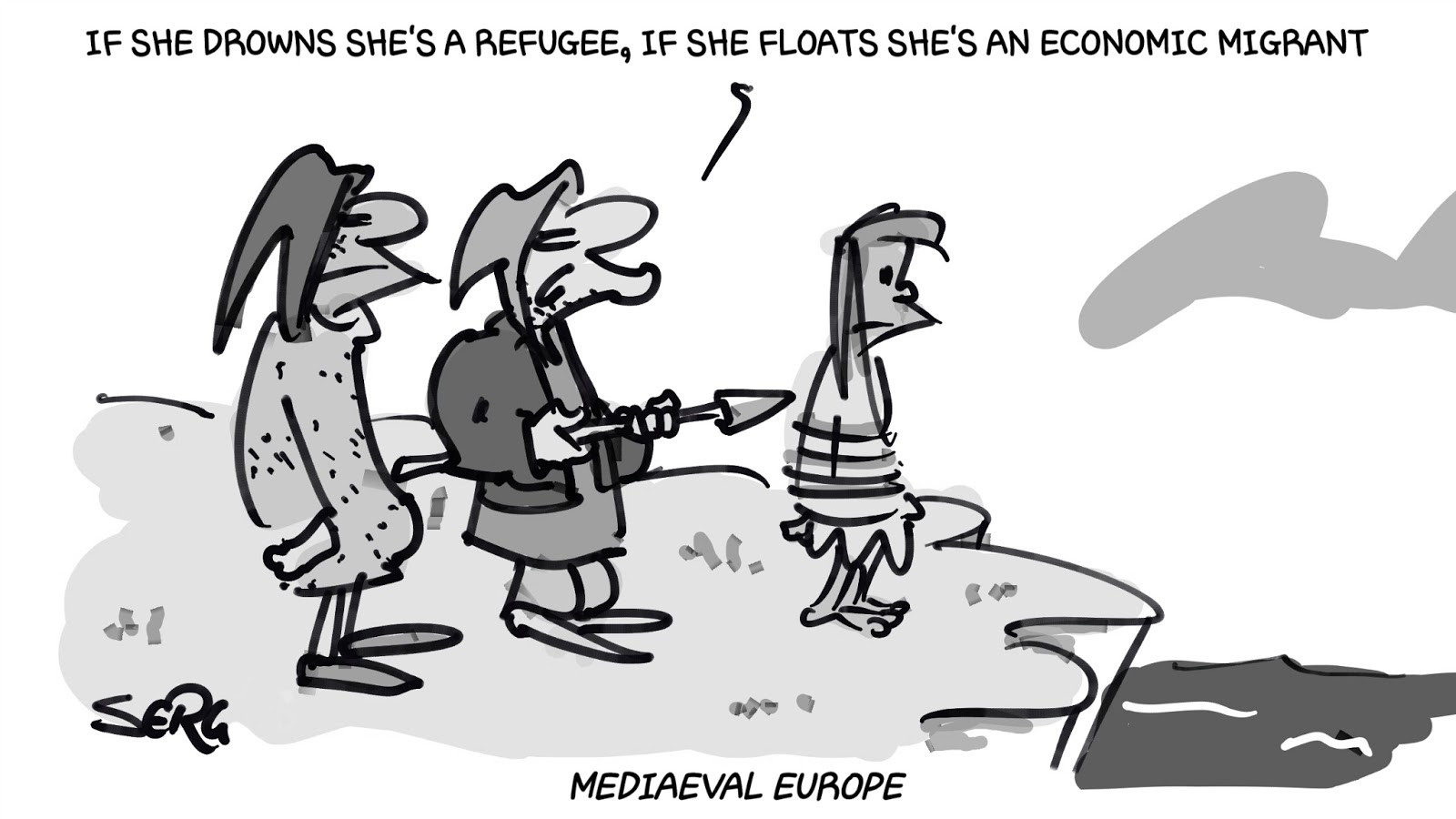
Galway artist Richard Chapman's take on Europeans'
hypocrisy towards refugees. 

But how many of us have ever stopped to check out their living conditions or to ask how they are getting on in 21st century Ireland?

Do we really know about the months and years it takes to process their applications while entire families live in tiny hotel rooms?

To mark Culture Night, the Galway Anti-Racism Network (GARN) invited Galwegians to spend a little time in Direct Provision.

The exact dimensions of a “normal” direct provision room were marked out in the middle of the city and passers-by were asked to imagine what it was like to live in a tiny hotel room for months on end.

The space available for furniture, belongings, and beds was mapped out on the ground and the ‘live’ exhibition attracted hundreds of curious on-lookers.

Some children lay on the ground, imagining the reality of sharing a tiny room with siblings and parents for months or even years on end.

It was interesting to see so many people check out the dimensions of the tiny room, trying to envision what it’s like for a family to live in such a confined space.

A stark message for Culture Night.
A direct provision centre hardly features among the “normal” cultural heights of the city.

Residents were on hand to engage with curious on-lookers and to give us an insight into their normal lives in Galway and Salthill.

They cannot work, so they asked us to imagine what it was like to get by on €19.10 per week while sharing a hotel with dozens of others.

They told us that some of them had been living in this limbo, in the land of a thousand welcomes, for over ten years.

They asked whether we knew that 17 firms across the country were taking in about €50 million per year from the Irish Government to run 34 accommodation centres across the State.

Some of them have to survive the winter months in mobile homes.

They asked us to imagine what it was like for the children, who attend primary or secondary schools in Galway, when their curious friends asked them about their living conditions, the food they ate, or when they’d be able to invite them over for sleepovers.

They can’t cook or bring food to their rooms and they most certainly can’t invite their school friends over to stay the night in the centres. Keeping a pet is also out of the question.

It was news to me that they were given a rule book, containing 44 pages of rules, when they arrived.
Or that any complaints they may have had about the running of a centre could only be made to the manager of their own centres. Even if their complaints may have been related to the management of the centres.

During the week, residents of the centres had written testimonies about the reality of their lives. The testimonies were posted on a wall, next to the Browne Doorway, for revellers to read as they made their way around Eyre Square.

“At least as a prisoner you know when you are getting out – not when you are an asylum-seeker,” wrote one lady.

The asylum-seekers present were so welcoming, so happy to share their stories. They spoke of the depression they experienced, as they waited anxiously to discover if they would be allowed to stay in Ireland or deported back to their countries of origin.            
Recreating a room in the heart of Galway.

Mental health problems in the direct provision system are estimated to be five times higher than in the wider Irish community.

It reminded me of a heart-breaking exhibition I attended in Galway last year, in which a South African asylum-seeker admitted that the system felt “familiar” – because it reminded her of the Apartheid system.                                                                          
In terms of raising awareness, it was a hugely admirable three hour event organised by the Galway Anti-Racism Network and the Movement of Asylum Seekers in Ireland.

It was not the most “enjoyable” event in the packed programme for Culture Night in Galway, but it served a hugely important purpose in reminding hundreds of people of one of the great scandals of our own era.

We can ask why Irish people turned a blind eye to clerical sex abuse or the scandal of the Magdalene Launderies in the past.

With Direct Provision, we have no excuse. Thanks to initiatives like last Friday night’s, nobody can claim that they don’t know about this system which condemns children to grow up in unsuitable accommodation for months or even years on end.


Thanks to Richard Chapman for the cartoon. You can view more of his work at http://lightbulbcartoon.com

Check out my website http://ciarantierney.com/ or follow me on twitter, @ciarantierney. 


Thursday, May 19, 2016

Have we really moved on?


When my best friend Joe died, I was an angry young man. We got drunk, we got stoned, we attended the Funeral . . . and then life just went on. The world kept turning and there was no such thing as counselling or grief recovery in the early 1990s.

It was nobody’s fault. Everyone around me was trying to cope with their grief in their own way and my little sister, Cliona, had passed away less than a year earlier. People shrugged and told me to get on with things.

As a young Irishman, I didn’t know how to talk about feelings . . . not without alcohol on board at any rate.
Sinead O'Connor: one of the best Irish singers of all time

Of course, there was no Internet in those days. I didn’t rant on Facebook after returning home from the pub at 4am or put up photos on Instagram of my friends and I drinking ourselves into oblivion, which was the norm for most of my friends at the time.

We didn’t think there was anything unusual about our hard drinking, we were just wild, out for the craic, living all the Irish clichés. It probably took years for me to realise that there was a lot of pain hidden behind that heavy drinking.

For me, one of the constants at the time was the music of Sinead O’Connor. I came home from a summer in London to become enraptured by this gorgeous, provocative diminutive singer who seemed to speak out for my generation in a way nobody else dared to.

I was 20 and I hated Ireland. I wanted to be back in London, going to punk and metal gigs, following my beloved Liverpool FC around. I wanted the freedom of meeting women from Italy or Spain or England, who were far more liberated than I was.

Back home, I wondered how somebody from my generation could be so daring, so sexy, so sure of her own voice in late 1980s Ireland.

When she sang ‘I Want Your Hands On Me’, Sinead was sexy in a way which seemed almost impossible for a young Irish person at the time. In those days we wore woolly jumpers as though we were ashamed of our own bodies.

In a country in which there was no contraception, no divorce, no abortion, this young woman from Dublin sang with a raw honesty which was simply incredible. Hell, there were still women living in Magdalene Laundries at the time.

Women who had committed the ‘crime’ of getting pregnant in Catholic Ireland were locked up barely a ten minute walk from my newspaper office, the sex abuse cases which rocked the Church had not yet been exposed, and hardly anybody questioned what was going on.

When Sinead (she’s so familiar, we call her by her first name) combined with the brilliant Benjamin Zephaniah to sing a song about the crimes committed by the British Empire, I was immensely proud.

When she reached number one with ‘Nothing Compares To You’, it felt as though there were boundless possibilities for a young Irish person who spoke out or sang the truth. I wasn’t mad into pop songs, but there was such passion in her voice.

I grew up on metal and punk, outlets for my rage in a very repressive Catholic Ireland, and here was an amazing young woman from Dublin who was willing to take on the world.

When she tore up a photo of the Pope, I thought she was a little misguided but I was also immensely proud. Nobody, yes nobody, was that brave in Ireland at the time.

Sinead O’Connor's music has been a constant in my life for more than half my life. I don’t claim to know her, although I did meet her once in Galway during the height of a summer Arts Festival. I was struck by how unassuming and shy she was that night, for someone who was a hero for so many of my generation on the Emerald Isle.

I thought about Sinead again this week, when a friend of mine alerted me to a troubling post on her Facebook page.

It was deeply personal and should never have appeared on a public social media site in the first place.

It shocked me when I did a Google search to find that quite a number of media outlets had shared the post in full, as though this very public meltdown by a ‘celebrity’  – or cry for help – deserved to become a form of entertainment.

No doubt the post, and the subsequent media reports, must have caused anguish to her close friends and family members as Sinead was clearly not in a good place when she wrote it.

I didn’t read it in detail and I most certainly didn’t want to read the comments underneath, but what shocked me was the fact that more than 1,000 people had taken the ‘trouble’ to ‘share’ it with their friends.

This was just two days after she had been reported missing by friends where she was staying, near Chicago. Thankfully, she was found safe and well.

Social media has transformed our lives in many ways, but have we become so dehumanised that we see entertainment value or ‘news’ in someone else’s anguish?

She might be a famous singer, but she is also a human being, facing the kind of troubles, challenges, and life-changing events we all have to face every day.

If she was clearly not in a good place on Tuesday night, where was the value in reading her deeply personal rant, aimed at some of the people closest to her, or sharing it on social media?

Or, worse, making jokes on Twitter about the whole sorry affair?

When Sinead went missing two days earlier, The Daily Telegraph felt that the ‘event’ merited a ‘live blog'.

It was clearly of no concern to the online editors that this in-depth coverage of such a vulnerable woman in distress might be deeply hurtful to Sinead and her family and friends.

Getting clicks on their website was clearly of far more importance than the well-being of a woman who was going through a tough time.

In 2016, a public figure’s meltdown can become a form of entertainment which would have been unthinkable back when my friend Joe died back in 1990.

Life was hard enough for me and my friends back then, without people making jokes on Facebook or posting insensitive remarks.

So … have we really moved on?

Ireland is going through a mental health crisis and the turn-out at this month’s Darkness Into Light walks (an estimated 120,000 across the country) showed that thousands upon thousands of people felt that the State is not doing a good enough job in this area.

Organisations like Pieta House and Console exist because our State health service is not addressing the crisis in mental health.

When I was in A&E with the MRSA ‘superbug’ last year, a young man who clearly had mental health problems was left languishing in a hospital corridor for hours.

He should have been in a state-of-the-art unit, not mixing with elderly people and accident victims lying on trolleys in an overcrowded corridor.

I wonder sometimes if the support available to a 20-year old whose best friend dies in 2016 is any better than it was in Ireland a quarter of a century ago.

I treasure Sinead as one of the most gifted songwriters of my, or any, generation. I firmly believe that people will still listen to the music of Sinead and Shane MacGowan long after most of today’s artists are forgotten.

But her personal demons are none of my business. I’m not going to ‘share’ them on Facebook as some form of titillation for my friends. I’m certainly not going to make hurtful jokes about a troubled soul on Twitter.

Sinead back in 1990 when she reached number one.
I only hope she gets the help she needs.

That’s all that matters right now for Sinead, her family, and her friends.

This week’s reaction on social media made me wonder whether we really have progressed from the witch trials and public hangings of the Middle Ages.

For all our technology, have we become so dehumanised that a public figure’s tragic meltdown is worthy of a click on a keyboard, or a Facebook share, on social media?

Do people even stop to think about the damage they cause when they post vicious or mocking posts about someone who is clearly going through a tough time?

It doesn’t seem that way. People post words on social media which they would never dare to utter to a person’s face.

We might be “connected” to each other 24/7 through our laptops, tablets, and smart phones, but in many ways we’ve become “disconnected” from our fellow human beings … We sit behind keyboards, poking fun at people who only need our help and good wishes as they struggle to make the most of this crazy, complicated life.

And, what’s worse, many of us don’t even think we are doing anything wrong.

Tuesday, September 30, 2014

Farewell to the Connacht Tribune


Writing my last ever article for the Galway City Tribune


When I was growing up in Galway in the 1970s and ‘80s, I never actually thought I would live as an adult in my home town. Most of us bypassed Dublin and gravitated towards the bright lights of London, where the delights of a big city, well-paid work, Liverpool FC games, and countless gigs provided a massive attraction during my summer holidays from NUI Galway.

 At one stage, I must have had 20 friends in the British capital and it offered a ‘freedom’ which was unavailable at home.

But when the opportunity presented itself to work full-time for my local newspaper, I jumped at it. Good jobs were hard to come by in the West of Ireland in the early 1990s and I was in dreamland at times, writing my own weekly music column, covering a vibrant club scene and following the exploits of a myriad of decent Galway bands.

Music got me into journalism in the first place and my column coincided with the arrival of venues such as the Roisin Dubh and Monroe’s. I used to get in free to all the gigs when a notorious club called The Castle featured some of the best nights out in the land. And I could marvel at the brilliance of bands like Toasted Heretic, The Far Canals, and Inflatable Sideshow in the 1990s, while getting paid to down pints at their gigs and rage at the injustice of how they failed to conquer the world.

There were some crazy nights, such as when a delirious crowd carried dance DJ Carl Cox, like a triumphant boxer, onto the Castle stage. The fact that the venue was threatened with closure by the Gardai only added to the intense atmosphere in the club. There was a manic energy on the Galway music scene, despite of or perhaps because of emigration and social deprivation, in those early years.

Clubs like Sex Kitchen, Wiped, and Feet First, influenced more by London and Cork than Dublin, were better than any you’d find in the capital.

And our generation of clubbers, with our free outdoor ‘raves’, were partially responsible for the drafting of the draconian Public Order Act in 1994 which still prompts concerns over civil liberties to this day.

The maddest day I ever had at work in the 1990s came when I was sent out to interview a priest in the wilds of Connemara but, thanks to a wayward hitch-hiker, ended up in a ‘shebeen’ frequented by poitin drinkers who hadn’t a word of English between them. I returned to the city with a couple of bottles and a much different story than my editor envisaged. But that’s another story ... 

In sport, I was a young freelancer in the press box when Galway United won the FAI Cup for the first and only time. The modesty of the likes of the late Tommy Keane and Eamon Deacy, the city’s two most gifted players in history, was a wonderful reflection of the part of the city which spawned them. 

Unlike, say, Corkonians, people from ‘The West’ tend not to blow their own trumpets ... even when they should at times.

I will never forget how accommodating Westside native David Forde was after he finally became Republic of Ireland goalkeeper at 33 years of age. Despite all his commitments with national and international media, the Millwall and former Galway United goalkeeper always went out of his way to do interviews with his home town 'paper.

Sometimes my friends thought I had the best job in the world. I was in the dressing-room when the Galway footballers won the Sam Maguire Cup for the first time in 32 years in 1998. Those were the days before Croke Park was taken over by over-eager security men in suits. It seemed totally natural to down about six pints of beer in a Salthill pub before covering an emotional homecoming for our Tuesday paper, The Sentinel, at 4am.

As for the hurlers, the frustrations in covering them just summed up the disappointments of a quarter of a century for followers of the Tribesmen. There were mighty days to report on against Kilkenny in 2001, 2005, and 2012, and yet an entire generation or two of gifted players never reached the promised land. It was sad to see fantastic hurlers, the likes of Eugene Cloonan, Joe Rabbitte, and Ollie Canning end their careers without winning an elusive All-Ireland medal.

Boxers were the most welcoming of all the sports people I came across. I was lucky enough to be the first journalist to interview Francie Barrett in his caravan at the Hillside encampment, a year before he became the first Traveller to represent Ireland at the Olympic Games. Boxers were always dignified, always thrilled by any coverage the Tribune gave them, and represented their impoverished communities with pride.

There were poignant days in the job, too. I will never forget the hospitality and sheer dignity of the parents of Siobhan Hynes and Kieran Cunningham, both senselessly murdered, when they welcomed me into their homes. These quiet, rural families were hurtled so cruelly into extraordinary grief and pain – and yet they had such quiet determination to tell their children’s stories, to make sure their short lives were remembered in the right way by their local 'paper.

As a reporter, it is sometimes amazing to get the chance to sit down and talk to people who just want to share their stories after experiencing unthinkable tragedy in their lives.

In recent years, I got to interview some extraordinary people, including my own school friend Liam Cullinane who has battled meningitis, with both bravery and determination, for over 20 years. Then there was Mark Logan, a man I knew through the city’s music scene who saved countless lives through his work in suicide prevention.

Mark and I joked for about five years about doing a long interview, but kept putting it off. Then, after we finally did sit down for a chat, Mark tragically died of a heart attack just two weeks later. The man was a legend and his funeral was one of the most memorable I ever attended. He was great fun, but dedicated his life to helping people in distress.

People like Liam and Mark may never make national or international headlines, but they inspire the communities around them with their extraordinary, understated lives.

Then  there was Declan Higgins, current President of the NUI Galway Students’ Union, who has had the courage to talk about depression and suicide with the kind of raw honesty which would have been alien to my generation two decades ago.

Or Galway-based cameraman Richie O'Donnell, whose documentary 'The Pipe' showed how ordinary people can have their lives turned upside down by big business and faceless bureaucrats. The 'Shell to Sea' controversy in North Mayo and the use of Shannon by US military aircraft are two of the great scandals of our time in so-called neutral Ireland.

In recent years, I’ve been inspired by the Palestinian activists in Galway, including 64-year old Tommy Donnellan who was shot by Israeli soldiers in the West Bank last year. Tommy, armed with a camera, is determined that the truth will come out. He shows no fear and jokes that he’s too old to be considered a threat by the Israeli authorities. His photos and videos give voices to the voiceless in the West Bank and Gaza, who feel they have been forgotten by the outside world.

Interviewing someone like Tommy or Richie showed me that Galway people do tend to keep a keen interest in the big, bad world, and that there are people out there giving voices to those who feel they have been denigrated or ignored.

Since I came back from a gap year in 2010, I've been fascinated by the turf-cutters' cause. They feel that faceless bureaucrats have imposed restrictions upon them, on their own land, which is an emotive issue for Irish people no matter what the environmental concerns. It's been heartening to see an outsider, Luke 'Ming' Flanagan, go from being a subject of ridicule by Fianna Fail gombeens in Galway to an elected MEP in the European Parliament.

Like Ming, it still annoys me that a person in possession of €10 worth of cannabis can end up before the District Court and in the local paper, with all the more serious issues going on. To me, drug use is a health rather than criminal issue. The fear of having your name appear in the paper for such a minor offence can cripple people and damage lives.

But, in many ways, Ireland has moved on. Homosexuality was illegal when I started working with the Tribune, for example, whereas nowadays we're likely to use a full page of photos from the Pride festival. And people have, rightly, become far more questioning of the Catholic Church because of all the abuse scandals which were unearthed by the local and national media.

The start of my career with the Tribune conicided with the 'Bishop Casey Scandal' and long gone are the days when the Bishop of Galway could urge his congregation to whip their daughters if they happen to be out late on a Saturday night.

There is a palpable anger in the West of Ireland that so many ordinary people have been forced to pay for the crimes of an elite few, through water, property, and USC taxes. Friends living overseas have told me that they get a better feeling of what Ireland is like since the crisis from the Connacht and City Tribune than they do from the national media.

Suicide is a theme which seems to have popped up far too frequently over the past couple of years and yet it’s been inspirational to meet the people who do Trojan work with the likes of Pieta House and Console.
In Ballinasloe, it was moving to see an entire community fight so hard to oppose cuts to mental health services – there has been palpable anger in local communities as politicians have continued to ‘slash and burn’ in recent years.

Yes, local journalism has allowed me to meet hundreds of people and shown me the dignity and pride of ordinary West of Ireland people who may never have wanted the limelight in the first place.

Provincial newspapers play a huge role in Irish life but, for me, the time has come to move on. With the industry going through a crisis, I decided to take a voluntary redundancy package this week. While my immediate future is uncertain, it’s been a privilege to meet so many wonderful people and attempt to tell their stories over the past two decades.