Showing posts with label Luke 'Ming' Flanagan. Show all posts

Thursday, November 15, 2018

Neutrality means nothing when we have dollar signs in our eyes

Remembering a Syrian child, who was murdered in a US airstrike,
during the monthly Shannonwatch protest at Shannon

Irish Current Affairs Blog of the Year 2018


On a cold Thursday night in November, a few dozen of us congregated in a beautiful but obscure new lecture hall on the western outskirts of the sprawling campus at NUI Galway.

Two Members of the European Parliament (MEPs), four TDs, academics, and peace activists had gathered for a lively and informative three hour discussion which garnered little or no media attention.

I know, because I asked three news editors in advance of the meeting if they would be interested in a piece. Not one of them even replied.

The subject of the meeting was the thorny question of whether or not Ireland is being steamrolled into joining a European Union army since PESCO – Permanent European Security / Military Co-Operation – was rushed through the Dail last December.

In theory at least, Ireland is a “neutral” country. Luke ‘Ming’ Flanagan, the Independent MEP, called the Galway meeting in response to growing alarm over what PESCO actually means to Ireland.

Are we on our way to becoming part of a European ‘Super State’?

Is our military spending going to increase dramatically to €6 billion per year (or half of what we spend on our desperate health service) because of something our country signed up to with so little debate last year?

Does anybody care?

It is astounding that we hear so much about Brexit on the national airwaves every day, because Britain’s shambolic departure from the EU has such massive implications for Ireland, but we hear little or nothing about the contentious issue of a European Army.
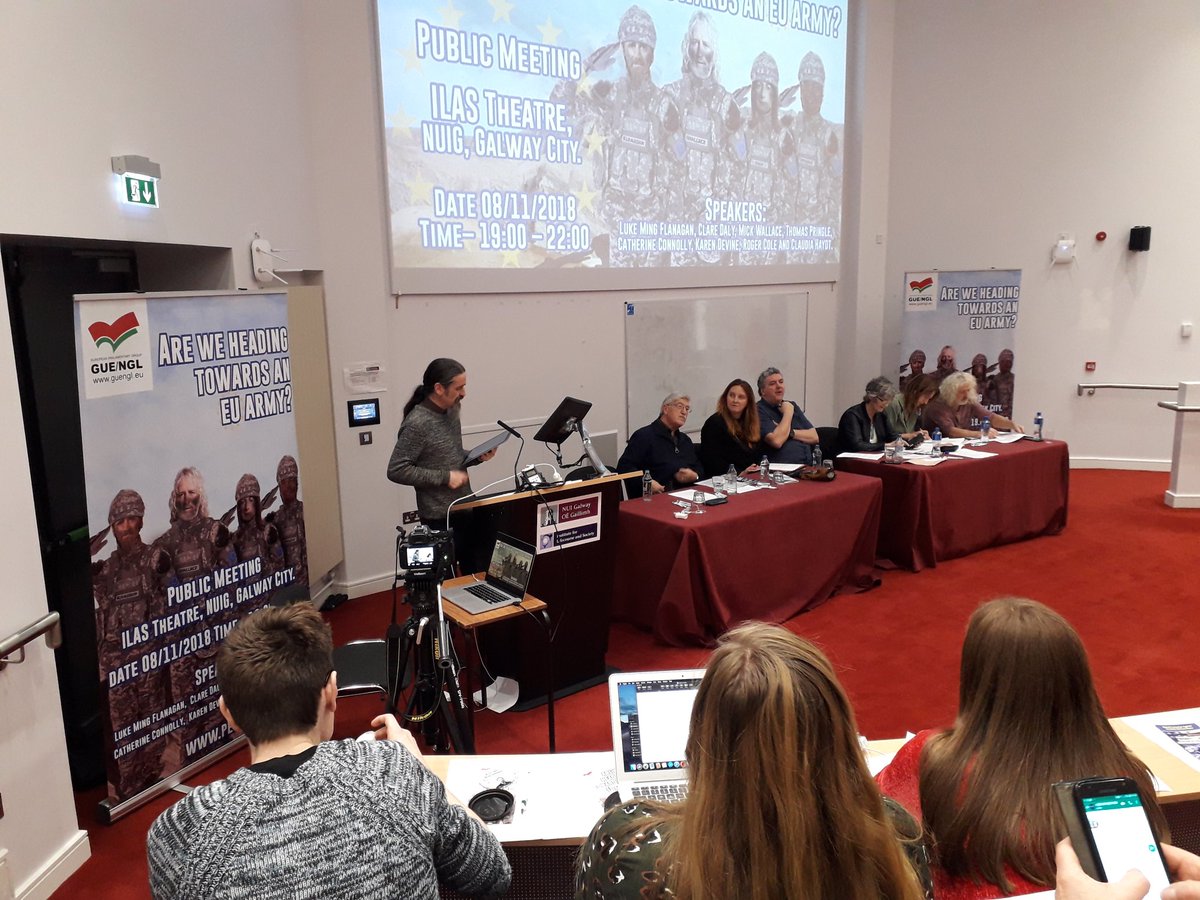

The conference about the EU Army at NUI Galway this week


Are ‘Ming’ and the Independent TDs just alarmist crackpots? Is it really acceptable that unelected EU officials can lead us towards the formation of a ‘super’ army to rival those of the USA and Russia in the future?

And why, oh why, are so few Irish people talking about this?

Perhaps Irish neutrality is a sham, but shouldn’t we at least discuss this issue?

In Shannon last week, the important Shannonwatch peace group noted that a US military plane stopped off in a civilian airport on its way to and from Tel Aviv.

Nobody in authority at Shannon Airport ever checks the contents of the US military machines which have been landing there each and every week since 2001.

Last year, over 61,000 US troops stopped off in Shannon on their way to and from wars in the Middle East.

That might mean a hell of a lot of leprechaun and whiskey sales in the duty free shop, but it also makes a mockery of the concept of Irish neutrality.


A US miltiary supply plane in Shannon this week. It was on its way
'home' from Tel Aviv. Photo via Shannonwatch. 


If it wasn’t so serious, Irish people would be laughing over Brexit and the shambolic way in which pro-Brexit politicians in Britain, in their jingoistic haste to leave the EU, seem to have had no vision for the future.

Perhaps reform, rather than withdrawal, might be the correct response to an undemocratic, unaccountable Europe; but at least in Britain they have had some sort of debate about the EU and their country’s place in it.

The Irish, meanwhile, see ourselves as “model” Europeans even though it was our EU masters who forced us into the “bank bailout”, with devastating implications in terms of the loss of public service jobs, health care and welfare cuts, the privatisation of state assets, and a new wave of emigration at the start of this decade.

Not to mention the huge debt our country has been saddled with for years to come.

Now PESCO, according to the Independent TDs and MEPs, will see Ireland being steamrolled into an EU Army and it is quite amazing how little talk there is about this in Ireland.

“We have to work on a vision of creating a real true European Army,” said German Chancellor Angela Merkel this week.

French President Emmanuel Macron called for the formation of a “real” European Army during the Armistice Day commemorations last weekend.

On Tuesday, the European Commission said that a European Army is “likely” to be formed one day.

So the Galway conference this week seemed to be extremely timely.

“Does PESCO damage our neutrality?” asked Catherine Connolly TD. “Yes, it does. We are normalising war and the militarisation of Europe. PESCO was not discussed in our Dail. The good news is that 42 of us voted against it. Language has been stood on its head. We are heading towards a militarised Europe.”

She said that Irish soldiers have to rely on family income supplement in order to survive, in the middle of unprecedented crises in health care and housing.

Deputy Connolly pointed out that the head of the European Commission has never been elected by anyone and spoke of how uncomfortable she felt when he was given a reverential reception in the Dail.


A Fine Gael MEP, Brian Hayes, has called for the “redefinition” of neutrality and both Fine Gael and Fianna Fail have denied that PESCO will impact on Irish neutrality.

Independent MEP Flanagan has described the massive global arms industry as an “untapped goldmine” in the eyes of the European Union.

Just as US President Donald Trump feels that punishing human rights abuses by Saudi Arabia would only be foolish if it damaged his country’s $110 billion arms trade with Riyadh, perhaps the Irish should be far more honest with ourselves.

Does our ‘neutrality’ mean anything when we get a chance to cosy up to and find favour with the world’s military powers?

Do we want to stand beside the French and Germans as they, too, aim to become global powers?

Perhaps, ultimately, the vast sums of money to be made from militarisation are far more important than the human rights of children in Syria, Palestine, Yemen or Afghanistan as the US military aircraft land and take off from Shannon Airport with total impunity every week.

“When you question why they are militarising the European Union, you must understand that this is not to protect or defend you,” said Flanagan.

“It is about money . . . and billions of it.”


Is Ireland already facilitating war crimes in the Middle East?
The horror of Syria.


Next time you have a loved-one lying on a hospital trolley for 48 hours, or finding it impossible to find an affordable place to live, remember that PESCO is set to increase Ireland’s military expenditure six times over.

Without any real, meaningful national debate about its implications.

Sometimes, when you look at the stories which are creating headlines, it’s just as informative to check out which stories are being ignored.

When a ‘neutral’ former colony wants to be part of a new global super-power, when arms sales are more important than human lives, language truly has been stood on its head.

Neutrality means next to nothing when we have dollar signs in our eyes.


Ciaran Tierney won the Irish Current Affairs and Politics Blog of the Year Award (personal) at the Tramline, Dublin, last month. He is seeking new opportunities in a digital age. Find him on Facebook at http://facebook.com/ciarantierneymedia

Find Ciaran on Twitter https://twitter.com/ciarantierney

The first Conference Against US and NATO Military Bases takes place in Dublin this weekend. Details at https://www.facebook.com/events/304522810146150/


Wednesday, June 29, 2016

Breaking down the barriers

When I was a youngster, the only British people I knew wore uniforms, pointed guns, and seemed to have hatred in their eyes.

For a couple of years in the 1970s, my parents lived right beside a militarized border which contained watch towers, a barbed wire fence, and was patrolled by heavily armed soldiers.

Crossing the bridge between Donegal and Tyrone was an ordeal; my parents and their friends had to psyche themselves up for routine journeys to places like the nearest supermarket or dentist's.

On one occasion, I remember my father being hauled out of the car by the men in uniforms after he dared to speak back after a long and tiring day spent visiting cousins in Monaghan.

The people of Lifford never knew whether or not they would be hauled out of their cars at gunpoint by young men from places like Sheffield and Sunderland who probably hadn't a clue why they had been sent to Northern Ireland in the first place.                          
Nigel Farage MEP addressing the European Parliament yesterday

Even though I was only five or six years old, I can still remember the agonizing fear in the car as we used to approach the border; our parents cajoling us to be as quiet as mice in the back in case we'd antagonize a hostile, or perhaps even trigger-happy, young soldier.

I remember a customs post up in flames or bombs going off, lighting up the night sky across Lifford and Strabane.

Some neighbours used to celebrate terrorist murders because some of them really believed that the victims deserved to die and you could almost feel the tension and hatred in the air.

People never mixed with the "other side". They'd go to separate schools, play separate games, work in different places and live in different neighbourhoods.

"Our" side had the GAA and Catholic schools, "their"side had cricket or rugby. To this day many people in places like Derry cannot bring themselves to support the Northern Ireland football team which is why James McClean, from the Creggan, plays for the Republic even though he grew up North of the border.

Two teams, a nation divided, and yet we live in peace in 2016.

In the 1970s, some members of my tribe, the Catholics, used to claim that there was no point in even looking for a job because discrimination was institutionalized. In those days it was almost impossible for a Catholic in Derry to get a Council home.

When 14 unarmed people were shot dead during a Civil Rights march my parents decided they'd had enough and they managed to orchestrate a move back to Galway. They did not want their five children to grow up in such a tense environment.

That tension was still in the air when I used to travel to Derry to cover Galway United games for my local newspaper in the 1990s.

You always felt fear or discomfort when you crossed that border and watched the military helicopters flying over the Brandywell on Sunday afternoons, even though the Royal Ulster Constabulary (the deeply unpopular police force) had an unwritten agreement with Derry City that they would not enter the football ground.

Years passed before I really got to know English people. Even when, as a third level student, I spent lengthy summer holidays working in London, I only really mixed with the Irish or Jamaicans; there was a lot of distrust of the Irish, while the IRA "campaign" provided a negative backdrop to our experiences as young migrants in the British capital.

It was in London that I first encountered casual racism, but I knew that didn't mean there were more racists in the UK than back home in Ireland. In those days, you could probably count the number of black people in Galway on two hands.

For me, strangely, the catalyst for change was my love for scuba diving. My two regular diving buddies on the west coast of Ireland both had young families and didn't have the time or the money to travel with me on my underwater adventures.

So I booked the first of many holidays to Egpyt and - shock, horror - found myself on a boat full of English people. I braced myself for a tense week and, yes, sometimes there were cultural misunderstandings or comments made through ignorance rather than hatred.

My fears were unfounded and I even began to make life-long friends who would contact me twice a year to see if I'd like to join them on trips to the Red Sea. By mixing with each other, by sharing our passion for a wonderful hobby, we broke down barriers which we had allowed to build up over generations.

During a wonderful gap year in 2010, I became a professional scuba diver. Every day I mixed with English people at Blue Planet Divers, some of whom had military backgrounds and had even served on tours of duty, pointing guns at Irish Catholic people in Northern Ireland.

Some of them also became life-long friends.

At the turn of the Millennium, I also renewed my love affair with Liverpool FC, honed as a child in the 1970s back in Ireland. I travelled all around Europe with Scousers and could not feel more accepted or have had more fun.

I'm never going to sing 'Rule Britannia' or 'God Save the Queen', but by mixing and having the 'craic' with English people I have completely banished the prejudices I built up in my mind as a child.

With the Brits having voted to leave the European Union this week, Ireland is in shock as many of us worry about an uncertain future as an isolated island off the north-west coast of the vast continent.

Everyone is focusing on the perceived racism and xenophobia of some of those who voted for Brexit last Thursday.

How quickly we forget how undemocratic, or even anti-democratic, the EU has become.

When our parents voted to join it in the 1970s, the European Economic Community led to economic prosperity on an island which had been ravaged by decades of stagnation, unemployment, and hopelessness.

They didn't vote for a system which would allow bureaucrats in Brussels to bully small countries such as Ireland, Greece, and Portugal.

They didn't vote for a dictatorship which would tell the Irish people that they made the "wrong" choice when they rejected the Lisbon and Nice treaties.

They didn't vote to impose severe hardship on the Greeks or to make a murky deal with an awful Government in Turkey, just to keep the migrants out in the face of growing racism across many of the 28 member states.

They didn't vote for the annihilation of Irish fishing rights or a loss of power by nation states which ensures that the Irish Government no longer seems able to decide whether or not it can abolish deeply unpopular water charges.

They didn't vote for a parliament which refused the right to Irish MEPs to comment on a vote which will have more of an impact here than anywhere else yesterday. Luke 'Ming' Flanagan MEP, from one of the most remote regions in Europe, claimed that he and the other MEPs from the Republic were effectively being 'gagged' yesterday.

But Brexit proved one thing, emphatically - ordinary people across Europe feel alienated from the EU institutions which govern them.

The EU needs reform, it's just that people like the racist Nigel Farage MEP (UKIP) and opportunist Boris Johnson MP (Conservative) are not the ones to provide the solutions.

It's a sad day for Ireland when our nearest neighbour and biggest trading partner leaves the EU, but in all of the noise over xenophobia and racism let's not forget that there were very valid arguments about how undemocratic the EU has become during the Brexit debate too.

This is a time for healing wounds and building bridges.

Nobody wants to see a militarized border separate the Republic from the North again.

Luke 'Ming' Flanagan MEP,
not allowed to speak yesterday
And few want a divisive vote about a United Ireland right now, either. Not while a million people see themselves as British, even if the Britain they know seems to be falling apart.

Before we talk about that we need to start following the same teams, drinking in the same bars, living in the same neighbourhoods and mixing with each other to break down the barriers.

I had to go all the way to Egypt and Thailand to learn that I could make friends with ordinary English people, and be accepted for who I am, yet how many of us have made no effort to find out about the "others" who live just down the road.

Racism and xenophobia only fuel ignorance and offer no solutions, while isolation is simply impossible in the 21st century.

I do think British people made the wrong decision last Thursday, but only a fool would claim that the EU is not in need of sweeping reforms.

As for the border; well, nobody, but nobody, wants a return to the dark days of the 1970s and 1980s. There are too many connections between our two islands and our communities within this island to allow that to happen.

It's a time to build bridges, not to put up new fences, customs posts, passport controls, and watchtowers, long after many of us were so happy to see them being dismantled.


http://facebook.com/ciarantierneymedia

http://ciarantierney.com/