Showing posts with label NUI Galway. Show all posts

Thursday, November 15, 2018

Neutrality means nothing when we have dollar signs in our eyes

Remembering a Syrian child, who was murdered in a US airstrike,
during the monthly Shannonwatch protest at Shannon

Irish Current Affairs Blog of the Year 2018


On a cold Thursday night in November, a few dozen of us congregated in a beautiful but obscure new lecture hall on the western outskirts of the sprawling campus at NUI Galway.

Two Members of the European Parliament (MEPs), four TDs, academics, and peace activists had gathered for a lively and informative three hour discussion which garnered little or no media attention.

I know, because I asked three news editors in advance of the meeting if they would be interested in a piece. Not one of them even replied.

The subject of the meeting was the thorny question of whether or not Ireland is being steamrolled into joining a European Union army since PESCO – Permanent European Security / Military Co-Operation – was rushed through the Dail last December.

In theory at least, Ireland is a “neutral” country. Luke ‘Ming’ Flanagan, the Independent MEP, called the Galway meeting in response to growing alarm over what PESCO actually means to Ireland.

Are we on our way to becoming part of a European ‘Super State’?

Is our military spending going to increase dramatically to €6 billion per year (or half of what we spend on our desperate health service) because of something our country signed up to with so little debate last year?

Does anybody care?

It is astounding that we hear so much about Brexit on the national airwaves every day, because Britain’s shambolic departure from the EU has such massive implications for Ireland, but we hear little or nothing about the contentious issue of a European Army.
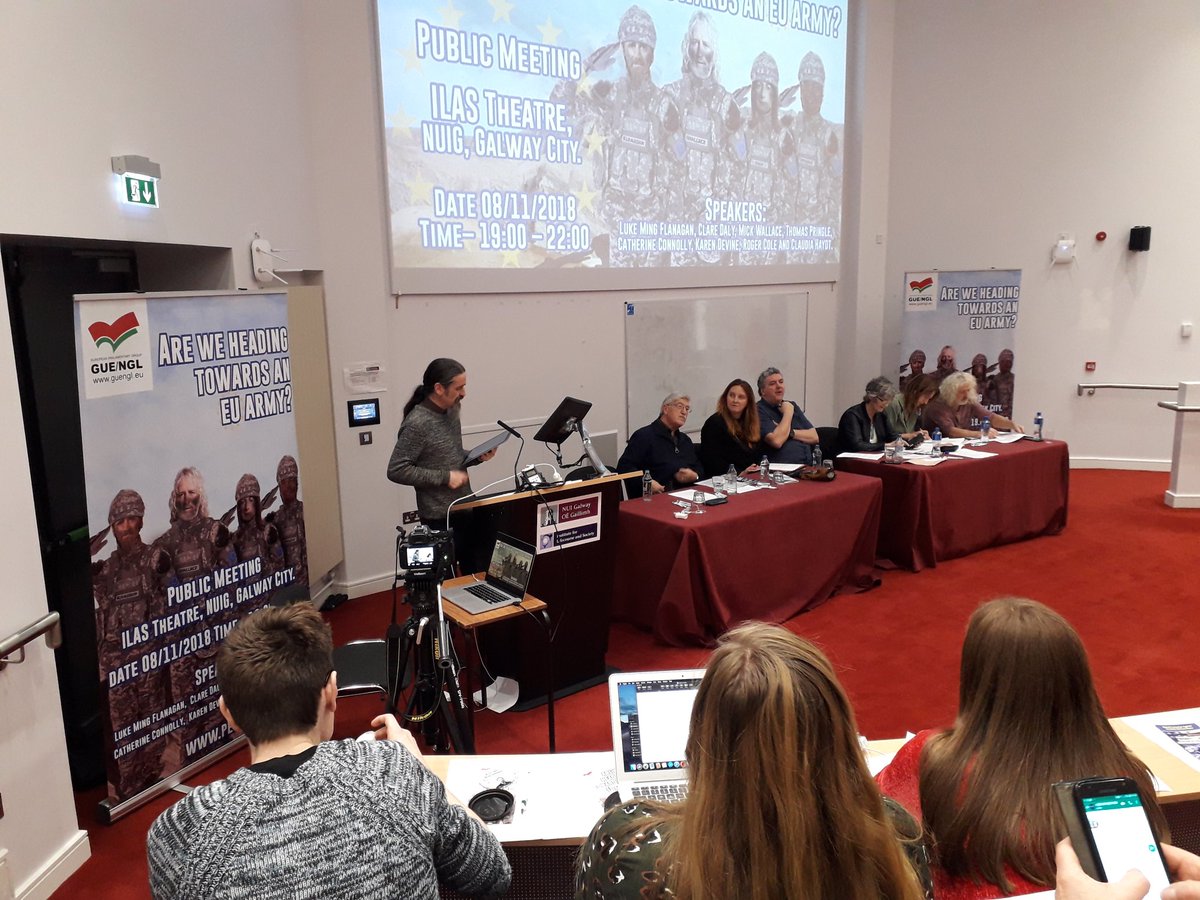

The conference about the EU Army at NUI Galway this week


Are ‘Ming’ and the Independent TDs just alarmist crackpots? Is it really acceptable that unelected EU officials can lead us towards the formation of a ‘super’ army to rival those of the USA and Russia in the future?

And why, oh why, are so few Irish people talking about this?

Perhaps Irish neutrality is a sham, but shouldn’t we at least discuss this issue?

In Shannon last week, the important Shannonwatch peace group noted that a US military plane stopped off in a civilian airport on its way to and from Tel Aviv.

Nobody in authority at Shannon Airport ever checks the contents of the US military machines which have been landing there each and every week since 2001.

Last year, over 61,000 US troops stopped off in Shannon on their way to and from wars in the Middle East.

That might mean a hell of a lot of leprechaun and whiskey sales in the duty free shop, but it also makes a mockery of the concept of Irish neutrality.


A US miltiary supply plane in Shannon this week. It was on its way
'home' from Tel Aviv. Photo via Shannonwatch. 


If it wasn’t so serious, Irish people would be laughing over Brexit and the shambolic way in which pro-Brexit politicians in Britain, in their jingoistic haste to leave the EU, seem to have had no vision for the future.

Perhaps reform, rather than withdrawal, might be the correct response to an undemocratic, unaccountable Europe; but at least in Britain they have had some sort of debate about the EU and their country’s place in it.

The Irish, meanwhile, see ourselves as “model” Europeans even though it was our EU masters who forced us into the “bank bailout”, with devastating implications in terms of the loss of public service jobs, health care and welfare cuts, the privatisation of state assets, and a new wave of emigration at the start of this decade.

Not to mention the huge debt our country has been saddled with for years to come.

Now PESCO, according to the Independent TDs and MEPs, will see Ireland being steamrolled into an EU Army and it is quite amazing how little talk there is about this in Ireland.

“We have to work on a vision of creating a real true European Army,” said German Chancellor Angela Merkel this week.

French President Emmanuel Macron called for the formation of a “real” European Army during the Armistice Day commemorations last weekend.

On Tuesday, the European Commission said that a European Army is “likely” to be formed one day.

So the Galway conference this week seemed to be extremely timely.

“Does PESCO damage our neutrality?” asked Catherine Connolly TD. “Yes, it does. We are normalising war and the militarisation of Europe. PESCO was not discussed in our Dail. The good news is that 42 of us voted against it. Language has been stood on its head. We are heading towards a militarised Europe.”

She said that Irish soldiers have to rely on family income supplement in order to survive, in the middle of unprecedented crises in health care and housing.

Deputy Connolly pointed out that the head of the European Commission has never been elected by anyone and spoke of how uncomfortable she felt when he was given a reverential reception in the Dail.


A Fine Gael MEP, Brian Hayes, has called for the “redefinition” of neutrality and both Fine Gael and Fianna Fail have denied that PESCO will impact on Irish neutrality.

Independent MEP Flanagan has described the massive global arms industry as an “untapped goldmine” in the eyes of the European Union.

Just as US President Donald Trump feels that punishing human rights abuses by Saudi Arabia would only be foolish if it damaged his country’s $110 billion arms trade with Riyadh, perhaps the Irish should be far more honest with ourselves.

Does our ‘neutrality’ mean anything when we get a chance to cosy up to and find favour with the world’s military powers?

Do we want to stand beside the French and Germans as they, too, aim to become global powers?

Perhaps, ultimately, the vast sums of money to be made from militarisation are far more important than the human rights of children in Syria, Palestine, Yemen or Afghanistan as the US military aircraft land and take off from Shannon Airport with total impunity every week.

“When you question why they are militarising the European Union, you must understand that this is not to protect or defend you,” said Flanagan.

“It is about money . . . and billions of it.”


Is Ireland already facilitating war crimes in the Middle East?
The horror of Syria.


Next time you have a loved-one lying on a hospital trolley for 48 hours, or finding it impossible to find an affordable place to live, remember that PESCO is set to increase Ireland’s military expenditure six times over.

Without any real, meaningful national debate about its implications.

Sometimes, when you look at the stories which are creating headlines, it’s just as informative to check out which stories are being ignored.

When a ‘neutral’ former colony wants to be part of a new global super-power, when arms sales are more important than human lives, language truly has been stood on its head.

Neutrality means next to nothing when we have dollar signs in our eyes.


Ciaran Tierney won the Irish Current Affairs and Politics Blog of the Year Award (personal) at the Tramline, Dublin, last month. He is seeking new opportunities in a digital age. Find him on Facebook at http://facebook.com/ciarantierneymedia

Find Ciaran on Twitter https://twitter.com/ciarantierney

The first Conference Against US and NATO Military Bases takes place in Dublin this weekend. Details at https://www.facebook.com/events/304522810146150/


Monday, January 11, 2016

After CRH, it's now time to look at G4S


In this globalised world, we are all interconnected.

When NUI Galway students voted to become the first in Ireland to adopt boycott, divestment and sanctions (BDS) of Israel as official Students’ Union policy, the international campaign against them was incredible.

For weeks leading up to the vote, posters popped up all over campus encouraging the students not to adopt the boycott as official SU policy.

One memorable poster told the students they should boycott Facebook if they intended to boycott Israel, because the founder of the social media site, Mark Zuckerberg, happens to be Jewish. 

The implication was that a boycott of Israel was an action against all Jews, rather than a response to the colonisation and occupation of Palestine, plus the illegal ‘settlements’ which have ruled out any possibility of a ‘two state’ solution.

The implication was crystal clear. Those who had any concerns about Israeli policies were branded as “anti-Semitic” and the Israeli Embassy in Dublin waged a propaganda campaign against the SU.

Despite the scare tactics, an overwhelming majority of students voted to adopt BDS as official SU policy in 2014.

The vote generated headlines across the world. It has prompted other third level institutions across Ireland, including the Galway Mayo Institute of Technology (GMIT), to adopt the same policy in response to the illegal occupation.

Galway protester Tommy Donnellan in the West Bank
I reported on the outcome of the vote for the local ‘paper, The Sentinel, and was then subjected to a barrage of abuse from throughout the globe. It had been quite a nasty campaign relating to an emotive issue, with abuse coming from both sides.

As they celebrated the election victory, the students vowed to remove global security giant G4S from the Galway campus.

G4S have been providing equipment and services to Israeli prisons, in which political prisoners including children are held without trial and subjected to torture, for years.

Every night after dark, security men from G4S patrol the NUI Galway campus. It didn't take the students long to realise that there was a connection between the vans driving around the University grounds and the people who are helping to run Israeli state prisons which are full of political prisoners from Palestine.

The day after the vote, a G4S van was parked outside my office. The company has a presence in 120 countries and I suddenly began to notice G4S vans all around Galway city centre, outside banks and other businesses.

Most people in Galway, and other Irish cities and towns, probably have no awareness of the vast reach of this security giant.

By helping the Israeli State to run five prisons and “interrogation centres”, G4S helps Israel to use torture and mass incarceration of more than 6,000 Palestinians. The British-Danish company promotes and prolongs an occupation which is illegal under international law.

Day by day, this firm facilitates racist policies against people who have been living under occupation since 1967.

G4S provide services and equipment to the checkpoints which see Palestinians being subjected to daily humiliations at the ‘Apartheid Wall’, which has cut many West Bank villagers off from their own land. 

This week, a prominent Irish firm, CRH, divested from Israel after coming under sustained pressure from activists opposed to the occupation of Palestine.

For over a decade, the Ireland Palestine Solidarity Campaign (IPSC) had urged CRH to cease operating in Israel. CRH held 25 per cent of the shares in Mashav, the owner of the top cement manufacturer in Israel.

It is believed that cement owned by the firm was used to build the ‘Apartheid Wall', which was deemed illegal by the International Court of Justice over a decade ago.

Cement owned by the firm has been used to build illegal Israeli settlements on occupied West Bank land, further reducing any hopes of a long-term peaceful solution to the conflict in the Middle East.

Over the years, CRH had learned that it doesn’t pay to do business with the Apartheid State. According to the IPSC, CRH's divestment is better late than never.

Two years ago, when I reported that the NUI Galway students wanted G4S to be removed from campus as a response to the company’s activities in Israel and Palestine, I received a torrent of abuse.

Protesting against G4S human rights abuses
People said that G4S staff in Galway were “only doing their jobs”. They said it was unfair to call for a boycott of the company in Galway.

But, like CRH, they can’t have it both ways. They can’t drive around a university campus in Ireland at night while facilitating human rights abuses in Israel.

If a company with a significant presence in Ireland is facilitating the imprisonment of children without trial, people have a right to know.

It’s time to look at G4S.

If they continue to trample on the human rights of children and teenagers across Palestine, Galway students have a right to insist that the University authorities remove them from their campus.

There are plenty of other security firms around with a far less murky record when it comes to human rights.

http://facebook.com/ciarantierneymedia


Monday, November 9, 2015

Learning compassion from absolute horror


One of the things which dismays me most about the seemingly never-ending “conflict” between Israel and Palestine is the way in which a people who suffered so much (or their descendants) have been able and willing to inflict such suffering on others.

It forces you to question human nature when you see how Zionists have occupied, colonised, and demonised the people of Palestine over the past seven decades; even though we should never forget the absolute horrors which prompted so many Jewish people to seek a new homeland in the 1940s.

It’s appalling to think that there were 11 million Jewish people living across Europe at the start of World War Two and that the Nazis’ insane “Final Solution” resulted in the loss of six million of them in just a few years.

Europe should, rightly, feel shame. That shame extends to the island of Ireland, where a closed society in its second decade of independence effectively shut its doors on the persecuted Jewish people who tried to flee the Nazis in the 1930s. 
Tomi Reichental wore a yellow star during his talk in Galway


Our own shameful history was alluded to during a talk in a crowded lecture hall in Galway yesterday, when a survivor of the notorious Bergen-Belsen concentration camp said that lessons from the Holocaust should be applied to the current refugee crisis facing Europe.

Over 300 people crammed into the lecture hall at NUI Galway to hear Tomi Reichental speak, and everyone of us was overwhelmed by his generosity of spirit as he recalled a childhood which was unthinkable to every Irish person in the room.

Tomi has written an absorbing book about his experiences as a Jewish child in war-time Slovakia and his subsequent transfer to the concentration camp where so many people lost their lives.

Just nine years old when he was captured by the Gestapo, Tomi urged Irish people to embrace diversity and to learn to live with different traditions when he referred to the thousands of refugees who are currently fleeing the Middle East for new lives in Europe.

“People tend to blame other people for their problems,” said Mr Reichental. “We have a lot of foreign people in Ireland now. If you hear somebody blaming somebody else because they are a foreigner or have a different skin colour, speak out. Don’t become a bystander. Get involved. It’s wrong.

“In the 1930s, Ireland closed the door to the Jewish people. We have a refugee crisis across Europe now. We have to learn to live with different traditions and embrace them, not to exclude them. The Holocaust must not be compared to anything that has happened since, but we must learn from it.”

Mr Reichental, who lost 35 extended family members in the Holocaust, said that he did not speak about his experiences at Bergen-Belsen for over 55 years.

He never discussed his experiences with his late wife, although she knew he was a Holocaust survivor. It was only when he retired, and after she passed away, that he began to write down his experiences 12 years ago.

He has since become a hugely popular figure with schoolchildren all over Ireland, as he regularly tours the country to talk about the Holocaust and what it was like to be a nine year old boy playing among piles of decomposing corpses.

“It is very important that I can speak to as many people as I can, because I feel that I owe it to the victims. I lost 35 people from my family. By speaking to young people, I hope that the memory of the Holocaust will be carried for generations to come,” he said.

“For over 55 years, trauma stopped me from speaking about it. But there are not many of us left, especially here in Ireland, who can talk about our experiences in the concentration camps.”

Tomi recalled an idyllic early childhood in rural Slovakia, where his family had been a part of the community for generations. All that changed when he was six years old, when the Government introduced harsh anti-Jewish laws.

“In 1939, the propaganda against the Jews began. Hatred was building up against Jewish people. I remember my aunt sewing a yellow star onto my coat. I was kicked out of the village school because I was Jewish and had to attend a separate school in the town.”

Yesterday, he wore a yellow star on his jacket with pride, to remind everyone in the room of the indignity faced by people living under the Nazi regime.

He said that deportations began in 1942 and 58,000 Jewish people were transferred from Slovakia to Germany. His father, a farmer, had a special document which allowed him to stay because he was contributing to the Slovak economy.

But his parents eventually had to flee their home village. They changed their names and he was with his mother, grandmother, brother, aunt and cousin when they were picked up by the Gestapo in Bratislava in 1944.

He recalled the crowded ‘cattle car’ which transferred them to Germany and the fear in the eyes of the adults, who had heard about the gas chambers and extermination camps from people who had managed to escape and return to Slovakia.

“The moment the door closed behind us, our civilised life ended. I will never forget it. There was no privacy, no hygiene. I remember the smell and that people were crying. The people in the camp were like skeletons in their striped pyjamas. Their heads were shaved and we could not tell if they were men or women.”

He said Bergen-Belsen was not an extermination camp, but people could not live on the amount of food they were allocated each day. The calories allocated to the prisoners were insufficient for many of them to survive.

“There were 1,000 people living in huts which were designed for 200 people. We used to play ‘hide and seek’ among the decomposing corpses. That’s how dehumanised we were. We were living in this open graveyard for months, with bodies all around us,” he told the audience.

“Typhoid and diphtheria were the biggest killers, but people were dying of starvation and cold in their hundreds. The soldiers who liberated the camp in April 1945 said they could smell the stench for two miles before they reached the camp.”

Mr Reichental moved to Ireland in 1959, but said he never wanted to talk about his experiences until he retired in 2004. Since then, he has spoken to thousands of students in schools all around Ireland and featured in an RTE television documentary. 

“My wife never knew what happened to me,” he said. “She just knew I was a Holocaust survivor. I lost her to cancer 13 years ago. Then I retired 12 years ago. I thought I would enjoy my retirement, but then I realised I needed to tell my story. I realise now that I am one of the last witnesses of this horror and I feel that I owe it to the victims.”

During a question and answers session after his talk, I was the only person in the audience to raise the issue of the occupation of Palestine with him.

I asked him whether or not it upset him that Palestinians were now being “dehumanised” by the Israeli media, and Jewish people “dehumanised” by the Palestinians, in ways which were eerily similar to how Jewish people were portrayed, horribly, in the German and Slovak media in the 1930s and 1940s.

Clearly uncomfortable with the subject, he said that the Middle East should not be judged by the same standards as European countries.

He said that he had served in the Israeli Army for a while in the 1950s and had never, ever been trained or taught to hate the Palestinians.

His message was one of peace and he encouraged the Irish to embrace refugees, to offer them meaningful and viable lives, as a response to the current crisis.

Children in a Nazi concentration camp
Mr Reichental received a standing ovation at the packed NUI Galway lecture theatre, before staying on to sign copies of his book, ‘I Was a Boy in Belsen’.

His powerful story was a timely reminder of the absolute horror which led to the foundation of the state of Israel, even though I firmly believe that the Holocaust no longer provides an excuse for how badly the Palestinian people have been treated under the occupation for decades.

Those of us who care about Palestine and the Palestinians sometimes tend to forget the trauma suffered by the entire Jewish population of Europe just seven decades ago.

Not that the Holocaust provides any excuse for the barbarism inflicted on the people of the West Bank and Gaza in recent years.

Like Tomi, we all have to learn from the horrors of the past, to ensure that people are never discriminated against because of the colour of their skin or their religion. If we were all a bit more like Tomi in respecting diversity, there might be some hope for the people of Israel and Palestine.

Wednesday, February 18, 2015

Protest has a vital place in a healthy democracy


When I was 16, the President of the United States visited my home town. It was a massive event for Galway and, fuelled by the passion which often drives people at that age, I attended a mass protest against the decision by University College Galway (now NUIG) to award an honorary degree to Ronald Reagan.

By that stage, people knew that his Government had been involved in war crimes in the Middle East and Latin America. His funding of people like Osama Bin Laden in Afghanistan and sale of chemical weapons to Saddam Hussein in Iraq was widely known, but that did not stop the city fathers from closing down the city centre and rolling out the red carpet in his honour.

A group of protesters had built a massive paper mache statue of Ronnie ‘Raygun’, with nuclear missiles coming out of his head, and we teenagers were disgusted when they agreed to lower it as the President’s cavalcade passed by in the glare of the world media. Compromise can be hard to understand when you are a teenager.

I remember that three of us from Colaiste Iognaid took time out to attend the protest beside the Cathedral. We were enraged that this perceived war criminal was being feted by our city’s University and among those who objected was the current President of Ireland, Michael D. Higgins.

I called myself a ‘Sandinista’, a fan of The Clash and supporter of Nicaragua, even though I had never ventured further away than the west coast of France at that stage in my life.

A bit of humour goes a long way ... 
Almost three decades on, during a wonderful gap year, I finally arrived in Nicaragua to work as a volunteer for three months. In my 40s, I suddenly realised that the teenage version of me was right about so many of the wrongs and injustices in the world way back when Reagan came to town.

I fell in love with Nicaragua, a land that stood up to Uncle Sam and its illegally funded ‘Contras’, even though it took me more than 25 years to get there. I felt so at home in the place, debating politics in the street or with taxi-drivers, especially when I met so many mothers who lost sons in the 1980s in a pointless war.

Suddenly, 26 years later, standing in a museum with these wonderful mothers, I felt a strange glow of satisfaction that the teenage version of me had the guts and wisdom to protest on behalf of the people of Nicaragua so many years before. If it was not for Ronald Reagan, many of their sons would still be alive today.

One of my friends at that Galway protest back in 1984 was active in the youth wing of Sinn Fein. It was quite normal in those days for detectives from Galway Garda Station to pick him up on his way home from school and question him for more than an hour. It was ‘political policing’ before we had heard of the term.

That teenage rebel has since gone on to become a respected academic – we have long since lost touch – and I don’t even think he is a member of Sinn Fein anymore, but his regular harassment by detectives really alarmed some of us who were in school with him at the time. 

Not that we all supported Sinn Fein at the height of the Troubles, but it was scary to think that a 16 year old could be arrested (or at least detained in the back of a police car) just because of his political views or the adults he associated with in the evenings. His parents were horrified when the detectives used to call to their home.

I was reminded of that demonstration against President Reagan this week when I saw a video of a protest meeting against ‘political policing’ in Dublin, which was addressed by a 16-year old.

That young lad was hauled from his bed at dawn last week, on a school day, after ten Gardai called to his front door. Instead of going to school, he spent two hours in a Garda Station answering questions about an Irish Water protest he had attended three months earlier.

He told the meeting that footage from the protest in Jobstown had been supplied to the Gardai by RTE, the national broadcaster. He worried about what the neighbours thought of him after being whisked off to a police station by such a huge force of Gardai.

There is something ‘sinister’ about a 16-year old being taken from his own bed at dawn by a force of ten Gardai, a full three months after he took part in a protest. He said he was baffled that he had to spend two hours in a police cell when he should have been in school.

And yet, according to members of our Government, the people who protest against Irish Water are the ‘sinister fringe’.

There is no excuse for abuse or violence, but people have a right to protest peacefully against what they believe to be an unjust charge. 

For 14 years, a protest at a small rural community in North Mayo received scant publicity. Incidents of police brutality were documented at the Shell to Sea protests in Rossport and the way in which the gas pipeline tore the community apart is brilliantly documented in Richard O’Donnell’s film, The Pipe (2010).

Time after time, people were arrested at the Shell protests only to be later released without charge.
Seven years ago, the British newspaper The Guardian reported that Shell delivered €35,000 worth of alcohol to Belmullet Garda Station as a Christmas present for the officers. The protesters in Rossport felt that the Gardai were not ‘neutral’ and that the national media almost ignored a shocking dispute which saw five local men spend months in jail.

People have a right to protest peacefully and if they were engaged in criminal activity in Rossport or Jobstown then of course the Gardai have a right to arrest and question them.

But protest has a vital place in a healthy democracy, which is why last week’s spate of arrests in the capital - and today's imprisonment of five water charges protesters - have caused so much concern. People are genuinely outraged that those who brought Ireland to its knees, leading to this 'crisis', have largely gone unpunished for their crimes.

The message seems to be that protesting against a form of "triple taxation" is more of a crime than corrupt banking or political practices.

I wonder will that 16-year old who was hauled out of his bed in Dublin, Jason Lester, look back in 30 years and say he was dead right to protest against the Irish Water ‘quango’. 

Just as I can now say that the thousands of us who protested against President Reagan in Galway way back in 1984 were perfectly justified in doing so, given what we now know about his murky and downright criminal dealings at the time. 

Sometimes a teenager can have as good a grasp of political realities as any mature adult, even or especially if he is labelled as a member of the “sinister fringe”.