Showing posts with label Brexit. Show all posts

Thursday, February 7, 2019

No going back to the horrors of disrupted lives

Irish Current Affairs Blog of the Year 2018


A mock border post brings of a reminder of more troubled times

It’s never nice to feel that you are an irrelevance, that your very existence does not matter and that your views are better left ignored.

It’s never nice when things most people take for granted – security, safety, the freedom to pop out to the shops or to enjoy a night out on the town – are being threatened by people who are oblivious to the impact their politics have on other people’s lives.

And it’s pretty appalling when the people who threaten your fragile peace have little concern for history or the true consequences of the damage they are about to cause.

In the US, President Donald Trump’s obsession with a wall disrupted the government for weeks and provoked tensions across the land.

In the border communities of Ireland, older people in particular know all too well about the divisions caused by walls and the trouble they cause.

A hard border is the last thing they want to see in the small towns and tight-knit rural communities where life has been utterly transformed, for the better, over the past two decades.

I remember a Belfast lady once telling me, with a sense of wonder in her voice, that her mother had spotted two Japanese tourists in the vicinity of City Hall. That was 1996, hardly a lifetime ago.
But it was a very different land.


Checkpoints dotted the landscape until the 1990s.
Photo: Carly Bailey, via Facebook. 


Local people remember the checkpoints, the watchtowers, the military helicopters, the barbed wire fences, and the soldiers brandishing machine guns along the Irish border.

How a short ten minute drive to the supermarket in Strabane, Crossmaglen, or Newry could turn into a two hour nightmare, with long queues, intolerable delays, guns being brandished and hostile interrogations at the side of the road.

They have to tell their children that a seemingly uneventful or boring life is so much better than a life defined by fear. And remind them that there was a time when 3,600 people lost their lives because of walls, barriers, and the conflict between two opposing tribes; when it was simply too dangerous to cross the city at night.

Back then, a mother in Derry or Belfast could only dream of the carefree attitudes of parents in Donegal or Dublin when they watched their teenage children head out for the night.

As a child, a trip to the shops involved British soldiers pointing machine guns at my dad. The only British people we knew wore military uniforms and mothers cried at night that this was no place to bring up a child.

When I was a youngster, one of my best friends had part of his hand blown up by a British Army grenade. It had been discarded, casually or wrecklessly, in a field near our homes. It prompted my tearful mother to beg my father to move back to Galway. No border community deserves to witness those kind of scenes again.

People remember the celebrations in 1998, when we thought (no, we were sure) we had left all those dark days behind. The Good Friday Agreement guaranteed peace and prosperity to everyone  – for the unionists, there was the guarantee they would not be railroaded into a United Ireland against their will; for the nationalist minority, a guarantee they would never be treated as second class citizens in a sectarian state again.

The horror of Bloody Sunday alienated nationalists in Northern Ireland
and drove many young people into the arms of the IRA in Derry


In just a few months, we have seen so much optimism evaporate.

It is unimaginable that the simplest of journeys could be fraught with danger, bureaucracy, and security concerns again. But people are having to face those fears again.

The majority of the people in Northern Ireland did not vote for Brexit. The people who live along the border are now being told they should have no say in a decision which could have such drastic implications for their lives, by politicians in London who have no understanding of the reality of their lives.

They are being asked to forget that Northern Ireland came into being in order to create an artificial pro-British majority, meandering through villages and rural communities who would be cut off from their own hinterlands.

For 21 years now, they have been able to live peaceful, normal lives. The Queen of England might still appear on their pound notes, but a trip to Donegal, Cavan, or Monaghan is no longer fraught with danger, lengthy interrogations, or fears of exploding bombs.

As British politicians continue to discount and dismiss their fears, people who live and work along the barely visible border are expressing and hearing growing, frantic concerns.

There are farmers who proclaim they would dismantle the hated checkpoints or turn a blind eye if their neighbours took out guns – but their fears, concerns, and frustrations are rarely heard in the corridors of power in London.

In recent weeks, Irish people have had to deal with their elected leader being described as a “liability” in the British press.

A tabloid newspaper, infamous in the past for its anti-Irish venom, said that Taoiseach Leo Varadkar would “deserve much of the blame” for the “misery and chaos” a No Deal Brexit would cause to the Irish people.

Anti-Irish venom is all the rage in the UK tabloids again

All for reflecting the fears of people living all along the border, that a vote which had nothing to do with them would have a drastic impact on the quality of their lives.

People in the Republic had absolutely no say in the Brexit referendum, but they are already being blamed in case it all goes wrong and the British go crashing out of the European Union without any kind of a deal.

People in Fermanagh, Derry, or Tyrone were seen as an afterthought, an irrelevance during the 2016 Brexit campaign.

But the people who have real life experience of a 'hard border' have a right to be frightened that the violence which scarred so many lives could be set to return. Even though they are being told by those who haven’t a clue, or no memory of living through terrible times, that there is no need for concern.

It’s clearer than ever now that many of those who voted for Brexit could not have cared less about the implications for the people who live alongside the 200 border crossings on the 300 mile frontier which divides the island of Ireland.

A protest against Brexit along the Irish border


Pro-Brexit British politicians like Jacob Rees-Mogg, Nigel Farage, and Boris Johnson tell the people living along this invisible line that they are being over the top in their opposition to the prospect of the return of border posts and checkpoints to their small rural communities.

But none of these jingoistic ‘Brexiteers’ has ever explained to those who live along the border how the UK can make new trade deals across the globe, and have different tariffs and agricultural standards, without huge disruption to their lives.

How convenient it is to forget that, for almost a century, the border in Ireland has been an artificial line – designed almost a century ago to maintain a contrived ‘pro-British’ majority in the north-east corner of the island.

How convenient it is to forget that 56% of the people of Northern Ireland voted against Britain leaving the European Union in the shock 2016 poll.

We keep hearing about the 17.4 million who voted for Brexit, but not so much about those on the island of Ireland who had huge concerns about being cut adrift from the rest of the island.

We keep hearing about the pro-Brexit Democratic Unionist Party (DUP), who have held the balance of power in London since the last General Election, but far less about the farmers and small businesses whose livelihoods have been placed under a severe threat by the return of walls, checkpoints, and the return of a hard border.

We keep hearing about how the DUP even turned down a special deal for Northern Ireland, because holding on to their British identity seems to be even more important than the economic prospects of the people they represent.

And we hear so little of the alarm in small towns and villages over the threat to a fragile 20-year peace because old divisions and animosities have never really been resolved.

In Belfast, the history of a terrible conflict is painted on the walls
Photo Ciaran Tierney Digital Storyteller. 


Belfast is a great place to visit these days, but they still close off the roads along the ‘peace walls’, which split divided communities, late at night. When tour guides joke that they cannot go for a pint on the other side of those walls at night, they are not really joking at all.

Old tribal divisions and hatreds are still hidden away just behind those walls.

A few miles away, along a once bitterly disputed border, tourists hardly even realise when they are crossing from one part of Ireland into the other.

But the local people know, understand, and remember. With Brexit now less than two months away, there is a growing sense of alarm over the prospect of seeing the hated checkpoints, armed soldiers, and watchtowers return.

There is still a terrible fragility to the Irish peace process, even after 21 years of peace, a fragility which becomes all the more disconcerting the more the fears and concerns of those who are most affected by a hard border are being denigrated and ignored.

* Ciaran Tierney won the Irish Current Affairs and Politics Blog of the Year award at the Tramline, Dublin, last month. Find him on Facebook  or Twitter here. Visit his website here - CiaranTierney.com.

* If you would like to hire a professional journalist to blog for your website, you can get in touch at ciaran@ciarantierney.com

Ciaran Tierney with the Irish Blog of the Year award


Thursday, November 15, 2018

Neutrality means nothing when we have dollar signs in our eyes

Remembering a Syrian child, who was murdered in a US airstrike,
during the monthly Shannonwatch protest at Shannon

Irish Current Affairs Blog of the Year 2018


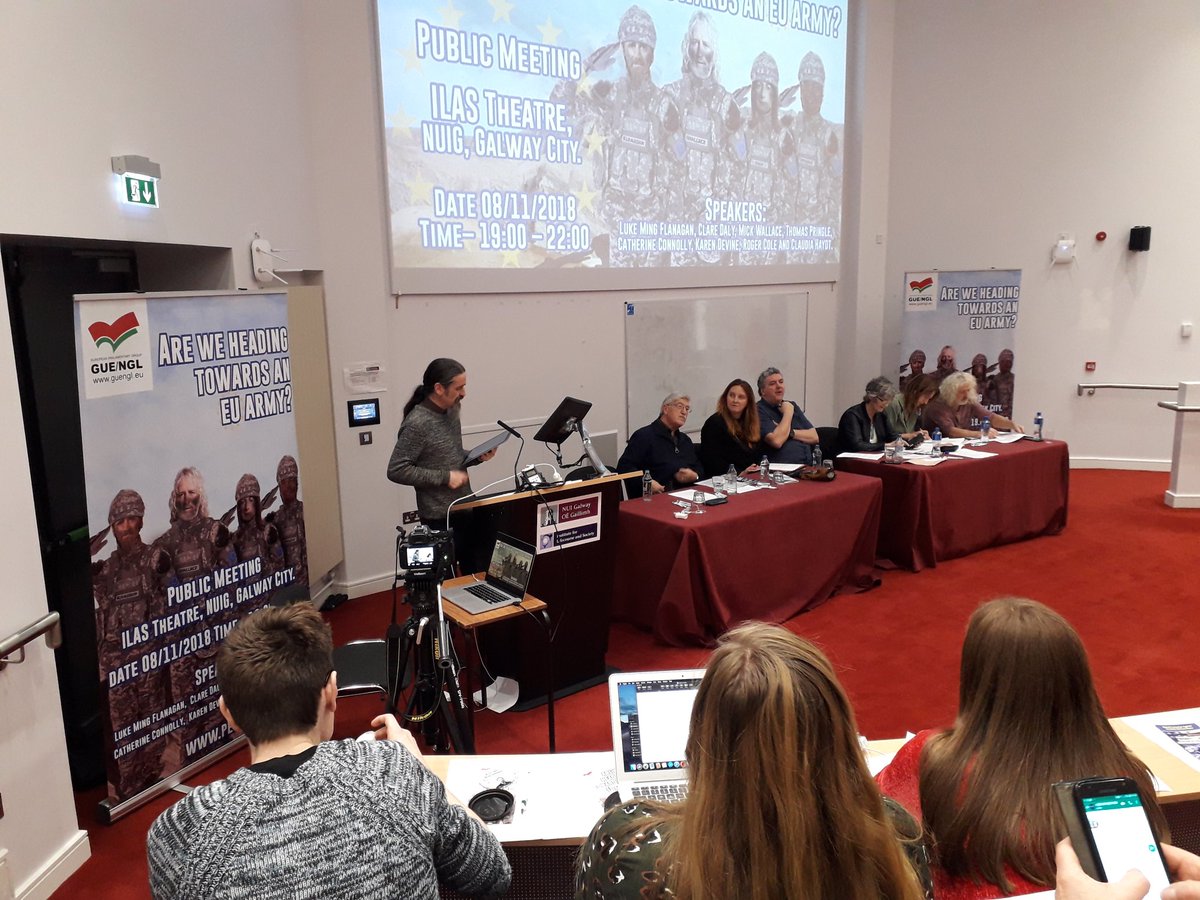
On a cold Thursday night in November, a few dozen of us congregated in a beautiful but obscure new lecture hall on the western outskirts of the sprawling campus at NUI Galway.

Two Members of the European Parliament (MEPs), four TDs, academics, and peace activists had gathered for a lively and informative three hour discussion which garnered little or no media attention.

I know, because I asked three news editors in advance of the meeting if they would be interested in a piece. Not one of them even replied.

The subject of the meeting was the thorny question of whether or not Ireland is being steamrolled into joining a European Union army since PESCO – Permanent European Security / Military Co-Operation – was rushed through the Dail last December.

In theory at least, Ireland is a “neutral” country. Luke ‘Ming’ Flanagan, the Independent MEP, called the Galway meeting in response to growing alarm over what PESCO actually means to Ireland.

Are we on our way to becoming part of a European ‘Super State’?

Is our military spending going to increase dramatically to €6 billion per year (or half of what we spend on our desperate health service) because of something our country signed up to with so little debate last year?

Does anybody care?

It is astounding that we hear so much about Brexit on the national airwaves every day, because Britain’s shambolic departure from the EU has such massive implications for Ireland, but we hear little or nothing about the contentious issue of a European Army.


The conference about the EU Army at NUI Galway this week


Are ‘Ming’ and the Independent TDs just alarmist crackpots? Is it really acceptable that unelected EU officials can lead us towards the formation of a ‘super’ army to rival those of the USA and Russia in the future?

And why, oh why, are so few Irish people talking about this?

Perhaps Irish neutrality is a sham, but shouldn’t we at least discuss this issue?

In Shannon last week, the important Shannonwatch peace group noted that a US military plane stopped off in a civilian airport on its way to and from Tel Aviv.

Nobody in authority at Shannon Airport ever checks the contents of the US military machines which have been landing there each and every week since 2001.

Last year, over 61,000 US troops stopped off in Shannon on their way to and from wars in the Middle East.

That might mean a hell of a lot of leprechaun and whiskey sales in the duty free shop, but it also makes a mockery of the concept of Irish neutrality.


A US miltiary supply plane in Shannon this week. It was on its way
'home' from Tel Aviv. Photo via Shannonwatch. 


If it wasn’t so serious, Irish people would be laughing over Brexit and the shambolic way in which pro-Brexit politicians in Britain, in their jingoistic haste to leave the EU, seem to have had no vision for the future.

Perhaps reform, rather than withdrawal, might be the correct response to an undemocratic, unaccountable Europe; but at least in Britain they have had some sort of debate about the EU and their country’s place in it.

The Irish, meanwhile, see ourselves as “model” Europeans even though it was our EU masters who forced us into the “bank bailout”, with devastating implications in terms of the loss of public service jobs, health care and welfare cuts, the privatisation of state assets, and a new wave of emigration at the start of this decade.

Not to mention the huge debt our country has been saddled with for years to come.

Now PESCO, according to the Independent TDs and MEPs, will see Ireland being steamrolled into an EU Army and it is quite amazing how little talk there is about this in Ireland.

“We have to work on a vision of creating a real true European Army,” said German Chancellor Angela Merkel this week.

French President Emmanuel Macron called for the formation of a “real” European Army during the Armistice Day commemorations last weekend.

On Tuesday, the European Commission said that a European Army is “likely” to be formed one day.

So the Galway conference this week seemed to be extremely timely.

“Does PESCO damage our neutrality?” asked Catherine Connolly TD. “Yes, it does. We are normalising war and the militarisation of Europe. PESCO was not discussed in our Dail. The good news is that 42 of us voted against it. Language has been stood on its head. We are heading towards a militarised Europe.”

She said that Irish soldiers have to rely on family income supplement in order to survive, in the middle of unprecedented crises in health care and housing.

Deputy Connolly pointed out that the head of the European Commission has never been elected by anyone and spoke of how uncomfortable she felt when he was given a reverential reception in the Dail.


A Fine Gael MEP, Brian Hayes, has called for the “redefinition” of neutrality and both Fine Gael and Fianna Fail have denied that PESCO will impact on Irish neutrality.

Independent MEP Flanagan has described the massive global arms industry as an “untapped goldmine” in the eyes of the European Union.

Just as US President Donald Trump feels that punishing human rights abuses by Saudi Arabia would only be foolish if it damaged his country’s $110 billion arms trade with Riyadh, perhaps the Irish should be far more honest with ourselves.

Does our ‘neutrality’ mean anything when we get a chance to cosy up to and find favour with the world’s military powers?

Do we want to stand beside the French and Germans as they, too, aim to become global powers?

Perhaps, ultimately, the vast sums of money to be made from militarisation are far more important than the human rights of children in Syria, Palestine, Yemen or Afghanistan as the US military aircraft land and take off from Shannon Airport with total impunity every week.

“When you question why they are militarising the European Union, you must understand that this is not to protect or defend you,” said Flanagan.

“It is about money . . . and billions of it.”


Is Ireland already facilitating war crimes in the Middle East?
The horror of Syria.


Next time you have a loved-one lying on a hospital trolley for 48 hours, or finding it impossible to find an affordable place to live, remember that PESCO is set to increase Ireland’s military expenditure six times over.

Without any real, meaningful national debate about its implications.

Sometimes, when you look at the stories which are creating headlines, it’s just as informative to check out which stories are being ignored.

When a ‘neutral’ former colony wants to be part of a new global super-power, when arms sales are more important than human lives, language truly has been stood on its head.

Neutrality means next to nothing when we have dollar signs in our eyes.


Ciaran Tierney won the Irish Current Affairs and Politics Blog of the Year Award (personal) at the Tramline, Dublin, last month. He is seeking new opportunities in a digital age. Find him on Facebook at http://facebook.com/ciarantierneymedia

Find Ciaran on Twitter https://twitter.com/ciarantierney

The first Conference Against US and NATO Military Bases takes place in Dublin this weekend. Details at https://www.facebook.com/events/304522810146150/


Tuesday, September 25, 2018

Brexit border implications never even entered some minds

Reviving memories of troubled times at the Irish border last year


In recent weeks, as Britain has hurtled towards a seemingly uncertain Brexit, many politicians in the United Kingdom have shown little or no interest in recent Irish history - or memory of the anguish of those who lived through 30 years of conflict.

Unlike those living along the 300 mile Irish border, who are waking up with increasing alarm as to the reality of what a “hard Brexit” actually means with every passing day.

People remember Bloody Sunday.

They might not have been in Derry on that terrible January afternoon, but they remember the black flags flying from houses all across the country, the sense of hopelessness, anger, and despair.

Bad enough that 14 innocent people were gunned down, but when the atrocity was committed by the State – the very forces who were supposed to protect ordinary people – the sense of isolation, of a city under siege, was palpable throughout the nationalist areas of Northern Ireland.

And the IRA described the atrocity as the greatest recruitment drive they could have hoped for in the province’s second city. Young men were queuing up to join.

Atrocities such as Bloody Sunday prolonged The Troubles


People remember Ballymurphy in Belfast, 1971.

Even though they may not have been told about it at the time.

Six months before the slaughter of innocents in Derry, British soldiers ran amok and massacred 11 people in two days.

Only nobody knew the full extent of the massacre, until a brave British TV crew put all the pieces together for a Channel 4 documentary 47 years later.

The inquests into those shootings, set to take place this coming November, will open up old wounds. How in the late 20th century the slaying of innocent people in their own housing estate could be spun into a grotesque parody of the truth.

The devastation of the Miami Showband Massacre.
Photo courtesy of Stephen Travers. 


People remember the Miami Showband massacre.

Talented young musicians, Catholic and Protestant, travelling home across the border after a wonderful gig in Co Down. Their music brought communities together at a time of too much polarisation and division.

Three men were hauled out of a van, gunned down at the side of a lonely road, after an attempt to frame them with a bomb. Their band mates left to die.

Collusion? That attack was all about the Irish border. It would have been so much easier to persuade the Irish Gardai to ramp up security at the 300 mile long border if people believed young musicians were driving around with bombs in the dead of night.

To this day, the survivors of that 1975 atrocity have never got justice or the sense of peace which comes with finding out the truth.

People of a certain vintage remember . . . and this week they have been choking on their breakfasts as Tory Brexiteers tell them that Ireland would be better off rejoining the United Kingdom and leaving the European Union.

“Re-joining the UK is the only way to reunite Ireland and the British Isles. Brexit makes Irish EU membership less logical,” tweeted one of them this week.

Irish people may have reservations about the growing power and bureaucracy of the European Union, but you would be hard pressed to find too many people who would countenance a new political union with the country which colonised our island from 1169 to 1921.

Talk of rejoining the old colonial power would be hilarious if it was not such a tragedy, if people did not worry that the Brexit drama was playing with people’s lives.

A mural in Belfast recalling one of the worst atrocities of 'The Troubles'
15 people - including two children - were killed at McGurk's Bar


Many British Brexiteers have no idea regarding the impact their words and deeds are having or the impact the return of border posts and checkpoints would have on people all along the 300 mile frontier.

In less than six months, Britain is due to have left the European Union and, already, the Irish Government has begun recruiting 450 customs and veterinary inspectors.

British politicians like Jacob Rees Mogg, Boris Johnson, and Nigel Farage do not seem to give a damn about the impact a “hard border” will have on ordinary people.

Instead, they rail against the EU for daring to contemplate splitting up the UK, seemingly with no memories of the damage caused to communities along the 300 mile long Irish border by the partition of Ireland.

Try telling a person who lives in Newry and works in Dundalk about what life will be like if he or she had to face border checkpoints every day.

Try telling young people living in Inishowen in Co Donegal that a trip to the cinema or a night club in Derry is set to become a logistical late night nightmare. After all, the border was never a ‘”real” border – it cut places such as Derry and Strabane off from much of their natural hinterlands.

Northern Ireland was created from six of Ulster’s nine counties in order to have an artificial two-thirds Unionist majority and the experience of being treated as second class citizens led the nationalist minority to rise up in search of civil rights in the late 1960s.

Of course, the British were not solely responsible for three decades of ‘The Troubles’. Far from it, in fact.

You only have to list the names of places – Omagh, Enniskillen, Manchester, Warrigton, Guildford, Mullaghmore, Kingsmill – to recall some of the terrible atrocities committed by the IRA in the name of Irish “freedom”.

Belfast's famous murals are now seen as a tourist attraction


But the British state played a huge part in creating the conditions which led to The Troubles and prolonged the violence by committing atrocities of its own.

Without Bloody Sunday, Ballymurphy, and the internment of young Catholic men, would so many young people have joined the IRA?

Would the conflict have gone on for so long?

And how can the concerns of people who have genuine fears of a return to violence, the hated border posts giving dissident republicans the motive they require, be dismissed so lightly?

People remember border checkpoints, watchtowers, and aggressive searches from gun-toting soldiers every time they popped across the road to a neighbouring town or village.

And they wonder if those awful scenes will return.

Belfast is now a fantastic place to visit, thanks to a fragile peace process.
The Titanic Quarter is now a 'must see' for tourists from all over the world


They remember the sense of elation which followed the Good Friday Agreement, the first sightings of tourists on the streets of Belfast, and how deserted those streets used to be after 7pm in the bad old days.

Not only did that historic vote bring about peace, it gave the unionists of the north a cast iron guarantee that they will never be steamrolled into a United Ireland against their will. It showed that, for all our differences, ordinary Irish people value peace and compromise over ancient tribal divisions.

Now the murals on the Belfast walls teach tourists about a bygone era.

Now people flock to the wonderful Titanic Belfast, because it's one of the most amazing attractions in Europe. Tourists in Belfast . . . what a strange concept that would have been three decades ago!

People have had 20 years of a fragile peace now and they cannot believe how quick jingoistic politicians in London are to dismiss their concerns.

Such as Jacob Rees Mogg MP, who said there was no need for him to visit the Irish border in order for him to understand it (although he was shamed into finally doing so in July).

Or his Conservative party colleague Boris Johnson, who pointed out that there was no border between two suburbs of London as some sort of a valid contribution to the “hard Brexit” debate.

Or Nigel Farage, of UKIP, who called on the Irish people to leave Europe when he visited Dublin in February of this year. He accused the Taoiseach, Leo Varadkar, of “taking Brussels’ side against Britain”, which was not “in the best interest of his country”.

Not for them concerns that 56% of the people of Northern Ireland voted against leaving the EU, that 3,600 people died in the conflict, or that peace remains fragile in a place in which two communities largely live their lives apart from each other, in terms of schooling, housing, or even where they socialise or work.

Twenty years after the Good Friday Agreement brought a welcome peace, transforming life in the North completely, 90% of the housing estates are still segregated; and nationalist and loyalist communities are divided by 90 “peace walls”.

The European Union underpinned the 1998 Good Friday Agreement, which is tied into 142 areas of north-south co-operation, and yet blustering Brexiteers are claiming that the EU should have no role in the future of Northern Ireland.

It’s not nice to realise that you are seen as peripheral, that your concerns don’t matter in the corridors of power in London.

People in Northern Ireland look around now and see a place brimful of hope, of normal life, with tourists enjoying themselves from all over the world, and wonder how anyone could even countenance a return to a “hard border” and the hated signs of division they were sure they had left behind.

And all because some people in Britain were so keen to break their ties with Europe that the implications for Ireland’s border communities never even entered their minds when they voted for Brexit two years ago.


Ciaran Tierney is a journalist, blogger, and digital storyteller, based in Galway, Ireland. Find him on Facebook at http://facebook.com/ciarantierneymedia/


Monday, September 17, 2018

Call off the blimp!

The Donald Trump 'blimp' is not coming to Ireland after all 


Let’s call off the blimp, because Mr President is not coming after all.

Well, not yet, at any rate!

It has been amazing to hear so many people in Ireland express regret that President Trump has postponed (or cancelled) his Irish visit this coming November.

They were so fired up that many said they were looking forward to joining a political protest for the first time.

Irish protesters had to reach out to their counterparts in the UK, who turned out in their thousands to make the President feel so unwelcome when he visited London back in July.

Sorry, they said, we won’t need to ship the giant orange “baby blimp” to Ireland after all!

People in Dublin were really looking forward to the sight of a giant baby Donald in a nappy floating across the skyline.

And a hugely successful crowdfunding campaign had already covered the cost of bringing over the six metre high blimp within days of being set up.

Everyone, it seemed, wanted to be part of mass protests against the US President. The sense of anti-climax was palpable as soon as the White House announced that he had postponed his travel plans.

The leaders of two opposition parties, Labour and the Greens, had come  together to announce plans for a joint rally for “democracy, decency, and international solidarity” in Dublin.

As though such concepts, so alien to Mr Trump, were plentiful across the political spectrum here in Ireland.

Labour Party leader Brendan Howlin went as far as to say that President Trump was “no friend of democracy or human rights”.

Mr Howlin said it was important to stand up to Trump on issues such as climate change, the treatment of migrant and asylum-seekers, spending on arms, and the slashing of aid budgets.

In Galway, the local anti-racism group wanted hundreds of people to gather to spell out the words “Feck off Trump” (with a little Irish humour, from the ‘Father Ted’ TV series) on a beach.

In much different times, President John Fitzgerald Kennedy addressed 50,000 people in Eyre Square and the city authorities renamed it as Kennedy Park in his honour.

We are unlikely to see a ‘Trump Park’ in Galway any time in this millennium.

So many Irish people wanted to protest against Trump in November


So many people are disappointed that the street protests are off. They wanted to convey a firm message that Trump’s policies have no place in a modern, prosperous, outward-looking Ireland.

They want to reject the anti-immigrant rhetoric on an island where emigration provided the only refuge for the afflicted through much of the 19th and 20th centuries.

The street protests are off . . . as though there was nothing to protest about closer to home.

The economy might be in recovery, but the recovery does not seem to have reached so many Irish people who are struggling to keep a roof over their heads.

Last week, masked thugs – protected by masked Gardai – used heavy-handed tactics to evict homelessness campaigners from an empty building in Dublin.


Marcing in solidarity with homelessness campaigners
in Galway city centre last week


The sight of masked policemen with no identification on their uniforms caused consternation at a time when there are almost 10,000 people living in emergency accommodation across Ireland.

And now our Minister for Justice says he would support moves to criminalise the photographing of Gardai as they carry out their duties.

Such a move would be an attack on press freedom and should lead to questions as to what the Gardai have to hide.

Would that mean banning photos of public events such as GAA games or the annual Macnas Parade?

The last time I checked such measures were only being considered in states such as Israel, where an oppressive occupation force has a vested interest in covering up its crimes in the West Bank.

Given recent Irish history, we don’t have to cross the Atlantic in search of police forces who abuse their power. In fact the filming of protests has helped to prevent injustice from occurring.

So, instead of worrying about Trump, perhaps we should be looking at how power is being abused much closer to home.

Children sleeping in a Garda Station in Dublin


Last month, a photo of homeless children sleeping in a Garda Station went viral. The youngsters had to sleep on hard chairs in the police station because there was nowhere else for them to go.

The distraught mother who took that photo could soon be guilty of a crime.

Last week, a photo of a sick and distressed 92-year old woman sitting on a chair in a public hospital Emergency Department went viral.

Gladys Cummins posted the photo on Facebook out of frustration and despair. Her mother did not even have a trolley, as she spent 25 hours sitting on that chair.

Two months ago, I saw a 93-year old family member spent 48 hours on a trolley in the ED Department in Galway. The unacceptable has become acceptable and lengthy waiting lists in our public hospitals have become the new norm.

In a supposedly “socialised” health service – compared to the US at any rate – the old and the weak are being forced to spend days lying in corridors in overcrowded facilities.

But Irish people are not taking to the streets to protest about our health crisis.

In June, Irish people became outraged by the images of child migrants on the US-Mexico border crying in distress after being separated from their families. They were outraged by Trump.

Yet few of them have much awareness of the hardships endured by those who spend up to seven or eight years in Ireland’s own Direct Provision system.


A protest against Direct Provision in Dublin


About 5,000 asylum-seekers are detained at 31 accommodation centres without permission to work, or even to cook for their children. Among them are 2,000 children, growing up in highly inappropriate shared spaces with adults from a variety of countries.

Direct Provision centres have been described as the Magdalene Laundries and Mother and Baby Homes of our times. Some even see them as a "time bomb" for future problems to come.

We have British politicians steamrolling headlong towards Brexit, with little or no awareness that their dangerous language is threatening the peace process which transformed life in Northern Ireland over the past 20 years.

We have the families of victims of loyalist collusion who are shocked that a former member of the Royal Ulster Constabulary is now at the helm of the Irish Gardai.

They believe he has questions to ask about their long search for justice for atrocities such as the Miami Showband Massacre and the Dublin and Monaghan bombings.

We rant against Trump for his sexism, at a time when Irish society has been convulsed by a cervical smear test scandal in which the Irish Government treated Irish women appallingly this year.

A lot of Irish people are disappointed that they won’t get a chance to protest against President Trump, but let’s not pretend that we don’t have some pressing problems much closer to home.


Would you like to advertise on this blog? Please email ciaran@ciarantierney.com if you would like to find out more! 

Ciaran Tierney is a journalist, blogger, and digital storyteller, based in Galway, Ireland. Find him at http://ciarantierney.com/


Thursday, December 14, 2017

Do the Irish really need to "get over themselves"?

In Derry, most people can't forget the past.
In Britain, some people don't even know it. 


Are the Irish an over-sensitive lot?

Is it really worthy of a national debate – and even a Twitter tag – when a British TV presenter goes on social media to tell us that some of us “need to get over ourselves”?

And all because he described a row between the British and the Irish over the impact ‘Brexit’ will have on the Irish border as a “kerfuffle” in an interview with the Irish Tanaiste (or Deputy Prime Minister)!

The online reaction to a Twitter outburst by Sky News presenter Adam Boulton might have been something of a storm in a tea-cup this week, but it comes at a time when Irish people are deeply alarmed by the attitudes they are hearing from some people on the other side of the Irish Sea.

Not to mention general disquiet over the impact Brexit will have on the Irish economy, particularly in border communities which were devastated by 30 years of The Troubles until the 1998 Good Friday Agreement brought wonderful changes to all of our lives.

The Republic exports €15.6 billion worth of goods to the United Kingdom each year and will have the only land border between the UK and the European Union once the Brexit divorce proceedings are completed.

As is often the case when a small country is located next to a much bigger neighbour, the Irish know far more about the British than the people on the bigger island do about the Emerald Isle.

Thousands of Irish people make the short journeys to Britain each week to cheer on the footballers of Liverpool, Manchester United, or Arsenal, often to the detriment of their local soccer clubs.

Thousands more love soap operas such as ‘Coronation Street’ and ‘East Enders’ and follow the gossip involving British celebrities through tabloid newspapers and magazines which circulate widely in Ireland.

It might be hard to believe, but some people even talk about the British ‘royal family’ around the water coolers at their workplaces.

Adam Boulton's remarks about the Irish kicked up a storm


The engagement of a British prince can generate headlines in Irish newspapers, without a hint of irony, whereas many people in the UK would struggle to identify the President of Ireland, Michael D. Higgins, if his photo appeared in a glossy magazine.

Given the vast differences in population between the two countries, Britain has 65 million citizens compared to 4.7 million in the Republic, it is no surprise that British TV is widely watched on the other side of the Irish Sea.

Until the recent “kerfuffle” over the impact Brexit will have on the Irish border, it’s fair to say that relationships between the two countries were never better than we have seen over the past two decades ago.

The Good Friday Agreement brought peace, respect for diversity, and guarantees for the Unionist population in the north-east of the island that they won’t be steamrolled into a United Ireland against their will.

It also brought about the demolition of the hated border posts and checkpoints, opening up the joys of the North to tourists for the first time.

Until the mid-1990s, tourists were virtually unheard of in Northern Ireland. Now Belfast is seen as one of the best cities to visit in the world and thousands visit to explore the landscapes made famous by 'Game of Thrones'.

Times have changed since the only time Northern Ireland made the UK news was for bombings or shootings and people in London used to warn tourists to stay well clear of the province.

Relationships have changed beyond all recognition. How much things have improved was evident in the State visit by Queen Elizabeth to Ireland in 2011.                         
Northern nationalists feel they have been
forgotten or abandoned post-Brexit

People were surprised, shocked even, by the warm welcome the British monarch received during her three day visit, given the symbolism attached to royalty throughout hundreds of years of colonisation.

But the relationship between Britain and Ireland has never been black and white and up to six million people in the UK have at least one Irish grandparent.

Like the US, Canada, and Australia, Britain has often provided a ‘safety valve’ for a land which has seen so many of its children emigrate to forge out brighter futures.

In the 1950s and again in the 1980s, when Ireland failed to provide hope to so many of its people, thousands upon thousands of Irish people poured into British cities in search of new lives.

Almost everyone on the island of Ireland has some family connections to Britain. In the European Union, the British were often the Irish people’s closest allies as two English-speaking islands on the western periphery of the continent.

But, since the shock of the Brexit vote in June of last year, many Irish people have become alarmed by some of the language they are hearing from across the Irish Sea.

Throughout the Brexit debate, there seemed to be barely a mention in the British media over the implications there would be for communities along the Irish border if the UK was to leave the EU.

A tabloid editor told our Taoiseach, Leo Varadkar, recently to “shut his gob” even though this issue has massive implications for Ireland for generations to come.

We have heard people wonder why Ireland does not also leave the EU, or even why we don’t rejoin the UK – as if they are totally oblivious to the terrible history of conflict, oppression, and suspicion between the two countries going back over 800 years.

We have been shocked to hear people celebrate our common language, with not a semblance of understanding of the way in which the British authorities went about killing off the Irish language over two centuries.

A graphic illustrating the decline of the Irish language.


Not many British people would be aware that, under the Penal Laws, it was illegal for Catholics to teach in schools between 1695 and 1782. Education through Irish was confined to 'hedge schools' until the 1840s, when the Great Famine took the lives of a million Irish people.

Just this week, 200 nationalists across Northern Ireland wrote a letter to the Irish News to express how alienated and abandoned they feel in the era of a Brexit vote which was rejected by 56% of voters in the province.

At a time when the Democratic Unionist Party holds the balance of power in London, their letter came as a grim reminder of the sectarian state which treated Catholics as second class citizens from partition in the 1920s until the eruption of the Troubles in the late 1960s.

Nobody wants to see a return to those dark days and perhaps it is true that the Irish cannot forget their history of famine, deprivation, and emigration.

But sometimes Irish people get the feeling that their counterparts in the UK are totally oblivious to their own country’s history of oppression and occupation in Ireland.

Respect works both ways. One land cannot seem to forget its past, and the other sometimes shows that it knows nothing about it.

A throwaway remark by a Sky News TV presenter might have generated an over-reaction and, yes, perhaps Irish people need to lighten up a bit and leave our sense of victimhood behind.

But the loudest Brexit supporters in Britain, who did not seem to have a concrete plan for life after leaving the EU, should not be so surprised that people in Ireland have massive concerns over the impact which their vote will have on all of our lives.

Check out my business website at http://ciarantierney.com/

Ciaran Tierney is a journalist, blogger, and digital storyteller, based in Galway, Ireland. Find him on Facebook at https://www.facebook.com/ciarantierneymedia/

Find Ciaran Tierney on Twitter, https://twitter.com/ciarantierney

Thursday, December 7, 2017

Bluster over Brexit shows many wounds have yet to be healed

Irene from Manchester, England, was very upset.                                 
Nobody wants a return to border checkpoints

She thought it was terrible that a small little island has been holding up those important Brexit negotiations.

She wrote to a newspaper this week to say that the island next door to Britain was “too small to have a border” and “causes everybody a headache”.

In her opinion, Ireland “should never have been split”.

She said it was about time the Irish made up their minds, to decide whether they were “in or out” of the wonderful United Kingdom.

It seemed to have escaped her attention that the Irish pretty much made their minds up about the British Empire a long time ago.

They spent hundreds of years trying to break free; issues such as the Plantation of Ulster, the Great Famine, the Penal Laws, and the attempted destruction of their native language might just have helped the pesky peasants to “make up their minds”.

Irene was quite shocked to discover that this little island to the west had a border, the only land frontier between the departing Great Britain and its former partners in the European Union – apart from that wonderful piece of Britain down on the Rock of Gibraltar.

Presumably, when she voted for Brexit last year, Irene did not think too much about the niceties or the consequences for the farmers or commuters dotted along the border in Tyrone, Fermanagh, or South Armagh.

She wasn't alone. How many times did the 300 border crossings feature in the Brexit debate in Britain last year?

It might have been news to Irene that few of the Irish were too happy about the border when it was invented back in 1922.

She had probably never heard of Michael Collins, sent to London to negotiate a peace deal for the Irish ‘terrorists’ at the cost of a border, a terrible civil war, and the loss of his own life.

The editor of The Sun was pretty upset last week, too.

His newspaper, owned by Rupert Murdoch, has longed for the day when “floods” of immigrants would no longer be able to access Great Britain via the port of Dover.

The tabloid campaigned vigorously for Britain to leave the European Union and how darn annoying it was in recent weeks to see a former colony delay the Brexit negotiations because of an inconvenient land border.

Papers like The Sun and The Daily Mail were gung-ho in their calls for a Brexit vote last year and one of the London tabloid’s columnists, Katie Hopkins, compared migrants to cockroaches at the height of the debate.

It's pretty hard to have a rational debate with someone who compares human beings fleeing wars to cockroaches.

“Rescue boats? I’d use gunships to stop migrants,” was the headline on one of Katie’s pieces, before she referred to migrants who try to board trucks heading to Britain as “a plague of feral humans” in The Sun.

The Sun in 2017 is the modern equivalent of the 18th and 19th century British publications which referred to Irish people as less than human, even as a million of them starved under the British Empire and poverty drove a further two million to emigrate to North America.

Irony and respect for the neighbours is lost on The Sun, who advised the Irish Taoiseach to “shut your gob and grow up” when he expressed concerns over the impact a ‘hard’ Brexit would have on communities either side of the Irish border.

An Taoiseach: told to "shut his gob" about Brexit


The Sun let An Taoiseach know, in no uncertain terms, that 17.4 million people voted for Britain to leave the European Union and reminded him that British billions “stopped Ireland going bust” as recently as seven years ago.

Arlene from Fermanagh was also upset.

On Monday, she put a spanner in the works of the Brexit negotiations.

Arlene is more British than Irish and the party she leads, the Democratic Unionist Party (DUP), has the balance of power at Westminster.

She found a deal which made a distinction between Northern Ireland and the rest of the United Kingdom, to prevent a hard border, unacceptable.

She’d rather have massive inconvenience for people in her region who regularly cross the border than any “divergence” which might separate Fermanagh from London or Liverpool.

Many people in Ireland find it ironic that the DUP see themselves as more British than Irish, yet do not want to bring in the kind of legislation which would bring the province’s abortion or marriage equality legislation in line with the rest of the United Kingdom.

When it comes to the relationships between the two islands, perhaps Irene is right after all and the smaller island really does “cause everybody a headache”.

Always has.

Murals in Belfast depict the long struggle
for Irish freedom from the British Empire
In 1847, for example, 15,000 Great Famine refugees were deported from England back to Ireland. Even though Ireland was part of the British Empire, it was made very clear by the authorities that the deaths of over a million people were an Irish – not a British – problem.

Relations have improved considerably between the two islands over the century which has passed since the 1916 Easter Rising and the executions of the Irish rebel leaders which eventually led to independence for most of Ireland.

Things have particularly improved over the past 20 years, since the Good Friday Agreement brought peace, joy, and prosperity to both parts of the island and the removal of the despised observation posts and military checkpoints along the border.

The ugly tower blocks have been removed and there are no longer British Army soldiers pointing guns at passing motorists but, clearly, less visible wounds remain.

Prior to the Brexit referendum in June 2016, when 51.9% of UK voters chose to leave the European Union, there was a long and lengthy debate about issues such as immigration, free movement, trade deals, and British sovereignty.                                             

Looking back now, the Irish border and the implications for people living and working in border counties barely featured in the debates across England.

If Ireland isn’t causing everybody a headache, it’s pretty much an afterthought for voters throughout Britain - pretty much how it has always been throughout centuries of animosity, misunderstanding, occupation, and suspicion.

Thankfully, the dispute over the border has been resolved and Irish people are delighted they will not see a return to British Army checkpoints when travelling from Letterkenny to Derry or Dundalk to Newry.

In standing up to the sabre-rattling Unionists this week, and achieving a deal which will not plunge border communities into disarray, An Taoiseach Leo Varadkar has done Ireland proud.

But, if nothing else, the tempestuous ‘hard’ Brexit negotiations managed to remind Irish people that there are still some appalling attitudes to Ireland and the Irish among some politicians and commentators on the other side of the Irish Sea.


Ciaran Tierney is a journalist, blogger, and digital storyteller, based in Galway. Ireland. Find him on Facebook at http://facebook.com/ciarantierneymedia

Find Ciaran Tierney on Twitter, https://twitter.com/ciarantierney

Thursday, January 5, 2017

A bluffer's guide to an eventful 2017

Check out my Facebook business page


For many people I know, 2016 was a horrible year.

Too many faced job insecurities or even job losses, relationship breakdowns, and financial worries about the future. Many felt they were only a pay cheque away from homelessness, with rents increasing and the prospect of buying a home in Ireland becoming ever more remote for an entire generation.

The crisis in our health service left far too many vulnerable people lying on trollies and all across the globe thousands of people lost their lives in appalling wars.              
The Donald: set to make a big impact in 2017

We saw many of our musical heroes pass away, while the Brexit and Trump votes seemed to suggest that hatred and fear had overcome love and understanding on both sides of the Atlantic.

People began to wake up to the appalling reality of climate change, only to realize that a man who completely denies the reality of pending environmental catastrophe had become the most powerful politician on the planet late in the year.

But the start of January is a time for renewal and change, and perhaps looking forward to a brighter future.

When I used to work in the newspaper business, I often wrote my predictions for the New Year.

So, for what it’s worth, here’s my tongue-in-cheek assessment of what 2017 has in store.

JANUARY
The Irish Times publishes a piece called ‘Why fascism is trendy again’ on the eve of the inauguration of US President Donald Trump in Washington DC. The event itself proves to be something of a damp squid, as Mexicans, Muslims, women, gays, gun-owners and liberals are banned from the ceremony. The only two foreign leaders to attend are from Holland and Northern Ireland, after Trump insists it’s an “orange only” event.

An Taoiseach Enda Kenny: our own wonderful leader

FEBRUARY
With an unprecedented number of patients on trolleys in Ireland’s public hospitals, An Taoiseach Enda Kenny is accused of gross hypocrisy when he takes a private jet to the United States for emergency heart surgery.

However, the emergency is quickly forgotten as a team of surgeons at a highly rated private clinic in New York fail to find his vital organ. Following his release from hospital, an emotional Mr Kenny calls on President Trump to give an amnesty to the “undocumented” Irish in the US who were unable to go home for Christmas.

MARCH
After returning to Ireland, Mr Kenny calls for an immediate clampdown on “illegal” immigration to Ireland. “This might be the best little country in the world to do business in, but our small island hasn’t got room for all these niggers,” he tells a Fine Gael function in his native Castlebar. After a reporter from the Mayo Gazette secretly records his speech, he accuses the media of lacking a sense of humour and promises to sell the Gazette to his close friend, Denis O’Brien.

Trump, meanwhile, pledges $100 billion in military aid to Israel, on his first overseas trip since taking office. “It’s simply inhumane to expect Israelis to live on just 78% of Palestinian land,” he says. “I’m very strong on Israel. I’m so strong on Israel, in fact, that I’m gonna kick the UN out of New York for daring to question their policies. I’m gonna make Israel great again.”

APRIL
Niamh Horan of the Sunday Independent courts controversy by organising a five page “Fascism is Fashionable” feature, with photo shoots of columnists Ian O’Doherty and Brendan O’Connor dressed up in Ku Klux Klan costumes. Controversy rages over the lack of security at Dublin Airport when UK columnist Katie Hopkins disguises herself as a cockroach when flying in for the feature.

Amazingly, security and customs personnel failed to notice any difference and waved Ms Hopkins through without even looking at her passport.

Is this Katie or a cockroach? Who knows?

MAY
Shannon Airport is in the news this month when management celebrate the arrival of the 5 millionth US soldier at the ‘neutral’ facility. A proposed party to welcome the soldier, on his way home from Iraq, has to be cancelled when white phosphorous is released from his plane, causing the deaths of 48 Ryanair passengers on their way to London.

Thankfully, no US soldiers were injured in the accident. And Michael O’Leary was presented with an Irish business innovation award when he managed to have his plane back in the air within four hours of the incident.

JUNE
Billionaire tycoon Denis O’Brien commissions a report which finds that Rupert Murdoch of News International has too much influence on the Irish media. By complete coincidence, Murdoch’s Sunday Times commissions a report which finds that O’Brien has too much influence on the Irish media.

O’Brien buys up every remaining regional newspaper in Ireland, while Murdoch purchases all of the country’s “independent” radio stations. New Minister for Communications Michael Lowry expresses complete satisfaction with both deals.

JULY
The five million Native Americans in the US are baffled when President Trump warns them that they will be deported “along with all the Mexicans and Muslims”. A new “Orange Lives Matter” movement is born in the USA to counteract vicious lies about police brutality and Guantanamo Bay in Cuba begins to fill up with environmental scientists after the phrase “climate change” is banned by the US Congress.

AUGUST
Tax exile Bono becomes Freeman of the City after spending three nights “sleeping out” on Grafton Street in Dublin to raise awareness of homelessness. However, he calls the Gardai when a real live homeless person turns up at his occasional Dalkey home. Later in the month, he’s presented with an award for services to humanity by UN Secretary General Ivanka Trump.

“Every day, the poor people of Africa must thank their lucky stars that they have a brilliant, billionaire Irish singer to speak out on their behalf,” she said at the award ceremony at Trump Tower Two, the new name for the UN HQ in New York. Back home, Ireland becomes the first country in Europe to successfully sue the EU in order to make sure that it did not get money owed to it.

Taoiseach Kenny says he’s delighted he won’t have to take €17 billion in taxes owed by Apple Inc, as it would do “enormous damage” to Ireland’s reputation as a great little country to do business in.


SEPTEMBER
Fears that RTE would have to go into liquidation due to financial difficulties are allayed when TV presenter Ryan Tubridy agrees to take a five per cent pay cut. Mayo win the All-Ireland football final (sorry …. That bit is made up!), no, actually, Dublin and Kilkenny win the football and hurling respectively. Hurling fans all over the country come together to hire Dublin drugs gang the Keenihans to ‘take out’ Kilkenny boss Brian Cody.

RTE are faced by a flood of complaints when crime journalist Paul Williams appears on the ‘Late Late Show’ for the 50th time, but lets his fans down badly by failing to utter the word “scumbag” once during his 45 minute appearance with Ryan Tubridy.

OCTOBER
Gardai issue an apology after a banker is arrested for drunk driving. An Taoiseach Enda Kenny summons the Garda Commissioner to his office to remind her that no banker is to be arrested for any offence, ever. The Government announces that Irish Water is to be revived and advertises for a new CEO, to be paid €400,000 per year. A demonstration against Irish Water attracts 30,000 people to the streets of the capital, but organisers claim that 100,000 took part and Gardai deny that it even happened.

Promises, promises ... but sure they're only promises!

NOVEMBER
The Prime Minister of Israel, Benjamin Netyanahu, is awarded the highly prestigious Tipperary Peace Prize. Human rights organisations condemn the prize, pointing out that Israeli soldiers have killed 1,500 people so far in 2017. A spokesman for the committee, Alan Kelly, says that this is a big decrease on the 2016 figure.

“And, anyway, sure, he’ll bring a crowd and he’ll give us a bit of publicity,” say Kelly.

Russian jets bomb 85 civilians to death in Syria on the same day as US fighters murder 85 civilians in Iraq. RT provide excellent coverage of the Iraqi deaths, but say those in Syria never happened. Fox News, now allowed 24/7 access to the White House for a new series called ‘The Don Knows Best’, accuse RT of “fake news” and call for the Russian TV channel to be banned from America.

“Unlike all the others, Fox gets it,” says Trump.

DECEMBER
A visit by US President Donald Trump to China turns controversial when the Chinese hosts fail to place a giant mirror in his Shanghai hotel bedroom. Enraged, Trump returns to Washington DC, where he presses the red button to blow the Chinese … and the rest of us … to Armageddon.

So ... that's the coming year for you.

It’s going to be a lot more eventful than 2016.

Happy New Year!


http://ciarantierney.com/

From the archives: An Uncomfortable Truth for Culture Night