Showing posts with label European Union. Show all posts

Thursday, November 15, 2018

Neutrality means nothing when we have dollar signs in our eyes

Remembering a Syrian child, who was murdered in a US airstrike,
during the monthly Shannonwatch protest at Shannon

Irish Current Affairs Blog of the Year 2018


On a cold Thursday night in November, a few dozen of us congregated in a beautiful but obscure new lecture hall on the western outskirts of the sprawling campus at NUI Galway.

Two Members of the European Parliament (MEPs), four TDs, academics, and peace activists had gathered for a lively and informative three hour discussion which garnered little or no media attention.

I know, because I asked three news editors in advance of the meeting if they would be interested in a piece. Not one of them even replied.

The subject of the meeting was the thorny question of whether or not Ireland is being steamrolled into joining a European Union army since PESCO – Permanent European Security / Military Co-Operation – was rushed through the Dail last December.

In theory at least, Ireland is a “neutral” country. Luke ‘Ming’ Flanagan, the Independent MEP, called the Galway meeting in response to growing alarm over what PESCO actually means to Ireland.

Are we on our way to becoming part of a European ‘Super State’?

Is our military spending going to increase dramatically to €6 billion per year (or half of what we spend on our desperate health service) because of something our country signed up to with so little debate last year?

Does anybody care?

It is astounding that we hear so much about Brexit on the national airwaves every day, because Britain’s shambolic departure from the EU has such massive implications for Ireland, but we hear little or nothing about the contentious issue of a European Army.
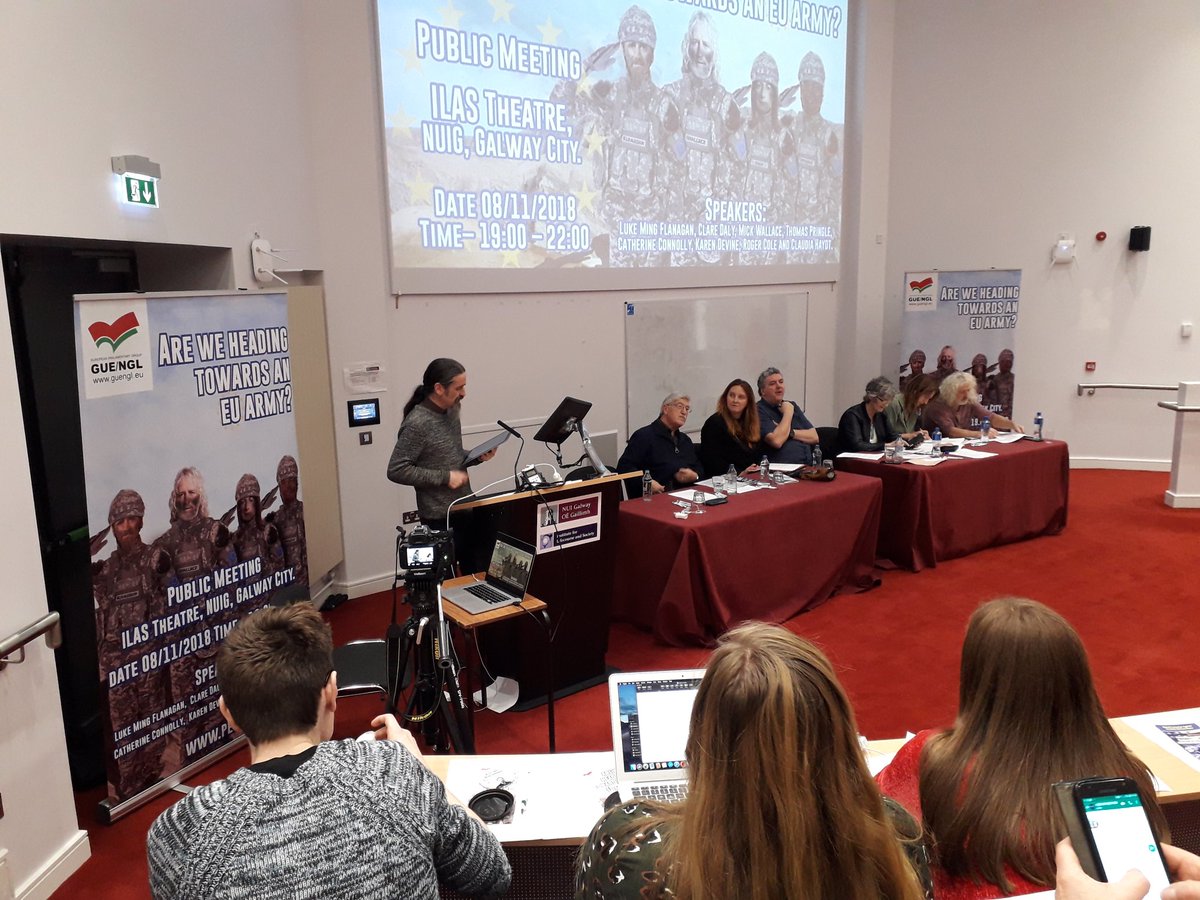

The conference about the EU Army at NUI Galway this week


Are ‘Ming’ and the Independent TDs just alarmist crackpots? Is it really acceptable that unelected EU officials can lead us towards the formation of a ‘super’ army to rival those of the USA and Russia in the future?

And why, oh why, are so few Irish people talking about this?

Perhaps Irish neutrality is a sham, but shouldn’t we at least discuss this issue?

In Shannon last week, the important Shannonwatch peace group noted that a US military plane stopped off in a civilian airport on its way to and from Tel Aviv.

Nobody in authority at Shannon Airport ever checks the contents of the US military machines which have been landing there each and every week since 2001.

Last year, over 61,000 US troops stopped off in Shannon on their way to and from wars in the Middle East.

That might mean a hell of a lot of leprechaun and whiskey sales in the duty free shop, but it also makes a mockery of the concept of Irish neutrality.


A US miltiary supply plane in Shannon this week. It was on its way
'home' from Tel Aviv. Photo via Shannonwatch. 


If it wasn’t so serious, Irish people would be laughing over Brexit and the shambolic way in which pro-Brexit politicians in Britain, in their jingoistic haste to leave the EU, seem to have had no vision for the future.

Perhaps reform, rather than withdrawal, might be the correct response to an undemocratic, unaccountable Europe; but at least in Britain they have had some sort of debate about the EU and their country’s place in it.

The Irish, meanwhile, see ourselves as “model” Europeans even though it was our EU masters who forced us into the “bank bailout”, with devastating implications in terms of the loss of public service jobs, health care and welfare cuts, the privatisation of state assets, and a new wave of emigration at the start of this decade.

Not to mention the huge debt our country has been saddled with for years to come.

Now PESCO, according to the Independent TDs and MEPs, will see Ireland being steamrolled into an EU Army and it is quite amazing how little talk there is about this in Ireland.

“We have to work on a vision of creating a real true European Army,” said German Chancellor Angela Merkel this week.

French President Emmanuel Macron called for the formation of a “real” European Army during the Armistice Day commemorations last weekend.

On Tuesday, the European Commission said that a European Army is “likely” to be formed one day.

So the Galway conference this week seemed to be extremely timely.

“Does PESCO damage our neutrality?” asked Catherine Connolly TD. “Yes, it does. We are normalising war and the militarisation of Europe. PESCO was not discussed in our Dail. The good news is that 42 of us voted against it. Language has been stood on its head. We are heading towards a militarised Europe.”

She said that Irish soldiers have to rely on family income supplement in order to survive, in the middle of unprecedented crises in health care and housing.

Deputy Connolly pointed out that the head of the European Commission has never been elected by anyone and spoke of how uncomfortable she felt when he was given a reverential reception in the Dail.


A Fine Gael MEP, Brian Hayes, has called for the “redefinition” of neutrality and both Fine Gael and Fianna Fail have denied that PESCO will impact on Irish neutrality.

Independent MEP Flanagan has described the massive global arms industry as an “untapped goldmine” in the eyes of the European Union.

Just as US President Donald Trump feels that punishing human rights abuses by Saudi Arabia would only be foolish if it damaged his country’s $110 billion arms trade with Riyadh, perhaps the Irish should be far more honest with ourselves.

Does our ‘neutrality’ mean anything when we get a chance to cosy up to and find favour with the world’s military powers?

Do we want to stand beside the French and Germans as they, too, aim to become global powers?

Perhaps, ultimately, the vast sums of money to be made from militarisation are far more important than the human rights of children in Syria, Palestine, Yemen or Afghanistan as the US military aircraft land and take off from Shannon Airport with total impunity every week.

“When you question why they are militarising the European Union, you must understand that this is not to protect or defend you,” said Flanagan.

“It is about money . . . and billions of it.”


Is Ireland already facilitating war crimes in the Middle East?
The horror of Syria.


Next time you have a loved-one lying on a hospital trolley for 48 hours, or finding it impossible to find an affordable place to live, remember that PESCO is set to increase Ireland’s military expenditure six times over.

Without any real, meaningful national debate about its implications.

Sometimes, when you look at the stories which are creating headlines, it’s just as informative to check out which stories are being ignored.

When a ‘neutral’ former colony wants to be part of a new global super-power, when arms sales are more important than human lives, language truly has been stood on its head.

Neutrality means next to nothing when we have dollar signs in our eyes.


Ciaran Tierney won the Irish Current Affairs and Politics Blog of the Year Award (personal) at the Tramline, Dublin, last month. He is seeking new opportunities in a digital age. Find him on Facebook at http://facebook.com/ciarantierneymedia

Find Ciaran on Twitter https://twitter.com/ciarantierney

The first Conference Against US and NATO Military Bases takes place in Dublin this weekend. Details at https://www.facebook.com/events/304522810146150/


Tuesday, September 25, 2018

Brexit border implications never even entered some minds

Reviving memories of troubled times at the Irish border last year


In recent weeks, as Britain has hurtled towards a seemingly uncertain Brexit, many politicians in the United Kingdom have shown little or no interest in recent Irish history - or memory of the anguish of those who lived through 30 years of conflict.

Unlike those living along the 300 mile Irish border, who are waking up with increasing alarm as to the reality of what a “hard Brexit” actually means with every passing day.

People remember Bloody Sunday.

They might not have been in Derry on that terrible January afternoon, but they remember the black flags flying from houses all across the country, the sense of hopelessness, anger, and despair.

Bad enough that 14 innocent people were gunned down, but when the atrocity was committed by the State – the very forces who were supposed to protect ordinary people – the sense of isolation, of a city under siege, was palpable throughout the nationalist areas of Northern Ireland.

And the IRA described the atrocity as the greatest recruitment drive they could have hoped for in the province’s second city. Young men were queuing up to join.

Atrocities such as Bloody Sunday prolonged The Troubles


People remember Ballymurphy in Belfast, 1971.

Even though they may not have been told about it at the time.

Six months before the slaughter of innocents in Derry, British soldiers ran amok and massacred 11 people in two days.

Only nobody knew the full extent of the massacre, until a brave British TV crew put all the pieces together for a Channel 4 documentary 47 years later.

The inquests into those shootings, set to take place this coming November, will open up old wounds. How in the late 20th century the slaying of innocent people in their own housing estate could be spun into a grotesque parody of the truth.

The devastation of the Miami Showband Massacre.
Photo courtesy of Stephen Travers. 


People remember the Miami Showband massacre.

Talented young musicians, Catholic and Protestant, travelling home across the border after a wonderful gig in Co Down. Their music brought communities together at a time of too much polarisation and division.

Three men were hauled out of a van, gunned down at the side of a lonely road, after an attempt to frame them with a bomb. Their band mates left to die.

Collusion? That attack was all about the Irish border. It would have been so much easier to persuade the Irish Gardai to ramp up security at the 300 mile long border if people believed young musicians were driving around with bombs in the dead of night.

To this day, the survivors of that 1975 atrocity have never got justice or the sense of peace which comes with finding out the truth.

People of a certain vintage remember . . . and this week they have been choking on their breakfasts as Tory Brexiteers tell them that Ireland would be better off rejoining the United Kingdom and leaving the European Union.

“Re-joining the UK is the only way to reunite Ireland and the British Isles. Brexit makes Irish EU membership less logical,” tweeted one of them this week.

Irish people may have reservations about the growing power and bureaucracy of the European Union, but you would be hard pressed to find too many people who would countenance a new political union with the country which colonised our island from 1169 to 1921.

Talk of rejoining the old colonial power would be hilarious if it was not such a tragedy, if people did not worry that the Brexit drama was playing with people’s lives.

A mural in Belfast recalling one of the worst atrocities of 'The Troubles'
15 people - including two children - were killed at McGurk's Bar


Many British Brexiteers have no idea regarding the impact their words and deeds are having or the impact the return of border posts and checkpoints would have on people all along the 300 mile frontier.

In less than six months, Britain is due to have left the European Union and, already, the Irish Government has begun recruiting 450 customs and veterinary inspectors.

British politicians like Jacob Rees Mogg, Boris Johnson, and Nigel Farage do not seem to give a damn about the impact a “hard border” will have on ordinary people.

Instead, they rail against the EU for daring to contemplate splitting up the UK, seemingly with no memories of the damage caused to communities along the 300 mile long Irish border by the partition of Ireland.

Try telling a person who lives in Newry and works in Dundalk about what life will be like if he or she had to face border checkpoints every day.

Try telling young people living in Inishowen in Co Donegal that a trip to the cinema or a night club in Derry is set to become a logistical late night nightmare. After all, the border was never a ‘”real” border – it cut places such as Derry and Strabane off from much of their natural hinterlands.

Northern Ireland was created from six of Ulster’s nine counties in order to have an artificial two-thirds Unionist majority and the experience of being treated as second class citizens led the nationalist minority to rise up in search of civil rights in the late 1960s.

Of course, the British were not solely responsible for three decades of ‘The Troubles’. Far from it, in fact.

You only have to list the names of places – Omagh, Enniskillen, Manchester, Warrigton, Guildford, Mullaghmore, Kingsmill – to recall some of the terrible atrocities committed by the IRA in the name of Irish “freedom”.

Belfast's famous murals are now seen as a tourist attraction


But the British state played a huge part in creating the conditions which led to The Troubles and prolonged the violence by committing atrocities of its own.

Without Bloody Sunday, Ballymurphy, and the internment of young Catholic men, would so many young people have joined the IRA?

Would the conflict have gone on for so long?

And how can the concerns of people who have genuine fears of a return to violence, the hated border posts giving dissident republicans the motive they require, be dismissed so lightly?

People remember border checkpoints, watchtowers, and aggressive searches from gun-toting soldiers every time they popped across the road to a neighbouring town or village.

And they wonder if those awful scenes will return.

Belfast is now a fantastic place to visit, thanks to a fragile peace process.
The Titanic Quarter is now a 'must see' for tourists from all over the world


They remember the sense of elation which followed the Good Friday Agreement, the first sightings of tourists on the streets of Belfast, and how deserted those streets used to be after 7pm in the bad old days.

Not only did that historic vote bring about peace, it gave the unionists of the north a cast iron guarantee that they will never be steamrolled into a United Ireland against their will. It showed that, for all our differences, ordinary Irish people value peace and compromise over ancient tribal divisions.

Now the murals on the Belfast walls teach tourists about a bygone era.

Now people flock to the wonderful Titanic Belfast, because it's one of the most amazing attractions in Europe. Tourists in Belfast . . . what a strange concept that would have been three decades ago!

People have had 20 years of a fragile peace now and they cannot believe how quick jingoistic politicians in London are to dismiss their concerns.

Such as Jacob Rees Mogg MP, who said there was no need for him to visit the Irish border in order for him to understand it (although he was shamed into finally doing so in July).

Or his Conservative party colleague Boris Johnson, who pointed out that there was no border between two suburbs of London as some sort of a valid contribution to the “hard Brexit” debate.

Or Nigel Farage, of UKIP, who called on the Irish people to leave Europe when he visited Dublin in February of this year. He accused the Taoiseach, Leo Varadkar, of “taking Brussels’ side against Britain”, which was not “in the best interest of his country”.

Not for them concerns that 56% of the people of Northern Ireland voted against leaving the EU, that 3,600 people died in the conflict, or that peace remains fragile in a place in which two communities largely live their lives apart from each other, in terms of schooling, housing, or even where they socialise or work.

Twenty years after the Good Friday Agreement brought a welcome peace, transforming life in the North completely, 90% of the housing estates are still segregated; and nationalist and loyalist communities are divided by 90 “peace walls”.

The European Union underpinned the 1998 Good Friday Agreement, which is tied into 142 areas of north-south co-operation, and yet blustering Brexiteers are claiming that the EU should have no role in the future of Northern Ireland.

It’s not nice to realise that you are seen as peripheral, that your concerns don’t matter in the corridors of power in London.

People in Northern Ireland look around now and see a place brimful of hope, of normal life, with tourists enjoying themselves from all over the world, and wonder how anyone could even countenance a return to a “hard border” and the hated signs of division they were sure they had left behind.

And all because some people in Britain were so keen to break their ties with Europe that the implications for Ireland’s border communities never even entered their minds when they voted for Brexit two years ago.


Ciaran Tierney is a journalist, blogger, and digital storyteller, based in Galway, Ireland. Find him on Facebook at http://facebook.com/ciarantierneymedia/


Thursday, December 14, 2017

Do the Irish really need to "get over themselves"?

In Derry, most people can't forget the past.
In Britain, some people don't even know it. 


Are the Irish an over-sensitive lot?

Is it really worthy of a national debate – and even a Twitter tag – when a British TV presenter goes on social media to tell us that some of us “need to get over ourselves”?

And all because he described a row between the British and the Irish over the impact ‘Brexit’ will have on the Irish border as a “kerfuffle” in an interview with the Irish Tanaiste (or Deputy Prime Minister)!

The online reaction to a Twitter outburst by Sky News presenter Adam Boulton might have been something of a storm in a tea-cup this week, but it comes at a time when Irish people are deeply alarmed by the attitudes they are hearing from some people on the other side of the Irish Sea.

Not to mention general disquiet over the impact Brexit will have on the Irish economy, particularly in border communities which were devastated by 30 years of The Troubles until the 1998 Good Friday Agreement brought wonderful changes to all of our lives.

The Republic exports €15.6 billion worth of goods to the United Kingdom each year and will have the only land border between the UK and the European Union once the Brexit divorce proceedings are completed.

As is often the case when a small country is located next to a much bigger neighbour, the Irish know far more about the British than the people on the bigger island do about the Emerald Isle.

Thousands of Irish people make the short journeys to Britain each week to cheer on the footballers of Liverpool, Manchester United, or Arsenal, often to the detriment of their local soccer clubs.

Thousands more love soap operas such as ‘Coronation Street’ and ‘East Enders’ and follow the gossip involving British celebrities through tabloid newspapers and magazines which circulate widely in Ireland.

It might be hard to believe, but some people even talk about the British ‘royal family’ around the water coolers at their workplaces.

Adam Boulton's remarks about the Irish kicked up a storm


The engagement of a British prince can generate headlines in Irish newspapers, without a hint of irony, whereas many people in the UK would struggle to identify the President of Ireland, Michael D. Higgins, if his photo appeared in a glossy magazine.

Given the vast differences in population between the two countries, Britain has 65 million citizens compared to 4.7 million in the Republic, it is no surprise that British TV is widely watched on the other side of the Irish Sea.

Until the recent “kerfuffle” over the impact Brexit will have on the Irish border, it’s fair to say that relationships between the two countries were never better than we have seen over the past two decades ago.

The Good Friday Agreement brought peace, respect for diversity, and guarantees for the Unionist population in the north-east of the island that they won’t be steamrolled into a United Ireland against their will.

It also brought about the demolition of the hated border posts and checkpoints, opening up the joys of the North to tourists for the first time.

Until the mid-1990s, tourists were virtually unheard of in Northern Ireland. Now Belfast is seen as one of the best cities to visit in the world and thousands visit to explore the landscapes made famous by 'Game of Thrones'.

Times have changed since the only time Northern Ireland made the UK news was for bombings or shootings and people in London used to warn tourists to stay well clear of the province.

Relationships have changed beyond all recognition. How much things have improved was evident in the State visit by Queen Elizabeth to Ireland in 2011.                         
Northern nationalists feel they have been
forgotten or abandoned post-Brexit

People were surprised, shocked even, by the warm welcome the British monarch received during her three day visit, given the symbolism attached to royalty throughout hundreds of years of colonisation.

But the relationship between Britain and Ireland has never been black and white and up to six million people in the UK have at least one Irish grandparent.

Like the US, Canada, and Australia, Britain has often provided a ‘safety valve’ for a land which has seen so many of its children emigrate to forge out brighter futures.

In the 1950s and again in the 1980s, when Ireland failed to provide hope to so many of its people, thousands upon thousands of Irish people poured into British cities in search of new lives.

Almost everyone on the island of Ireland has some family connections to Britain. In the European Union, the British were often the Irish people’s closest allies as two English-speaking islands on the western periphery of the continent.

But, since the shock of the Brexit vote in June of last year, many Irish people have become alarmed by some of the language they are hearing from across the Irish Sea.

Throughout the Brexit debate, there seemed to be barely a mention in the British media over the implications there would be for communities along the Irish border if the UK was to leave the EU.

A tabloid editor told our Taoiseach, Leo Varadkar, recently to “shut his gob” even though this issue has massive implications for Ireland for generations to come.

We have heard people wonder why Ireland does not also leave the EU, or even why we don’t rejoin the UK – as if they are totally oblivious to the terrible history of conflict, oppression, and suspicion between the two countries going back over 800 years.

We have been shocked to hear people celebrate our common language, with not a semblance of understanding of the way in which the British authorities went about killing off the Irish language over two centuries.

A graphic illustrating the decline of the Irish language.


Not many British people would be aware that, under the Penal Laws, it was illegal for Catholics to teach in schools between 1695 and 1782. Education through Irish was confined to 'hedge schools' until the 1840s, when the Great Famine took the lives of a million Irish people.

Just this week, 200 nationalists across Northern Ireland wrote a letter to the Irish News to express how alienated and abandoned they feel in the era of a Brexit vote which was rejected by 56% of voters in the province.

At a time when the Democratic Unionist Party holds the balance of power in London, their letter came as a grim reminder of the sectarian state which treated Catholics as second class citizens from partition in the 1920s until the eruption of the Troubles in the late 1960s.

Nobody wants to see a return to those dark days and perhaps it is true that the Irish cannot forget their history of famine, deprivation, and emigration.

But sometimes Irish people get the feeling that their counterparts in the UK are totally oblivious to their own country’s history of oppression and occupation in Ireland.

Respect works both ways. One land cannot seem to forget its past, and the other sometimes shows that it knows nothing about it.

A throwaway remark by a Sky News TV presenter might have generated an over-reaction and, yes, perhaps Irish people need to lighten up a bit and leave our sense of victimhood behind.

But the loudest Brexit supporters in Britain, who did not seem to have a concrete plan for life after leaving the EU, should not be so surprised that people in Ireland have massive concerns over the impact which their vote will have on all of our lives.

Check out my business website at http://ciarantierney.com/

Ciaran Tierney is a journalist, blogger, and digital storyteller, based in Galway, Ireland. Find him on Facebook at https://www.facebook.com/ciarantierneymedia/

Find Ciaran Tierney on Twitter, https://twitter.com/ciarantierney